
Your CIBIL score for business loan applications is one of the first things a bank checks, before it reads your project report or CMA data. A weak credit report can lead to a rejection, a smaller limit or a higher interest rate, however good the business plan is. This guide explains which credit reports banks check for an MSME loan, what CIBIL score for a business loan banks usually look for, what damages it, your rights under RBI rules, and a realistic plan to improve it before you apply.
CIBIL score for a business loan: the key points
- Banks check more than one report. For a business loan, they look at the business’s own credit report and the personal reports of the proprietor, partners or directors, and guarantors.
- There is no RBI minimum CIBIL score. Each lender sets its own policy. Many banks are comfortable with personal scores of around 700–750 and above, but the whole report matters, not just the number.
- A weaker profile usually costs more. For floating-rate MSME loans linked to an external benchmark, banks add a credit risk premium based on their assessment of the borrower.
- You have legal rights. You’re entitled to a free full credit report once a year from each credit bureau, and to ₹100 a day in compensation if a complaint about wrong data isn’t resolved within 30 days.
- Small loans may not need collateral. For loans to micro and small enterprises sanctioned or renewed from 1 April 2026, banks must not take collateral for loans up to ₹20 lakh.
The credit reports banks check for an MSME loan
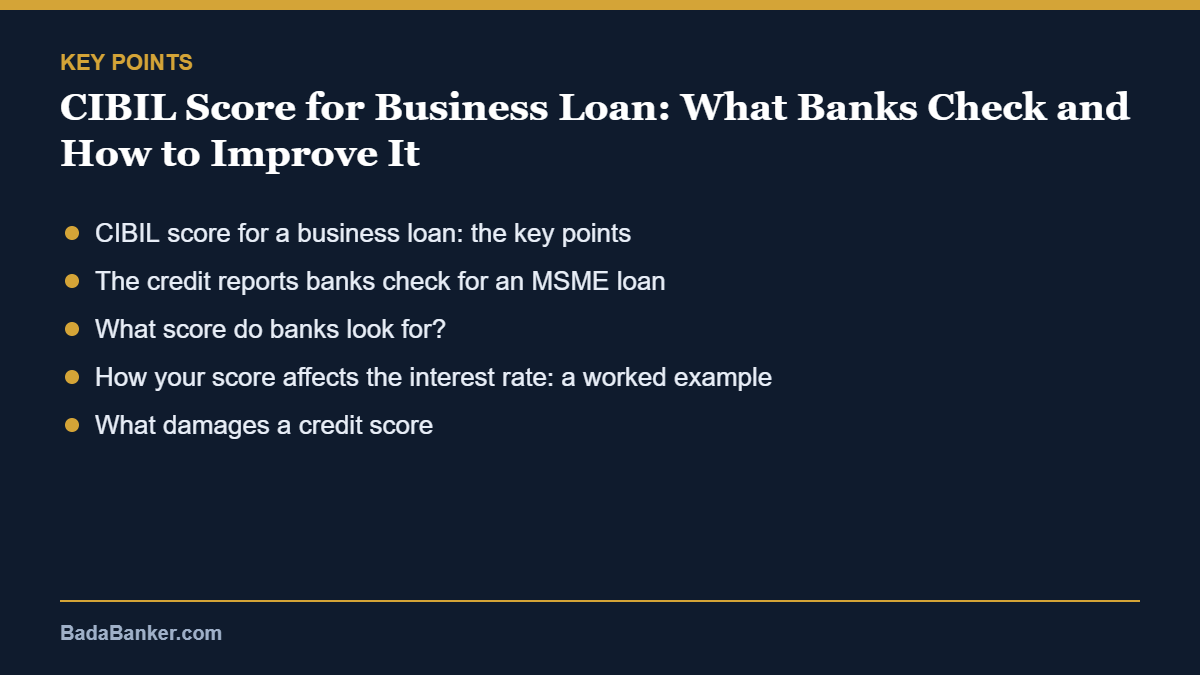
| Report | Whose | What it shows |
|---|---|---|
| Personal credit report and score (CIBIL score 300–900, or the equivalent from Experian, Equifax or CRIF High Mark) | Proprietor, partners, directors and guarantors | Personal loans, credit cards, home and car loans, and loans you’ve guaranteed, with your repayment record |
| Company credit report, with the CIBIL MSME Rank (CMR) on a scale of 1 to 10, where 1 is the lowest risk | The business entity: proprietorship, firm, LLP or company | Cash credit, overdraft and term loans of the business, overdues, and any suit-filed or wilful-default status |
For a proprietorship, the owner’s personal record and the business’s record are closely linked, because the owner is personally liable. For partnerships and companies, a single partner or director with a poor record, or a guarantor with defaults, can hold back an otherwise strong application. Check every report before you apply, not just your own.
What CIBIL score do banks look for?
The RBI doesn’t prescribe a minimum CIBIL score. Banks and NBFCs set their own norms in their credit policies, and these vary by lender, loan type and amount. As a broad guide to how lenders commonly view personal scores:
| Personal score | How lenders commonly view it |
|---|---|
| 750 and above | Strong. You’re more likely to get the limit you asked for and better pricing. |
| 700–749 | Acceptable at many banks, sometimes with closer scrutiny or conditions. |
| 650–699 | Weak. Expect questions, a lower limit, more security or a higher rate. |
| Below 650 | Difficult at most banks unless the report shows a clear, explained reason. |
| No score (“NH” or “NA”) | Not a rejection by itself. It means there’s too little credit history, and the bank relies more on your financials and banking record. |
The number is only the start. A credit officer reads the report itself: overdue amounts, days past due, how many accounts are settled or written off, how much you already owe across lenders, and how many loan enquiries you’ve made recently. A 720 with a clean, steady record can look better than a 780 that has just fallen because of fresh overdues.
How your CIBIL score affects the interest rate: a worked example
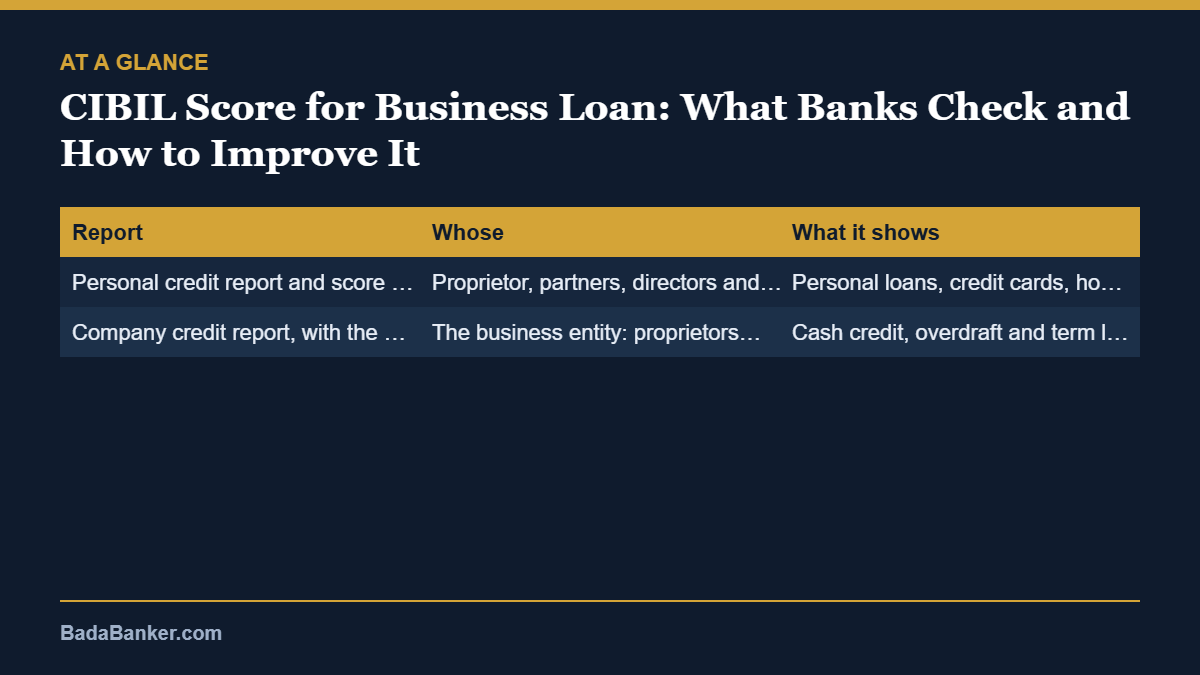
Since 2019, banks have had to link new floating-rate loans to MSMEs to an external benchmark such as the repo rate. On top of the benchmark, the bank adds a spread, which can include a credit risk premium for the borrower. A weaker credit profile usually means a higher premium.
Take a ₹50 lakh term loan repaid over 7 years. The rates below are illustrations, not quotes, but the difference between them is typical of how pricing changes with risk.
| Interest rate | Monthly EMI | Total interest over 7 years | Extra cost vs 10% |
|---|---|---|---|
| 10.0% | ₹83,006 | ₹19.72 lakh | – |
| 10.5% | ₹84,303 | ₹20.81 lakh | about ₹1.09 lakh |
| 11.0% | ₹85,612 | ₹21.91 lakh | about ₹2.19 lakh |
A half to one percentage point added because of a weaker profile costs ₹1–2 lakh over the life of this loan. If the profile is weak enough that only an NBFC will lend, the gap is usually much wider. You can test your own numbers with our loan EMI calculator.
What damages a CIBIL score
- Late payments. Every EMI or card payment made after the due date is reported as days past due (DPD). Recent and repeated delays do the most damage. Lenders must now alert you by SMS or email when they report a default or DPD, so treat those alerts seriously.
- Settled or written-off accounts. “Settled” means the lender accepted less than the full amount. It shows on your report for years and is one of the first things a credit officer looks for. If you can, repay in full or restructure instead.
- High credit card use. Using most of your card limits month after month signals stress. Keeping balances well below the limit, commonly suggested as under 30%, helps.
- Many loan enquiries in a short time. Each application to a lender is recorded. Applying to several lenders at once can look like credit hunger. Checking your own report doesn’t count against you.
- Guarantees for someone who defaults. Loans you’ve guaranteed appear on your report, and their defaults can hurt you. Read our guide to loan guarantor risk before you sign.
- Errors you haven’t spotted. A loan you’ve closed still showing as open, an overdue you’ve paid, or someone else’s account in your name.
Your rights under RBI rules
- A free full credit report every year. Each credit bureau must give individuals one free full credit report, including the score, every calendar year, with the link shown on its home page.
- Alerts. Credit bureaus must alert you by SMS or email when a lender accesses your report. Lenders must alert you when they report a default or DPD on your account.
- Time limits for correcting errors. A lender has 21 days to send corrected data after being told of an error. The whole complaint must be resolved within 30 days of filing.
- Compensation for delays. If the complaint isn’t resolved within 30 calendar days, you’re entitled to ₹100 for every day of delay, paid into your bank account within five working days of resolution. If the complaint is rejected, you must be told why.
- A contact person at each lender. Every lender must have a nodal officer to handle credit-report complaints.
How to correct errors in your credit report
- Download your free full report from each bureau: CIBIL, Experian, Equifax and CRIF High Mark. For the business, get its company credit report too.
- Check your personal details: name, PAN, date of birth, address and mobile number.
- Go through every account. Check the status (open, closed, settled, written off), the amount overdue and the DPD history.
- Raise a dispute online on the bureau’s website for each error, attaching proof such as a no-dues certificate or closure letter.
- Write to the lender’s nodal officer at the same time, with the same proof.
- Note the complaint date. If it isn’t resolved within 30 days, you can claim compensation. If you’re still not satisfied, you can complain to the RBI Ombudsman at cms.rbi.org.in.
- Download your report again after the correction, and keep copies for your loan file.
A 90-day plan before you apply
No one can promise a particular CIBIL score gain in a fixed time, because it depends on what’s in your report. But these steps address what lenders look at, and most of them show up quickly, because lenders now report to the bureaus at least every fortnight.
Days 1–15: find out where you stand
- Get the reports for the business and for every proprietor, partner, director and guarantor.
- List every account with its status and any overdue amount.
- Raise disputes for any errors.
Days 16–60: fix what you can
- Clear any overdue amounts and set up auto-debit for every EMI and card bill.
- Bring card balances down. For example, if you have ₹3 lakh of card limits and owe ₹1.8 lakh (60%), paying ₹1.05 lakh brings it to ₹75,000 (25%).
- Don’t apply for any new credit during this period.
- Get no-dues certificates for any loans you’ve closed, and make sure they show as closed.
Days 61–90: prepare the application
- Download the reports again and check that every correction has gone through.
- Make sure your GST returns, ITR and bank statements tell the same story about turnover. Mismatches are one of the most common reasons for queries.
- Prepare a short note explaining any old default or settlement honestly. A credit officer takes an explained one-off problem far better than an unexplained one.
- Apply to one lender at a time.
What else banks check besides your CIBIL score
A good credit report gets your file read properly. Approval then depends on the business itself:
- Repayment capacity: for term loans, the DSCR, meaning whether cash earnings cover the loan instalments with a margin.
- Working capital assessment: projections in CMA data, the turnover method or MPBF.
- Project viability: for new units and expansions, a project report with realistic costs and sales.
- Consistency of records: GST returns, ITR, audited accounts and bank statements that agree.
- Banking conduct: cheque returns, how fully a cash credit limit is used, and whether interest is serviced on time.
- Business vintage, industry and security offered.
Collateral-free loans and government schemes
- No collateral up to ₹20 lakh: for loans to micro and small enterprises sanctioned or renewed from 1 April 2026, scheduled commercial banks must not accept collateral up to ₹20 lakh. Banks may go up to ₹25 lakh for units with a good track record.
- CGTMSE: a government credit guarantee that lets banks lend to micro and small enterprises without collateral or a third-party guarantee. The ceiling was raised from ₹5 crore to ₹10 crore from 1 April 2025.
- PM Mudra Yojana: loans up to ₹20 lakh. The Tarun Plus category (₹10–20 lakh) is for borrowers who have taken and repaid an earlier Tarun loan.
- Stand-Up India: loans from ₹10 lakh to ₹1 crore for SC/ST and women entrepreneurs setting up a new enterprise.
These schemes reduce the need for security. They don’t replace a clean credit report: the bank still checks your credit history and repayment capacity.
Applying for a business loan?
BadaBanker prepares CMA data and project reports for MSME loan proposals, checked the way a bank’s credit team will read them.
Email msmebanktool@gmail.com with your loan amount, type of limit and business details. Please don’t send account numbers, passwords or OTPs.
Frequently asked questions
What is the minimum CIBIL score for business loan approval?
There’s no RBI-mandated minimum. Each lender decides. Many banks are comfortable with personal scores of around 700–750 and above, but they read the full report, including overdues, settlements and recent enquiries, along with your business financials.
Can I get a business loan with a CIBIL score below 700?
Sometimes, especially if the low CIBIL score has a clear explanation and the business has strong cash flows or security. Expect closer scrutiny, a smaller limit or a higher rate. Correcting errors and clearing overdues first usually gives better terms.
Does checking my own credit report lower my score?
No. Checking your own report doesn’t count as a loan enquiry. Only enquiries made by lenders when you apply for credit are considered.
What is the CIBIL MSME Rank (CMR)?
It’s TransUnion CIBIL’s rank for businesses, on a scale of 1 to 10, where 1 indicates the lowest risk of default. It’s based on the business’s own credit record. Banks look at it together with the personal reports of the people behind the business.
How long does it take to correct an error?
Under RBI rules, the lender and the credit bureau together must resolve a complaint within 30 calendar days. After that, you’re entitled to compensation of ₹100 a day until it’s resolved.
Does a settled loan stop me from getting a business loan?
Not automatically, but it’s a serious negative and stays on your report for years. If you can, repay the remaining amount and ask the lender to update the status, then keep a clean record afterwards. Be ready to explain the circumstances to the bank.
Related reading
Sources
- RBI, Framework for compensation to customers for delayed updation/rectification of credit information (26 October 2023)
- RBI, Strengthening of customer service rendered by Credit Information Companies and Credit Institutions (26 October 2023)
- RBI, Frequency of reporting of credit information by Credit Institutions to Credit Information Companies (8 August 2024)
- RBI, Master Direction on Lending to the MSME Sector (updated 9 February 2026)
- RBI, External Benchmark Based Lending (4 September 2019)
- CGTMSE and MUDRA official websites
- TransUnion CIBIL
This guide explains how banks commonly use credit reports for business loans. It’s general information, not advice on your loan. Each lender’s credit policy decides its own requirements.