
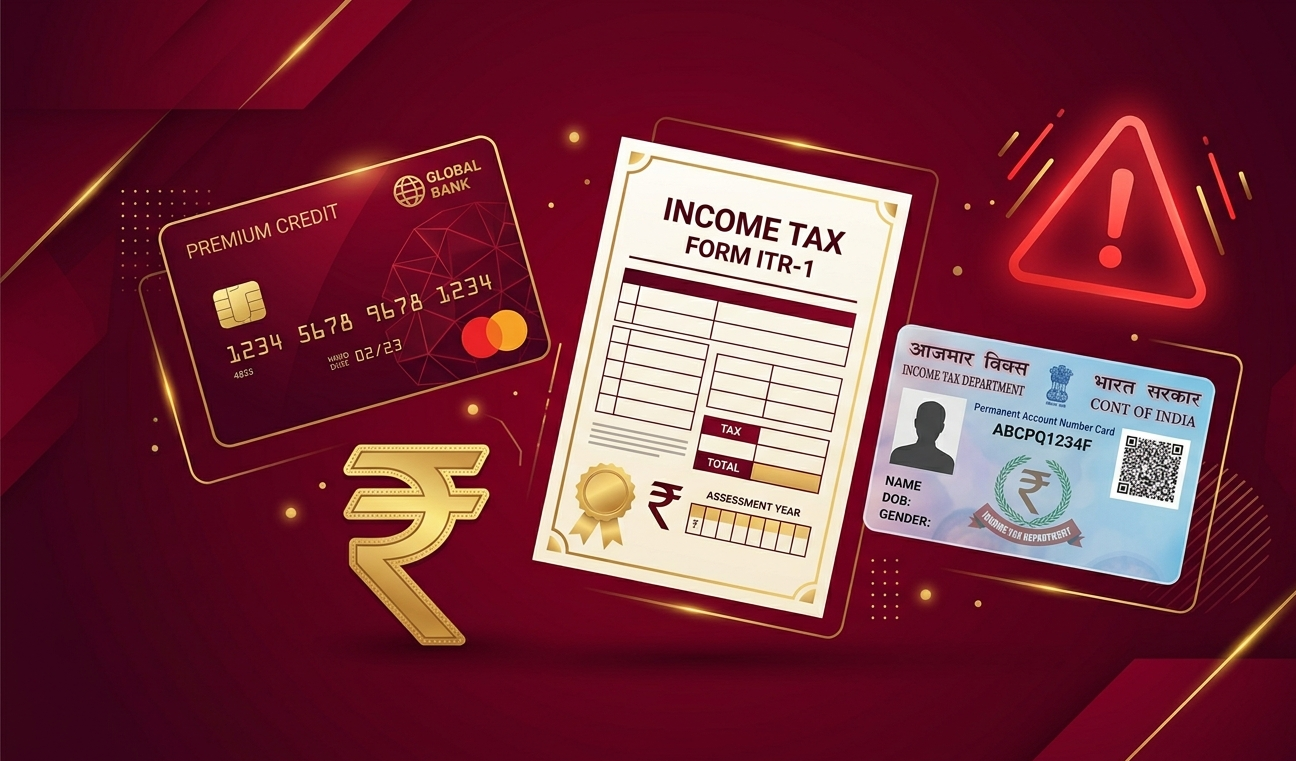
Credit card tax rules 2026 India ne April 1, 2026 se sab kuch badal diya. Spending above ₹10 lakh per year now triggers mandatory SFT reporting to the Income Tax Department. This proven guide decodes the shocking new framework — real ITAT case, 5 triggers that cause notices, and a 7-step compliance strategy to protect yourself.

🚨 Credit Card Tax Rules 2026 India — Shocking ₹10 Lakh Limit & Proven Compliance Guide
April 2026 mein sab kuch badal gaya. Real ITAT case, 5 shocking triggers, proven 7-step strategy — sab kuch decode kiya hai.
📅 Last Updated: May 3, 2026 | ⏱️ Reading Time: 12 minutes | ✅ Verified: CBDT, Income Tax Act 2025, ITAT Order
Under the Income Tax Act 2025, credit card tax rules 2026 India require spending above ₹10 lakh per year to be reported via SFT. A recent ITAT ruling shows ₹16.6 lakh spending triggered an ₹8 lakh tax + penalty demand. Read this proven guide before your next statement.
📋 Quick Summary: Under credit card tax rules 2026 India, annual spending above ₹10 lakh across all PAN-linked cards triggers mandatory SFT reporting. If declared income doesn’t match spending — a shocking tax notice can arrive. This guide tells you exactly what triggers a notice and a proven 7-step compliance strategy.
Shocking annual threshold — credit card tax rules 2026 India SFT trigger
Real ITAT case — shocking example of new tax rules in action.
A taxpayer (Prateek) didn’t file his ITR. SFT picked up ₹16.6 lakh credit card spending. Tax Officer assumed: “PAN-linked card = personal undeclared income.” Demand: ₹8 lakh (tax + 60% penalty).
He got relief at ITAT — but only after comprehensive documentation and months of legal effort. This proven guide helps you stay protected before any notice arrives.
📊 Shocking Changes in Credit Card Tax Rules 2026 India — Before vs After April
Here is how the framework changed for every credit card user in India:
❌ Before April 2026
- Cash CC payments above ₹1L flagged
- Bulk payments inconsistently reported
- PAN linking optional for many cards
- Manual scrutiny only
- No AI income-spending matching
✅ New Rules from April 2026
- ₹10L+ spending — mandatory SFT
- PAN compulsory — no PAN = no card
- Overseas spending separately tracked
- AI matching income vs spending
- Corporate card personal use = taxable
Earlier, spending data and income data existed in separate silos. Under credit card tax rules 2026 India, both are integrated within SFT and Form 26AS. AI automatically detects mismatches — ₹5L declared income vs ₹15L CC spending = automatic flag. No manual scrutiny needed anymore.
💳 The Shocking ₹10 Lakh Threshold — Credit Card Tax Rules 2026 India Decoded
Understanding what counts toward this threshold is most critical for compliance:
✅ What COUNTS Toward the Threshold
- Total payments across ALL PAN-linked credit cards combined
- UPI payments funded through credit cards
- Net banking payments toward credit card bills
- Cheque/DD payments toward card balances
- Auto-debit and standing instruction payments
- Cash deposits to credit card accounts
- Foreign currency transactions
❌ What Does NOT Count
- Reward points redemption
- Cashback received
- Late fees and interest charges
- EMI conversions of existing balances
- Failed or reversed transactions
| Annual Spending | Reporting Status | Risk | Action |
|---|---|---|---|
| Below ₹3 lakh | Generally not reported | 🟢 Low | Normal usage |
| ₹3–7 lakh | Not reported but tracked | 🟡 Medium | Basic documentation |
| ₹7–10 lakh | Borderline monitoring | 🟠 Watch out | Income justification ready |
| ₹10–15 lakh | Mandatory SFT reporting | 🔴 High | ITR mandatory |
| ₹15–25 lakh | Reported + AI-flagged | 🔴 Very High | Pre-emptive documentation |
| Above ₹25 lakh | Reported + scrutiny likely | 🔴 Critical | CA consultation required |
💡 Crossing ₹10 lakh does NOT automatically mean a tax notice. A notice is issued only when AI detects mismatch between declared income and actual spending. Matching income = typically no issue.
Even ₹10,001 above the limit triggers SFT reporting under the new framework. ₹9.8 lakh = fine. ₹10.1 lakh = mandatory reporting. Plan accordingly before your statement date.
⚖️ Real ITAT Case — Shocking Proof of Credit Card Tax Rules 2026 India Impact

| Case Element | Details |
|---|---|
| Annual CC Spending | ₹16.6 lakh — flagged via SFT system |
| Actual Usage | Self + father + brother + partnership firms + HUF entity |
| Critical Issue | ITR NOT filed for that financial year |
| Initial Demand | ~₹8 lakh (tax + 60% penalty + interest) |
| Final Result | Relief at ITAT — but after months + ₹1L legal costs |
Even when innocent, defending an SFT-flagged case costs ₹50,000–₹2 lakh in legal fees plus 6–18 months of stress. Under credit card tax rules 2026 India, pre-emptive preparation is 100x cheaper than reactive defense. This is a documented, proven pattern — not a theoretical risk.
🚨 5 Shocking Triggers That Cause Tax Notices — Credit Card Tax Rules 2026 India
Trigger 1 — Income vs Spending Mismatch (Primary Trigger)
₹6L declared income + ₹15L CC spending = automatic AI flag. Mathematical reality: ₹6L income cannot support ₹15L spending without a declared alternative source. This is the most common trigger under the new framework.
Trigger 2 — High-Value Single Transactions
₹2L+ jewellery, ₹5L+ international travel, ₹3L+ luxury electronics — AI tracks wealth display patterns against declared income. Proven shocking trigger under credit card tax rules 2026 India.
Trigger 3 — International Spending Without Declaration
₹3L+ overseas transactions without declared foreign income source — most common trigger for NRIs and frequent travelers. Document all travel purposes comprehensively.
Trigger 4 — Corporate Card for Personal Expenses ⚠️
From April 2026, company card personal use = taxable perquisite in employee’s hands. Both employer and employee face scrutiny. Stop this practice immediately if you are doing it.
Trigger 5 — Multiple Cards Crossing ₹10L Combined
Card 1 ₹4L + Card 2 ₹3L + Card 3 ₹4L = ₹11L total. All PAN-linked. Combined threshold crossed → automatic SFT flag. Many people don’t know this shocking fact about the new rules.
✅ Proven 7-Step Compliance Strategy — Credit Card Tax Rules 2026 India

Step 1 — Quarterly Self-Audit
- Collect ALL credit card statements every 3 months
- Calculate total payments — project against ₹10L threshold
- By Q3 — begin compliance planning if trajectory exceeds limit
Step 2 — File ITR Every Year Without Exception
Under the new framework, ITR filing becomes mandatory under Section 139(1) if spending crosses ₹10 lakh — even if income is below taxable limit. File every year without exception.
Step 3 — Document All Income Sources
- Salary → Form 16 | Business → Books of accounts
- Investment income → Capital gains statements
- Loan-funded spending → Loan agreements
- Family pooled spending → Affidavits + bank statements
Step 4 — Maintain Spending Justification Folder
Every major transaction (₹50,000+) should have payment source statement and purpose. This is your proven defense if a notice arrives under credit card tax rules 2026 India.
Step 5 — Address Card-Sharing Risk
- Add family members as Add-On cardholders — clear paper trail
- OR family pays via UPI to your card bill — creates documentation
- Never allow family use without a documented arrangement
Step 6 — Corporate Card Personal Use — Stop Immediately
- NEVER use company card for personal expenses
- If accidentally used — reimburse company immediately
- Maintain detailed quarterly expense reports
Step 7 — Annual Pre-ITR Reconciliation
- Check Form 26AS for SFT entries before filing ITR
- Match with your own records — address mismatches IN the ITR
- If spending exceeds ₹10L — CA consultation strongly recommended
Pattern + Documentation + ITR filing. All three together = 95% safe under credit card tax rules 2026 India. Missing any one = compliance exposure and shocking penalty risk.
👴 Special Cases — Senior Citizens, Students, Housewives
Senior Citizens
- Pension ₹3L but CC spending ₹8L (children paying) — children should pay via UPI/bank transfer to create paper trail
- Gifts under ₹50,000/year from non-relatives exempt under Section 56
Students
- Student should be Add-On user — not primary cardholder
- Parent’s PAN linked = parent’s income justifies spending — much cleaner arrangement
Housewives
- Maintain bank statement showing husband’s transfers to account
- Consider Add-On card to husband’s primary card — simplest solution
💰 Shocking Penalty Structure — Real Numbers Under New Tax Rules
| Scenario | Tax | Penalty | Interest | Total |
|---|---|---|---|---|
| ITR not filed, ₹15L spending | ₹3L | ₹1.8L (60%) | ₹0.5L | ₹5.3L |
| ITR filed, mismatch ₹5L | ₹1L | ₹0.5L (50%) | ₹0.2L | ₹1.7L |
| Documentation incomplete | ₹1.5L | ₹0.3L (20%) | ₹0.2L | ₹2.0L |
| Honest disclosure with full docs | ₹1L (if any) | NIL | Minimal | ₹1.0L |
💡 Comprehensive documentation saves 60–80% of penalty exposure. The ITAT case cost ₹50K–₹1L in CA fees alone — plus 8+ months of stress. Proven fact: prevention is dramatically cheaper than cure.
📨 Got a Shocking Notice? Proven Response Framework
Within 7 Days
- Read notice carefully — identify type (143(1), 143(2), 148, 142)
- Check response deadline — typically 15–30 days
- Save notice digitally and physically
- Do NOT respond emotionally or hastily
Within 15 Days
- Hire experienced CA — ₹15,000–50,000 is reasonable
- Compile all credit card statements and bank records
- Gather all income proofs and supporting evidence
Within 30 Days
- File detailed response via incometax.gov.in
- Attach all supporting documents clearly
- Be completely transparent — never hide information
❓ Proven FAQs — Credit Card Tax Rules 2026 India
Does ₹10 lakh spending automatically trigger a notice under credit card tax rules 2026 India?
No. Crossing the threshold causes SFT reporting. A notice is issued only when AI detects income-spending mismatch. If declared income justifies your spending — no notice is typically issued.
Are cashback and rewards taxable under new rules?
Generally no — treated as commercial discounts. However, rewards above ₹50,000 annually from one source may trigger Section 56(2)(x). Consult a CA if your rewards are unusually high.
Can I pay income tax using credit card in 2026?
Yes — credit card payment option added effective April 2026. Processing fees apply and interest accrues if bill is not cleared on time. Use judiciously.
Is spending on multiple cards counted separately?
No. All PAN-linked cards are combined. Card 1 ₹4L + Card 2 ₹3L + Card 3 ₹4L = ₹11L = threshold crossed. This is a shocking fact most cardholders don’t know about credit card tax rules 2026 India.
Will foreign spending trigger a notice?
Overseas spending is tracked separately. ₹3L+ foreign transactions without declared foreign income source can trigger investigation. Document all travel purposes and amounts comprehensively.
What if I use corporate card personally?
Stop immediately. From April 2026, this is taxable perquisite under Income Tax Act 2025. For past usage — reimburse employer with written acknowledgment and handle correctly in your ITR.
Whose spending counts on add-on cards?
Add-on cards are linked to primary cardholder’s PAN. All spending reflects in primary cardholder’s SFT records. Family shared spending requires proper supplementary documentation to avoid issues.
Can I make pre-emptive disclosure if I suspect a mismatch?
Yes — and you should. Proper disclosure in ITR or revised return under Section 139(5) results in significantly lower penalties compared to department-detected mismatches. Always better to disclose voluntarily.
🏦 Proven Banker’s Verdict
Credit card tax rules 2026 India represent a structural shift from self-reported income to data-validated income. For compliant taxpayers — zero practical impact. For those with documentation gaps — this is a shocking wake-up call that deserves immediate attention.
Three things protect you completely: File ITR every year. Keep documentation for all major transactions. Ensure declared income matches your spending pattern. Do all three consistently — the new framework will never trouble you.
Confused About Credit Card Tax Rules 2026 India?
Share this proven guide with family using credit cards heavily. A single tax notice = ₹2–5 lakh plus months of stress. Awareness equals protection.
📖 Also Read on BadaBanker
📚 Sources & References
- Income Tax Act, 2025 — Government of India — incometax.gov.in
- CBDT Notifications 2026 — cbdt.gov.in
- ITAT Order — Credit Card SFT Case — TaxBuddy (April 2026)
- SFT Framework — Income Tax Department
- Section 56(2)(x), 139(1), 139(5) — Income Tax Act
- RBI Banking Ombudsman — cms.rbi.org.in | 14448