
A fixed deposit is one of the safest places for savings in India, but how safe your money is depends on where you book it and how you book it. This safe FD checklist covers the ten things to check before you put money in any FD, whether at a big bank, a small finance bank, a co-operative bank or an NBFC. Most of the checks take a few minutes on the bank’s website or the DICGC website.
Based on DICGC, RBI and Ministry of Finance rules. Checked 29 October 2026.
Is your FD safe? The short answer
- Bank FDs are insured up to ₹5 lakh. Deposits in commercial banks, small finance banks, regional rural banks and co-operative banks are insured by the Deposit Insurance and Credit Guarantee Corporation (DICGC) up to ₹5 lakh per depositor per bank, principal and interest together.
- NBFC and corporate FDs are not insured. Their safety depends on the company’s finances and credit rating.
- Above ₹5 lakh in one bank, the bank’s own health matters. That is why the capital and bad-loan checks below are worth doing.
Who regulates and insures your FD
| Where you book the FD | Regulator | DICGC insured? | What to check |
|---|---|---|---|
| Public and private sector banks | RBI | Yes, up to ₹5 lakh | Capital ratio, net NPA |
| Small finance banks | RBI | Yes, up to ₹5 lakh | Capital ratio against the 15% minimum, net NPA |
| Regional rural banks and local area banks | RBI | Yes, up to ₹5 lakh | Any RBI restrictions |
| Co-operative banks | RBI and the state Registrar of Co-operative Societies | Yes, up to ₹5 lakh | Any RBI restrictions, financial results |
| Primary co-operative credit societies | State co-operative law | No | They are not banks |
| Deposit-taking NBFCs and housing finance companies | RBI | No | RBI deposit licence, credit rating |
| Unregistered firms and “fixed return” schemes | None for deposits | No | Do not deposit |
The 10-point safe FD checklist
1. Confirm it is a bank, or an RBI-licensed deposit-taking NBFC
Many entities use the words “deposit” or “FD” without being a bank. Search for the name in DICGC’s list of insured banks. If it is a company rather than a bank, check RBI’s list of NBFCs allowed to accept deposits. RBI has not given a deposit licence to any new NBFC since 1997, so a recently formed company offering “fixed deposits” is a warning sign.
2. Keep each bank within the ₹5 lakh DICGC cover
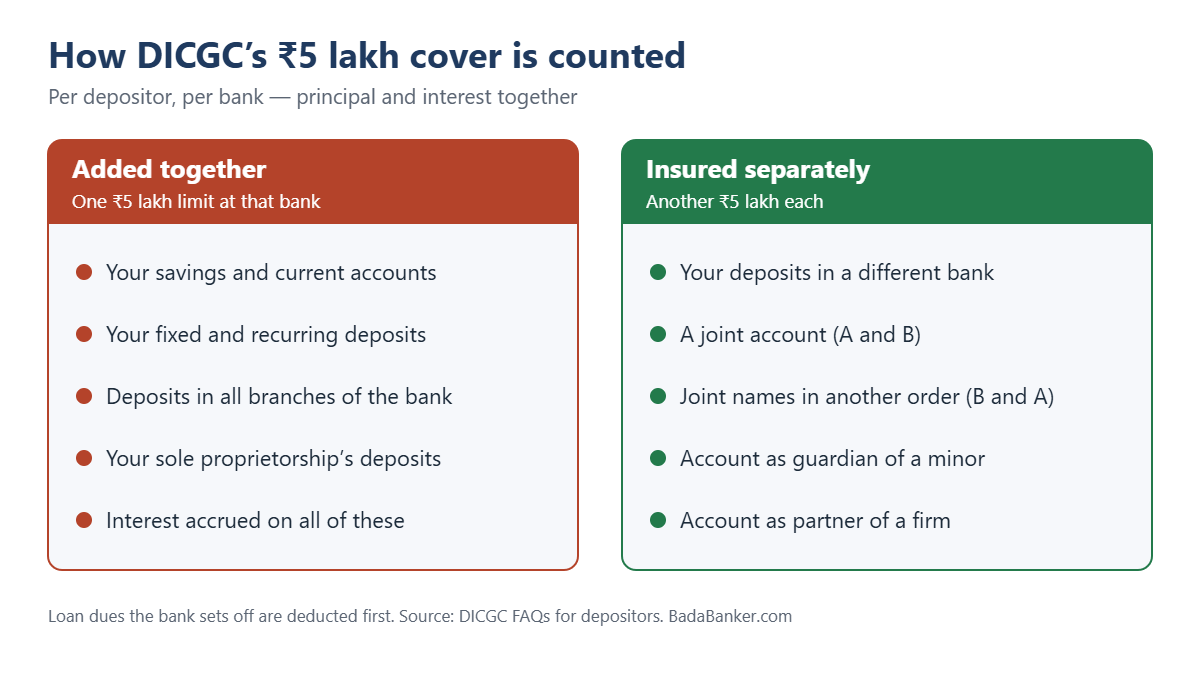
The ₹5 lakh limit applies per depositor per bank, not per FD. DICGC adds up everything you hold in the same right and capacity at that bank:
- savings, current, fixed and recurring deposits, in all branches of the bank;
- deposits of a sole proprietorship that you own;
- principal and accrued interest together.
Deposits held in a different capacity get their own ₹5 lakh cover. Examples are a joint account, a joint account with the names in a different order, an account you hold as guardian of a minor, or as a partner of a firm. Deposits in different banks are insured separately, even if both banks fail on the same day. If you owe the bank money on a loan, the bank can set it off before the insured amount is worked out.
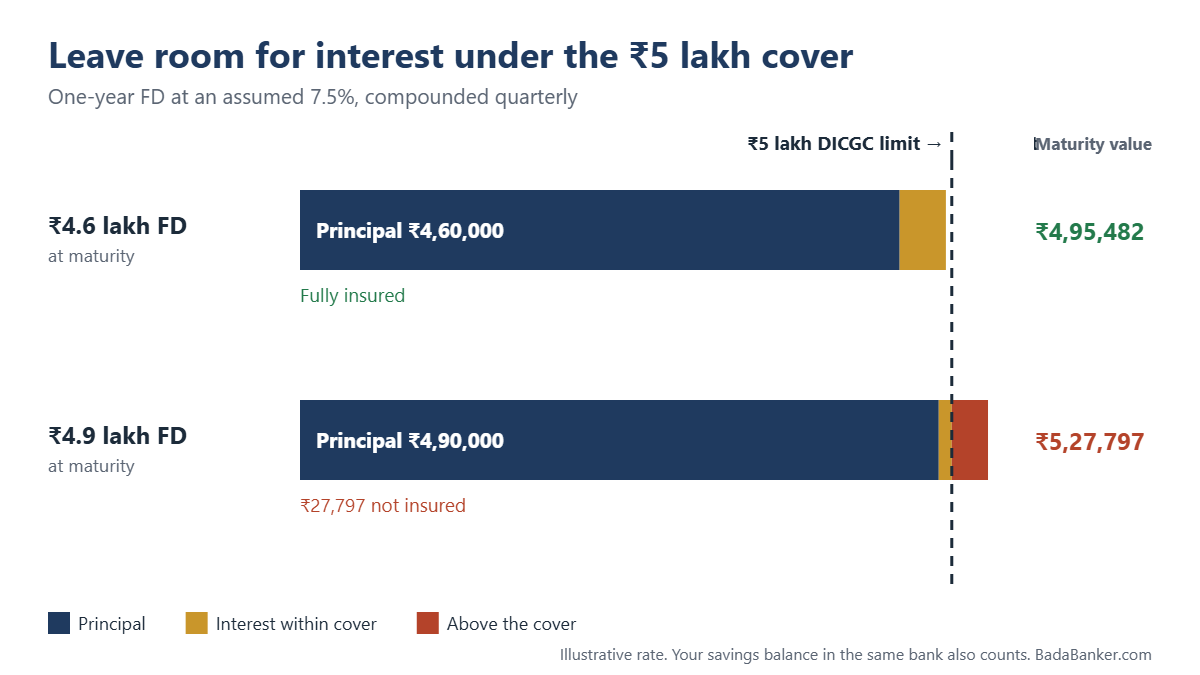
Leave room for interest. Suppose you put ₹4.6 lakh in a one-year FD at an assumed 7.5%, compounded quarterly. It grows to ₹4,95,482, which is still inside the cover. A ₹4.9 lakh FD at the same rate grows to ₹5,27,797, so ₹27,797 would be uninsured by maturity. Remember that your savings balance in the same bank also counts towards the limit.
3. Check the bank’s capital adequacy ratio (CRAR)
The capital adequacy ratio shows how much of its own capital a bank holds against its loans and other risky assets. For most commercial banks, RBI’s minimum is 9% plus a 2.5% capital conservation buffer, or 11.5% in all. Small finance banks must keep at least 15%. You will find the figure in the bank’s quarterly results or its Basel III disclosures, usually under “Investor relations” on its website. A ratio comfortably above the minimum is a good sign; one close to it is not.
4. Check the net NPA ratio
Net NPA is the share of the bank’s loans that have gone bad, after the provisions it has already made. It appears in the same quarterly results. Under RBI’s Prompt Corrective Action framework, a net NPA ratio of 6% or more can trigger restrictions on the bank. Compare the bank with others of a similar type, and look at whether the ratio is rising or falling over the last few quarters.
5. Check whether RBI has restricted the bank
Search RBI’s press releases for the bank’s name. Look for “All-Inclusive Directions”, which can limit withdrawals, or for the bank being placed under Prompt Corrective Action. A bank under such restrictions is not where you want fresh money, whatever rate it offers.
6. Treat an unusually high rate as a question
Small finance banks often pay more than large banks to attract deposits, and that is not a problem in itself. But if one lender pays far more than its peers, go back to checks 3 to 5 before you book. Compare rates on our small finance bank FD rates page. For NBFCs, RBI caps the deposit rate at 12.5%, so a company offering more is outside RBI’s rules.
7. For NBFC and corporate FDs, check the credit rating
An NBFC can take public deposits only if it holds a deposit-taking certificate from RBI and has at least an investment-grade rating of BBB– from a SEBI-registered rating agency. That is only the minimum, so prefer the highest ratings and check whether the rating has been cut recently. NBFC deposits must be for 12 to 60 months. They are not covered by DICGC, so keep the amount in any one company modest.
8. Read the premature withdrawal terms
If you break an FD early, banks usually pay the rate for the period the money actually stayed, minus a penalty that each bank sets. Ask for the penalty in writing, or check the FD terms on the bank’s website, before you book. Five-year tax-saving FDs cannot be closed before the lock-in ends, so do not put emergency money there.
9. Sort out TDS on the interest
From 1 April 2026, TDS on FD interest falls under Section 393 of the Income-tax Act, 2025. Banks deduct TDS only when your interest from one bank crosses ₹50,000 a year, or ₹1 lakh for senior citizens. The rate is 10% with PAN and 20% without. If your total income is below the taxable limit, submit Form 121, which replaced Forms 15G and 15H. FD interest is taxable whether or not TDS is cut. Our guide to TDS on FD interest explains the details.
10. Add nominees, and check they appear on record
From 1 November 2025, you can name up to four nominees for a bank deposit. They can be simultaneous, each with a percentage share adding up to 100%, or successive, where the next nominee steps in only if the one before has died. After you book the FD, check that the nominee details appear on the FD advice or in net banking. Update them after a marriage, divorce or death in the family.
Book the FD the safe way
- Book only at a branch, or through the bank’s own net banking or app, and pay from your own bank account.
- Never pay cash or transfer money to an agent’s personal account or a UPI ID for an FD.
- Do not open FD links sent by SMS, WhatsApp or social media. Type the bank’s address yourself.
- Keep the FD advice or receipt, and check that the amount, rate, tenure and maturity date are right.
- Report entities that take deposits illegally on RBI’s Sachet portal.
What happens to your FD if a bank fails
If RBI places a bank under All-Inclusive Directions that stop depositors from withdrawing, DICGC must pay insured deposits within 90 days. The bank sends DICGC its list of depositors within 45 days. DICGC verifies the claims within 30 days and pays within 15 days after that. To claim, you give the bank a signed willingness form with your ID documents. If the bank is liquidated instead, DICGC pays the liquidator within two months of receiving the claim list, and the liquidator pays depositors. Money above ₹5 lakh is repaid only from whatever the bank recovers, which can take years.
Quick reference: good signs and warning signs
| Check | Good sign | Warning sign |
|---|---|---|
| Licence | In DICGC’s insured banks list or RBI’s deposit-taking NBFC list | Not in either list |
| Amount per bank | Principal plus interest stays within ₹5 lakh | One bank holds more than ₹5 lakh of your money |
| Capital ratio | Well above 11.5% (15% for small finance banks) | Close to or below the minimum |
| Net NPA | Low and falling, in line with peers | Rising, or 6% and above |
| RBI action | No restrictions | All-Inclusive Directions or Prompt Corrective Action |
| Rate offered | Close to similar banks | Far above peers; above 12.5% from an NBFC |
| Nominee | Shown on the FD advice | Missing |
Run through this safe FD checklist each time you book or renew an FD. A bank’s capital and bad-loan numbers change every quarter, and your total balance in each bank changes as interest is added.
Frequently asked questions
Is the ₹5 lakh DICGC cover per FD or per bank?
Per bank. All your deposits in one bank, across all branches and account types, are added together with interest, and the total is insured up to ₹5 lakh. Deposits in another bank get a separate ₹5 lakh.
Are joint FDs insured separately?
Yes. A joint account is held in a different capacity from your individual accounts, so it gets its own ₹5 lakh cover. Joint accounts with the names in a different order, or with a different group of holders, are also insured separately.
Are FDs in small finance banks safe?
Small finance banks are RBI-licensed banks, and their deposits have the same ₹5 lakh DICGC cover as any other bank. They must keep a higher capital ratio of at least 15%. For amounts above ₹5 lakh, check the bank’s capital and net NPA, or split the money across banks.
Are co-operative bank FDs insured?
Yes. DICGC states that all co-operative banks are covered. Primary co-operative credit societies are not banks, and their deposits are not insured.
Are corporate FDs safe?
They carry more risk than bank FDs because DICGC does not insure them. Use only companies on RBI’s list of deposit-taking NBFCs, prefer the highest credit ratings, and do not put a large share of your savings in any one company.
Related reading
Sources
- DICGC, FAQs for depositors and list of insured banks
- RBI, Prompt Corrective Action Framework for Scheduled Commercial Banks (2 November 2021)
- RBI, FAQs on Non-Banking Financial Companies
- RBI, Guidelines for licensing of small finance banks
- PIB, Nomination provisions of the Banking Laws (Amendment) Act, 2025 from 1 November 2025
For general information only. Check the latest terms with your bank before you invest.