
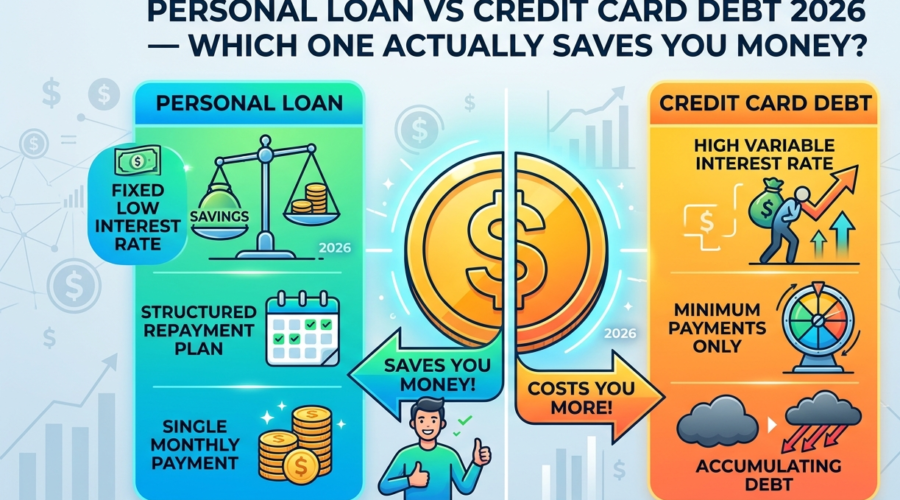
Personal Loan vs Credit Card Debt 2026: Which Saves More?

Personal Loan vs Credit Card Debt 2026 is a decision millions of Indians are quietly getting wrong every month — by paying only the minimum due on a credit card charging 36-45% annual interest, instead of switching to a personal loan at 10.5-16%. Getting the Personal Loan vs Credit Card Debt 2026 math right can save you lakhs in interest over a few years, and get you an actual debt-free date instead of an endlessly revolving balance. This complete guide breaks down the real numbers, when a personal loan makes sense, when it doesn’t, and the smarter middle option most people don’t know exists.
The Personal Loan vs Credit Card Debt 2026 gap has actually widened this year. With the RBI holding the repo rate at 5.25% and banks passing on lower rates to personal loan products, the interest differential between the two options is now wider than it’s been in years — while credit card interest rates have stayed flat near their regulatory ceiling. If you’re also tracking your CIBIL score impact from card utilisation, this decision affects that too.
Quick Fact Check — Personal Loan vs Credit Card Debt 2026
- Credit card interest: 36% to 45% per annum, charged on the full outstanding balance from the transaction date once the full amount isn’t paid — not just on the overdue portion.
- Personal loan interest: 10.5% to 16% per annum for most salaried applicants with a CIBIL score above 700, roughly a third of card rates.
- Minimum due trap: paying only 5% minimum due on a ₹2 lakh card balance can take 6-8 years to clear, with total interest often exceeding the original amount borrowed.
- Break-even point: a personal loan generally becomes worth the processing fee and paperwork once your card outstanding crosses ₹50,000-1 lakh.
- Credit score impact: credit utilisation above 50-60% hurts your CIBIL score even with on-time payments — clearing the card balance helps your score recover faster than the loan itself does.
36-45%
Credit Card Interest (p.a.)
10.5-16%
Personal Loan Interest (p.a.)
₹50,000-1L
Break-even Outstanding
6-8 yrs
Time to Clear at Minimum Due
Personal Loan vs Credit Card Debt 2026 — Side by Side
| Factor | Credit Card (Revolving) | Personal Loan |
|---|---|---|
| Interest rate (2026) | 36% – 45% p.a. | 10.5% – 16% p.a. |
| Interest calculated on | Full outstanding, from transaction date | Reducing balance, fixed schedule |
| Repayment structure | Flexible minimum due — no fixed end date | Fixed EMI, fixed tenure |
| Processing fee | None (but late fees, over-limit charges apply) | 1% – 2.5% of loan amount |
| Impact on CIBIL if unpaid | Severe — high utilisation flagged immediately | Severe on default, neutral to positive if paid on time |
| Best suited for | Outstanding under ₹30,000-40,000 | Outstanding above ₹50,000-1 lakh |
Personal Loan vs Credit Card Debt 2026 — Real Examples
| Scenario | Outstanding | Path Chosen | Approx. Total Interest |
|---|---|---|---|
| Rohan, 29, IT employee | ₹2,00,000 | Credit card, paying minimum due only | ₹1.8-2.2 lakh over 6-7 years |
| Same case | ₹2,00,000 | Personal loan at 13% over 3 years | Approx. ₹42,000 over 3 years |
| Meera, 34, teacher | ₹35,000 | Card EMI conversion at 16% p.a. | Approx. ₹5,500 over 1 year |
| Same case | ₹35,000 | Fresh personal loan (fees + paperwork) | Similar interest, but extra 1-2% processing fee |
Common misconception: people assume the Personal Loan vs Credit Card Debt 2026 comparison always favours the loan, regardless of amount. Below roughly ₹30,000-40,000 outstanding, the processing fee and fresh CIBIL hard inquiry on a new loan can eat into the savings — a card issuer’s own EMI conversion is often the better call at that size. You can check your own numbers using our Loan Prepayment Calculator, or run them on the go with the BadaBanker Calculator app on Google Play.
The Middle Path — Card EMI Conversion
Most credit card issuers will convert your outstanding balance into a fixed-tenure EMI if you simply call and ask. This isn’t as cheap as a personal loan, typically 14-18% p.a., but it’s far cheaper than revolving the balance — and there’s no new loan application, no fresh CIBIL hard inquiry, and no paperwork. Worth trying first if your outstanding is on the smaller side, before deciding between a Personal Loan vs Credit Card Debt 2026 head-to-head.
When a Personal Loan Wins
- Outstanding is large enough that the interest differential matters — generally above ₹50,000-1 lakh.
- You have stable income and can comfortably service a fixed EMI without missing payments.
- You’re disciplined enough not to run the card balance back up once it’s cleared — this is the single most common reason the strategy fails in practice.
When Credit Card Debt Is Fine to Keep
- Outstanding under ₹30,000-40,000 — processing fee and documentation hassle may not be worth it.
- You’ve missed EMIs on existing loans recently — a fresh personal loan application may get rejected or priced higher.
- You can realistically clear the card balance within 2-3 months without a fresh loan.
📋 Our Verdict — Personal Loan vs Credit Card Debt 2026
“If your credit card debt has crossed ₹1 lakh and you’ve been paying only the minimum for more than 2-3 months, don’t wait — check your personal loan eligibility and compare the total interest outgo against what the card is currently charging you. In almost every case, the personal loan wins, provided you have the discipline not to let the card balance creep back up afterward. The debt itself isn’t the enemy — revolving debt at 40%+ interest with no fixed end date is.”
Personal Loan vs Credit Card Debt 2026 — FAQs
Q: Will taking a personal loan to close my credit card hurt my CIBIL score?
A: In the short term, a new loan application triggers a hard inquiry which can dip your score slightly. But clearing high card utilisation typically improves your score within 1-2 billing cycles, more than offsetting the dip — provided you keep paying the new EMI on time.
Q: Is it better to do a balance transfer to another credit card instead?
A: A balance transfer to a lower-interest or 0% introductory card can work for outstanding amounts you can clear within the promotional period, usually 3-6 months. Beyond that window, rates typically revert to standard card rates, so a personal loan’s fixed tenure is usually safer for larger balances.
Q: What CIBIL score do I need for the best personal loan rates in 2026?
A: Most banks reserve their lowest rates, closer to 10.5-11%, for applicants with a CIBIL score of 750 and above. Scores between 700-750 typically see 12-14%, and below 700 the rate rises further or approval becomes harder.
Q: Can I negotiate my credit card interest rate directly with the bank instead?
A: Some issuers will reduce your rate temporarily or offer a hardship EMI plan if you call and explain your situation, especially if you have a good repayment history. It rarely matches personal loan rates, but it’s worth a call before committing to a fresh loan.
To see your own numbers, try our CIBIL Score Impact Tool, download the BadaBanker Calculator app, or browse more Loans coverage on BadaBanker.
📎 Sources: RBI — Repo Rate Notifications · CIBIL — Credit Score & Utilisation. For informational purposes only. Personal loan and credit card interest rates vary by bank and applicant profile — always check current rates with your specific bank before deciding.