

The RBI has now issued the final rules on locking borrowers’ phones over loan defaults, and they take effect on 1 January 2027. In short: banks cannot disable a borrower’s phone, tablet or laptop to recover a loan — unless the loan was taken to buy that very device. Even then, the bank must restrict it gradually, and incoming calls, SMS and emergency SOS must keep working. If you bought a phone on EMI, this guide explains what that means for you. It was first published when the rules were still a draft; the sections below describe the May 2026 draft, and we have marked what is confirmed in the final rules.
Status as of 3 October 2026: the RBI issued the final directions in August 2026, effective 1 January 2027. The 90-day trigger, the notice periods, the 1-hour unlock and the ₹250-per-hour compensation described below come from the May 2026 draft. We could not confirm them in the final text, so check the RBI’s circular before relying on them.
RBI Mobile Phone Lock Loan Default 2026 — Complete Rules, Safeguards and Borrower Rights
- Final rules issued — effective January 1, 2027. RBI released the draft on May 20, 2026 and issued the final directions in August 2026. The effective date moved from the draft’s October 1, 2026 to January 1, 2027.
- Only applies to device-specific loans. The lock rule only covers loans taken specifically to purchase that phone or tablet. Personal loans used to buy a phone are NOT covered.
- Consent required in loan contract. Lender can only lock your phone if the loan contract explicitly mentions the lock mechanism. Existing EMI contracts without this clause cannot use the feature.
- Minimum 90 days overdue before any action. Lenders must wait until your EMI is 90 days overdue — and serve two formal notices first — before any lock can be applied.
- Emergency calls, internet, banking apps CANNOT be locked. RBI explicitly bans locking emergency services, internet access, incoming calls, and banking functions regardless of default.
- Compensation if wrongfully locked: ₹250 per hour penalty on the lender for every hour your phone is wrongfully locked. Restrictions must be lifted within 1 hour of repayment.
Millions of Indians buy smartphones on EMI every year — through bank loans, NBFC financing, and BNPL (Buy Now Pay Later) schemes. The RBI mobile phone lock loan default 2026 proposal has triggered significant debate this week about borrower rights, digital access, and whether lenders should have this kind of control over your personal device.
Here is everything you need to know — clearly, without panic.
What the Final Rules Say
- Effective date: January 1, 2027.
- General ban: a bank may not use technology to restrict or disable a borrower’s phone, tablet or laptop as a recovery tool.
- The one exception: a loan taken to finance that same device. Even then the bank must take a gradual approach, not disable the device outright.
- Always available: incoming calls, SMS and emergency SOS must not be restricted.
- Certification: the technology provider must get certification from the device maker or the operating-system maker.
- Recovery agents: contact only between 8 am and 7 pm unless the borrower is comfortable otherwise; at least one day’s notice before a visit; no threats, abusive language or posting of borrower details on social media.
Sources: The Federal — RBI bars banks from disabling mobile devices of defaulting borrowers (August 6, 2026) and The Federal — RBI lays down strict rules for loan recovery. Read the RBI’s own circular at rbi.org.in for the exact wording.
What the May 2026 Draft Proposed
On May 20, 2026, the RBI released revised Draft Directions titled “Conduct of Regulated Entities in Recovery of Loans and Engagement of Recovery Agents.” One section of this draft proposes allowing banks and NBFCs to deploy software-based mechanisms that can partially restrict a financed device’s functions when a borrower defaults on EMI payments.

This is the second draft — the RBI had released an earlier version in February 2026 and incorporated stakeholder feedback before releasing this revised version. The proposal came partly because smartphone loan defaults have been rising in India’s booming EMI financing market.

What the Draft Said Can Be Locked vs What Cannot
Can Be Restricted
- Non-essential apps (entertainment, games)
- Camera function
- Social media apps
- App store downloads
- Premium features of the device
- Specific non-critical functions as agreed in loan contract
Can NEVER Be Locked
- Emergency calls (100, 108, 112)
- Internet access
- Incoming calls
- Banking and UPI apps
- Government service apps
- Access to data stored on the phone
- Any function needed for work communication
The Notice Process the Draft Required Before Any Lock
The RBI mobile phone lock loan default 2026 framework is not a sudden action. A lender must follow this graduated process:

Does This RBI Mobile Phone Lock Rule Apply to Your Phone?
| Your Situation | Does Lock Rule Apply? |
|---|---|
| Bought phone on EMI from Samsung/Apple store via their financing partner | ⚠️ Possibly — depends on loan contract |
| Took personal loan from bank and used it to buy a phone | ✅ NO — personal loans not covered |
| Bought phone on Bajaj Finserv / HDFC EMI specifically for that device | ⚠️ Yes if new contract has consent clause |
| Existing EMI contract signed before Jan 1, 2027 | ✅ NO — rule not retroactive |
| New phone EMI contract signed after Jan 1, 2027 | ⚠️ Read contract carefully before signing |
| BNPL (Buy Now Pay Later) for phone purchase | ⚠️ Depends on NBFC’s loan contract terms |
| Your EMI is overdue by less than 90 days | ✅ NO — no lock before 90 days |
New Recovery Agent Rules — Also in This Draft
The RBI mobile phone lock loan default 2026 proposal is part of a larger set of rules that significantly strengthen your rights against aggressive loan recovery. The same draft includes:
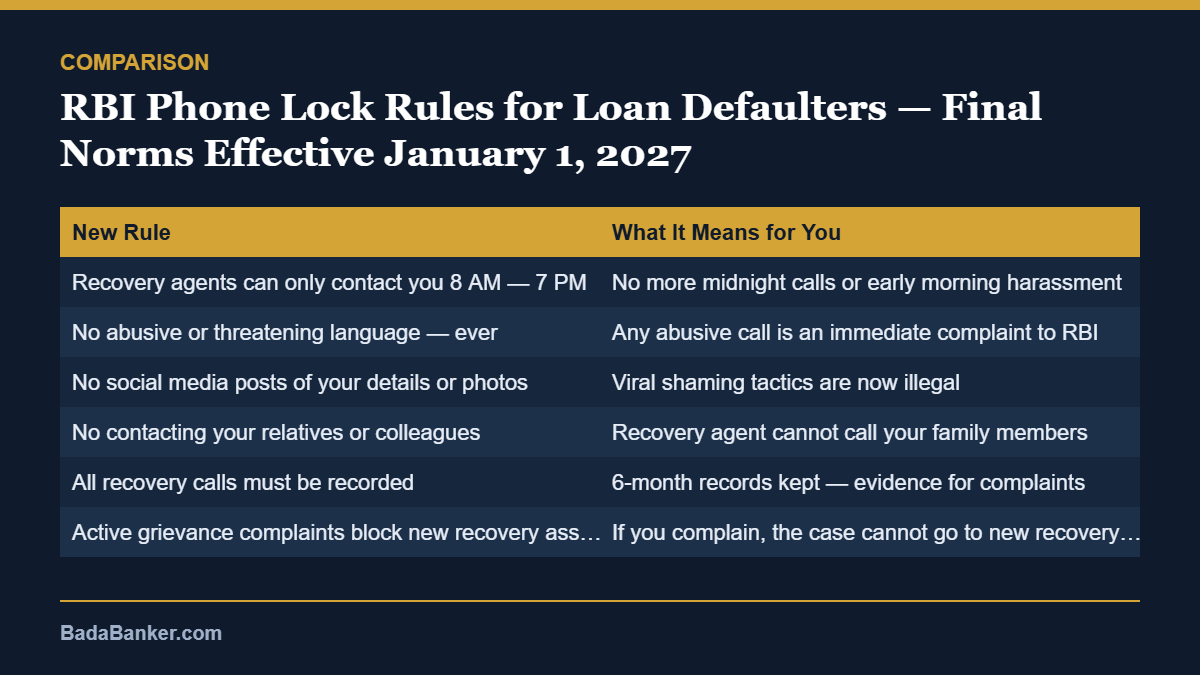
| New Rule | What It Means for You |
|---|---|
| Recovery agents can only contact you 8 AM — 7 PM | No more midnight calls or early morning harassment |
| No abusive or threatening language — ever | Any abusive call is an immediate complaint to RBI |
| No social media posts of your details or photos | Viral shaming tactics are now illegal |
| No contacting your relatives or colleagues | Recovery agent cannot call your family members |
| All recovery calls must be recorded | 6-month records kept — evidence for complaints |
| Active grievance complaints block new recovery assignment | If you complain, the case cannot go to new recovery agent until resolved |
| Bank cannot access data stored on your phone | Your personal photos, messages, contacts — completely protected |
Who Is Most Affected by the RBI Mobile Phone Lock 2026 Proposal?
This proposal specifically targets India’s booming device financing market:
- Tier-2 and Tier-3 city buyers who purchase ₹10,000–₹30,000 smartphones on 6–18 month EMIs through bank or NBFC financing
- BNPL users who finance devices through apps like Bajaj EMI Card, HDFC SmartEMI, or ZestMoney
- First-time borrowers who may not fully understand EMI obligations
- Gig workers who use financed phones as their primary work tool
“The RBI mobile phone lock loan default 2026 proposal is balanced on paper — strong safeguards, a 90-day grace period, two formal notices, and protection for essential functions including internet, calls, and banking apps. The ₹250 per hour wrongful lock compensation and the 1-hour unlock-after-repayment rule are genuinely strong consumer protections. The real risk is implementation — whether lenders will accurately define ‘non-essential’ functions and whether the grievance mechanism will work fast enough when someone’s phone is wrongly locked. The final rules are now out — read the RBI’s circular for the exact wording before relying on any detail here.”
RBI Mobile Phone Lock Loan Default 2026 — FAQs
Questions About Your Phone EMI or Loan Rights?
Have a question about how the RBI mobile phone lock loan default 2026 proposal affects your specific EMI situation? Ask us — completely free.
📎 Sources:
Business Standard — RBI Phone Lock Draft May 20, 2026 ·
MediaNama — RBI Draft Rules Full Analysis ·
Deccan Chronicle — RBI Phone Lock Proposal ·
RBI Draft Directions May 20, 2026.
For informational purposes only. Updated October 3, 2026 to reflect the final RBI directions (effective January 1, 2027); details marked as draft come from the May 2026 draft.
Related reading
The most reassuring clarification is that this is not a general power to switch off a borrower’s phone: it applies only to device-specific loans, only with contract consent, and only after 90 days and two notices. Protecting emergency calls, internet, banking apps and stored data from any lock is a strong safeguard. The ₹250-per-hour compensation and one-hour unlock rule should also give lenders a real incentive to get it right.