

A Mudra loan is a collateral-free business loan of up to ₹20 lakh for micro and small enterprises, given under the Pradhan Mantri MUDRA Yojana (PMMY) through banks, small finance banks, NBFCs and microfinance institutions. A Mudra loan can be used to start or grow a shop, service, small factory, transport business or an allied agricultural activity such as dairy or poultry. This guide explains the four Mudra loan categories, who qualifies, interest and repayment, how to apply in 2026, and how Mudra compares with PMEGP.
Based on the Ministry of Finance’s PMMY releases of April 2026. Checked 29 October 2026.
Mudra loan at a glance
- Amount: up to ₹20 lakh, in four categories: Shishu, Kishor, Tarun and Tarun Plus.
- No collateral: loans are covered by the Credit Guarantee Fund for Micro Units (CGFMU), run by the National Credit Guarantee Trustee Company, so lenders do not ask for security.
- Who can borrow: non-corporate, non-farm micro and small enterprises in manufacturing, trading, services and allied agricultural activities.
- Who lends: scheduled commercial banks, regional rural banks, small finance banks, NBFCs and microfinance institutions. MUDRA itself does not lend directly; it refinances these lenders.
- Scale: as of 27 March 2026, more than 57 crore Mudra loans worth ₹40.07 lakh crore had been disbursed. Women hold about 60% of loan accounts.
Mudra loan categories: Shishu, Kishor, Tarun and Tarun Plus
| Category | Loan amount | Typically for |
|---|---|---|
| Shishu | Up to ₹50,000 | Starting a very small business, even with no credit history |
| Kishor | Above ₹50,000 up to ₹5 lakh | New or running businesses needing working capital or modest expansion |
| Tarun | Above ₹5 lakh up to ₹10 lakh | Growing businesses buying equipment or adding capacity |
| Tarun Plus | Above ₹10 lakh up to ₹20 lakh | Only for borrowers who have fully repaid an earlier Tarun loan |
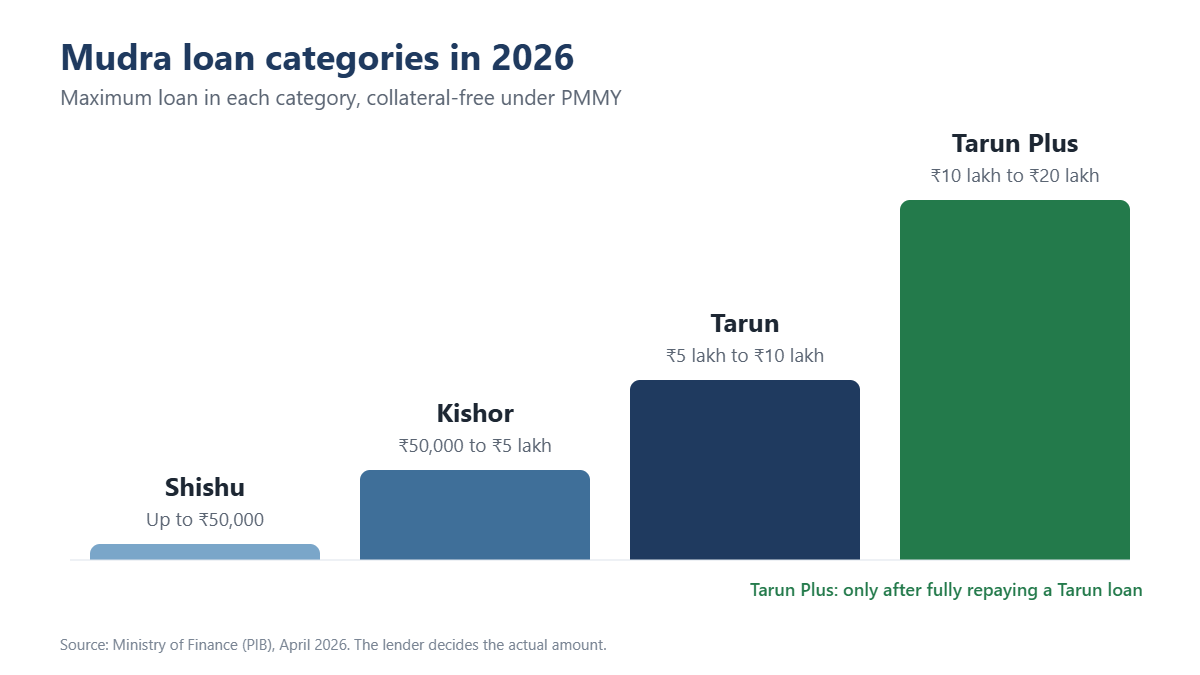
The category is a ceiling, not an entitlement. The lender decides the actual amount based on your project cost, your own contribution, and the cash flow the business can show.
What you can use a Mudra loan for
- Business loans for shopkeepers, traders, vendors and service businesses such as salons, tailoring, repair shops and food stalls.
- Working capital, often through a Mudra card that works like a debit card on your overdraft or cash credit limit.
- Equipment finance to buy machinery or tools for a micro unit.
- Commercial vehicles such as auto-rickshaws, e-rickshaws, three-wheelers and small goods carriers, for commercial use only.
- Allied agricultural activities such as dairy, poultry, fisheries, beekeeping, food and agro-processing, and agri-clinics.
Mudra loans are for income-generating business activity. They cannot be used for personal expenses, and crop loans are covered by separate agricultural schemes.
Who is eligible for a Mudra loan
- Individuals, proprietorships, partnership firms and other non-corporate businesses with a micro or small business plan or a running enterprise.
- New entrepreneurs as well as existing businesses. In 2024-25, about 21% of Mudra loan accounts went to new entrepreneurs.
- A clean repayment record helps. Shishu loans are open to borrowers with no credit history, but a past default on another loan usually leads to rejection.
- For Tarun Plus, you must have repaid a Tarun loan in full.
Mudra loan interest rate, fees and repayment
There is no single Mudra loan interest rate. Each lender sets its own rate within RBI rules. At banks, loans to micro and small enterprises are usually linked to an external benchmark such as the repo rate, so your rate moves when the RBI changes the repo rate. NBFCs and microfinance institutions generally charge more than banks. Processing fees and the repayment period also vary by lender, and the repayment period is fixed to match your business’s cash flow, sometimes with a short moratorium.
Before you sign, ask for the key fact statement, which lists the interest rate, fees and the total cost of the loan. Compare a bank or regional rural bank with an NBFC: for the same amount, the bank is usually cheaper.
How to apply for a Mudra loan in 2026
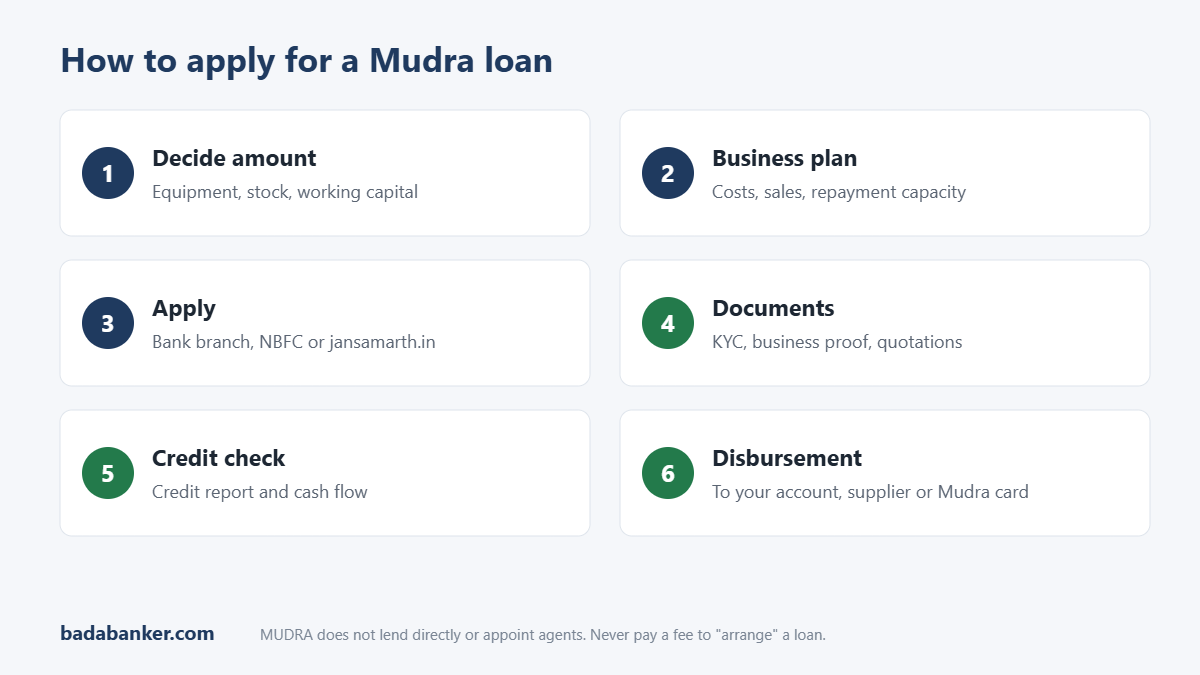
- Decide the amount and category. Work out what you need for equipment, stock and working capital, and how much you can bring yourself.
- Prepare a short business plan. For Kishor and Tarun loans, a simple project report with costs, expected sales and repayment capacity makes approval much easier.
- Apply at a bank branch or online. You can apply directly at a bank, RRB, small finance bank or NBFC, or online through the government’s JanSamarth portal (jansamarth.in), which connects you to more than 200 lenders.
- Submit documents. The lender checks your KYC, business proof and credit history.
- Sanction and disbursement. If approved, the loan is credited to your account or paid to the equipment supplier. Working capital may be given as a Mudra card limit.
Documents usually needed
- KYC: Aadhaar, PAN, photographs and address proof.
- Business proof: shop licence, GST registration or Udyam registration, if you have them.
- Quotations for machinery, equipment or vehicles you plan to buy.
- Bank statements for the last six to twelve months, for running businesses.
- A business plan or project report for larger loans, and income tax returns if available.
- Category certificate (SC, ST, OBC or minority) if applicable.
Mudra loan vs PMEGP: which should you choose?
Both schemes help small businesses borrow from banks, but they work differently. The main difference: a Mudra loan has no subsidy but is available to existing businesses and is quicker, while a PMEGP loan comes with a 15% to 35% subsidy but only for new units.
| Mudra loan | PMEGP loan | |
|---|---|---|
| Maximum amount | ₹20 lakh | Project up to ₹50 lakh (manufacturing) or ₹20 lakh (service) |
| Government subsidy | None | 15% to 35% of project cost |
| Existing businesses | Yes | No (only a second loan for PMEGP, REGP or Mudra units) |
| Collateral | None, guaranteed by CGFMU | None up to ₹10 lakh under RBI rules; CGTMSE cover is common above that |
| Training | Not required | Entrepreneurship training for projects above ₹2 lakh |
| Lenders | Banks, RRBs, SFBs, NBFCs, MFIs | Banks, through KVIC, KVIB or DIC |
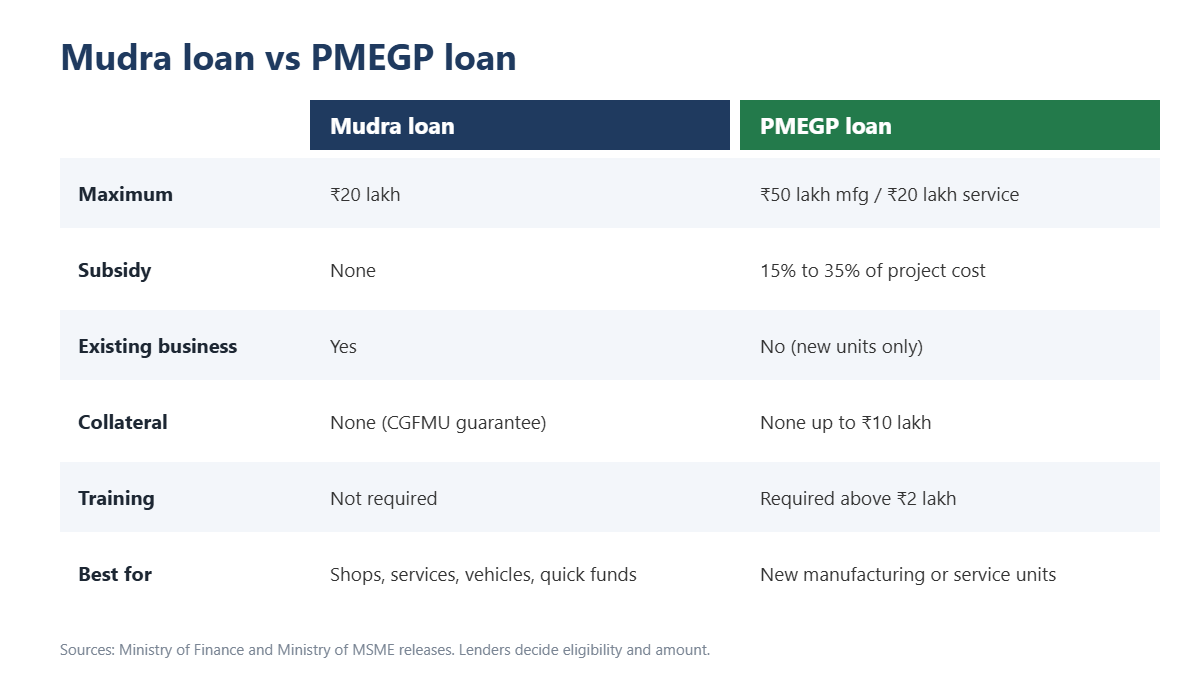
If you are starting a new manufacturing or service unit and can wait a few weeks for training and approval, the PMEGP loan subsidy is worth far more. If you run an existing shop or service, need a smaller amount quickly, or want a vehicle loan, a Mudra loan is the simpler route.
Why Mudra loan applications get rejected
- A weak or missing business plan: the lender cannot see how the loan will be repaid.
- Past defaults on loans or credit cards. Check your credit report first; our guide to the CIBIL score banks check for business loans explains what matters.
- Asking for more than the business can repay, or a Tarun Plus request without a repaid Tarun loan.
- A non-business purpose, such as personal expenses.
- Incomplete KYC or business proof.
Watch out for fraud. MUDRA does not lend directly and does not appoint agents. Apply only through a bank or regulated lender, or the JanSamarth portal, and never pay anyone a fee to “arrange” a Mudra loan.
Frequently asked questions
What is the maximum Mudra loan amount in 2026?
₹20 lakh, under the Tarun Plus category, which is only for borrowers who have repaid a Tarun loan. For everyone else, the maximum is ₹10 lakh under Tarun.
Is collateral required for a Mudra loan?
No. Mudra loans up to ₹20 lakh are covered by the Credit Guarantee Fund for Micro Units, so lenders do not need collateral or a third-party guarantee.
What is the Mudra loan interest rate?
It depends on the lender. Banks link most small business loans to the repo rate plus a spread based on your risk; NBFCs and microfinance institutions usually charge more. Always compare the key fact statements of two or three lenders.
Is there a subsidy on a Mudra loan?
No. Mudra is a credit and guarantee scheme, not a subsidy scheme. If you are setting up a new unit and want a subsidy, look at PMEGP or your state’s MSME scheme.
Can I apply for a Mudra loan online?
Yes, through the JanSamarth portal or your bank’s website or app. You can also apply at any bank branch, regional rural bank, small finance bank or NBFC that lends under PMMY.
Related reading
Sources
- PIB, MUDRA Yojana: Driving financial inclusion and micro-enterprise growth (8 April 2026)
- PIB, PMMY completes 11 years (April 2026)
- PIB, 11 Years of Pradhan Mantri MUDRA Yojana (factsheet)
- JanSamarth, national portal for credit-linked government schemes
Lenders decide eligibility, amount, interest and repayment within RBI rules. This is general information, not advice on a specific loan.