
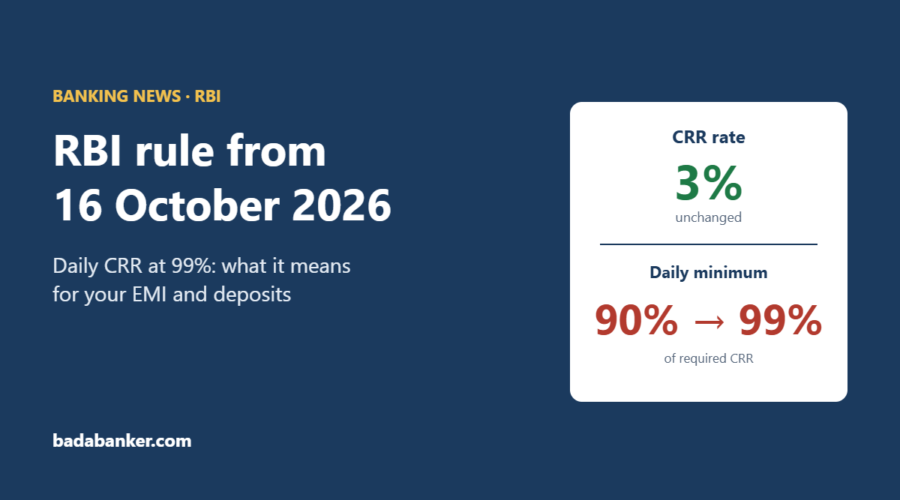
The new RBI CRR rule from 16 October 2026 has set off messages saying “your EMI will rise” and even “banks must now keep 99% of deposits with RBI”. Neither is true. What the RBI actually changed is a technical rule on how banks meet their cash reserve ratio (CRR) day to day. The CRR itself is unchanged at 3%. This guide explains the change in plain words, with an example, why the RBI did it, and what it does and doesn’t mean for your loans and deposits.
RBI CRR rule from 16 October 2026: the facts
- What changed: banks must now keep at least 99% of their required CRR balance with the RBI on every day, up from 90%. It applies from the reporting fortnight beginning 16 October 2026 (RBI circular RBI/2026-27/290, 9 October 2026).
- What didn’t change: the CRR rate stays at 3% of a bank’s net demand and time liabilities (NDTL), and banks still meet it as an average over each fortnight.
- Why: the RBI cited a review of current liquidity conditions. In the same week, it raised the repo rate to 5.50%, and on 13 October it sold ₹25,000 crore of government securities to absorb surplus money from the system.
- Your EMI: this rule doesn’t change your loan rate directly. Any EMI increase comes from the repo rate hike of 7 October, passed on by banks at your loan’s reset date.
- Your deposits: nothing changes. Your money is not being “locked” with the RBI.
What is CRR?
The cash reserve ratio is the share of a bank’s deposits and certain other liabilities, called net demand and time liabilities, that it must keep as cash with the RBI. The bank earns no interest on this money. The RBI uses CRR as one of its tools to control how much money banks have available to lend. As of 14 October 2026, the RBI’s website shows CRR at 3.00% and the statutory liquidity ratio (SLR) at 18.00%.
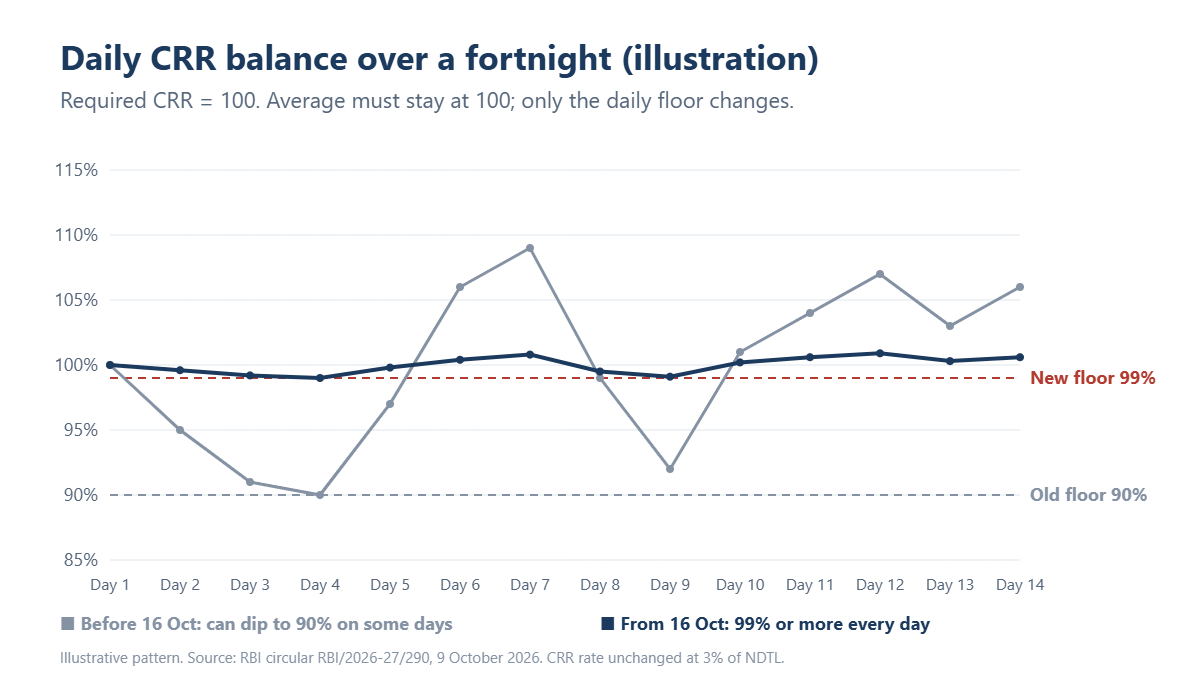
Banks don’t have to hold exactly 3% every single day. They meet the requirement as an average over a two-week reporting fortnight, as long as they don’t fall below a daily minimum on any day. That daily minimum is what has changed.
CRR, SLR and repo rate: how they differ
These three terms often get mixed up in news headlines. Each is a different tool, and the RBI CRR rule changed only how the first one is maintained.
| Tool | What it is | Current level | Effect on borrowers |
|---|---|---|---|
| Cash reserve ratio (CRR) | Share of deposits a bank must keep as cash with the RBI, earning no interest | 3% of NDTL | Indirect: affects how much money banks have to lend |
| Statutory liquidity ratio (SLR) | Share of deposits a bank must keep in safe liquid assets, mainly government securities | 18% of NDTL | Indirect |
| Repo rate | Rate at which the RBI lends to banks overnight; the benchmark for repo-linked loans | 5.50% | Direct: repo-linked loan rates move with it |
That’s why the repo hike matters far more for your EMI than the daily CRR change. CRR and SLR shape how much money banks have to lend, while the repo rate sets the price of a large share of floating-rate loans.
The change, with an example
Take a bank with net demand and time liabilities of ₹1,00,000 crore. At a 3% CRR, it must hold ₹3,000 crore with the RBI on average over the fortnight.
| Before 16 October | From 16 October | |
|---|---|---|
| CRR rate | 3% | 3% (unchanged) |
| Average required over the fortnight | ₹3,000 crore | ₹3,000 crore (unchanged) |
| Daily minimum | 90% = ₹2,700 crore | 99% = ₹2,970 crore |
| How far the balance can dip on a given day | up to ₹300 crore | only ₹30 crore |
Before, the bank could let its RBI balance drop to ₹2,700 crore on busy days and make it up later in the fortnight. Now it has to stay almost at the full amount every day. The bank doesn’t have to keep more money with the RBI on average. It just loses most of its day-to-day flexibility.
Why the RBI CRR rule was brought in
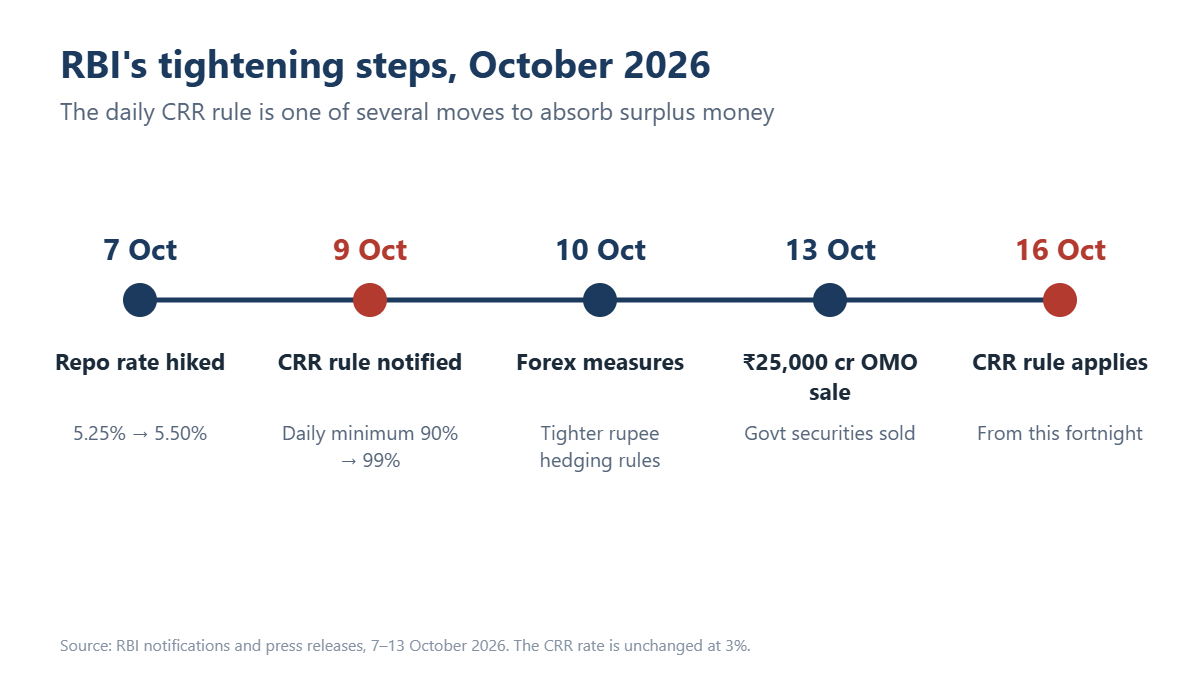
The circular gives one reason: a review of current liquidity conditions. Read together with the RBI’s other moves in the same fortnight, the direction is clear: it wants less surplus money sloshing around the banking system.
- 7 October: repo rate raised by 0.25 percentage points to 5.50%, the first hike since February 2023, with a shift in stance to “calibrated tightening”.
- 9 October onwards: variable rate reverse repo auctions, through which the RBI absorbs banks’ spare funds.
- 10 October: new rules for the foreign exchange market, which the RBI said were to ensure its orderly functioning.
- 13 October: sale of ₹25,000 crore of government securities through an open market operation, which takes money out of the system.
When banks can no longer park less than their full CRR on some days, they need to hold that cash in their RBI accounts consistently. That leaves slightly less spare money to lend overnight, which supports the RBI’s tighter policy.
Will the RBI CRR rule raise your EMI?
Not because of this rule. Here’s how to think about your loan:
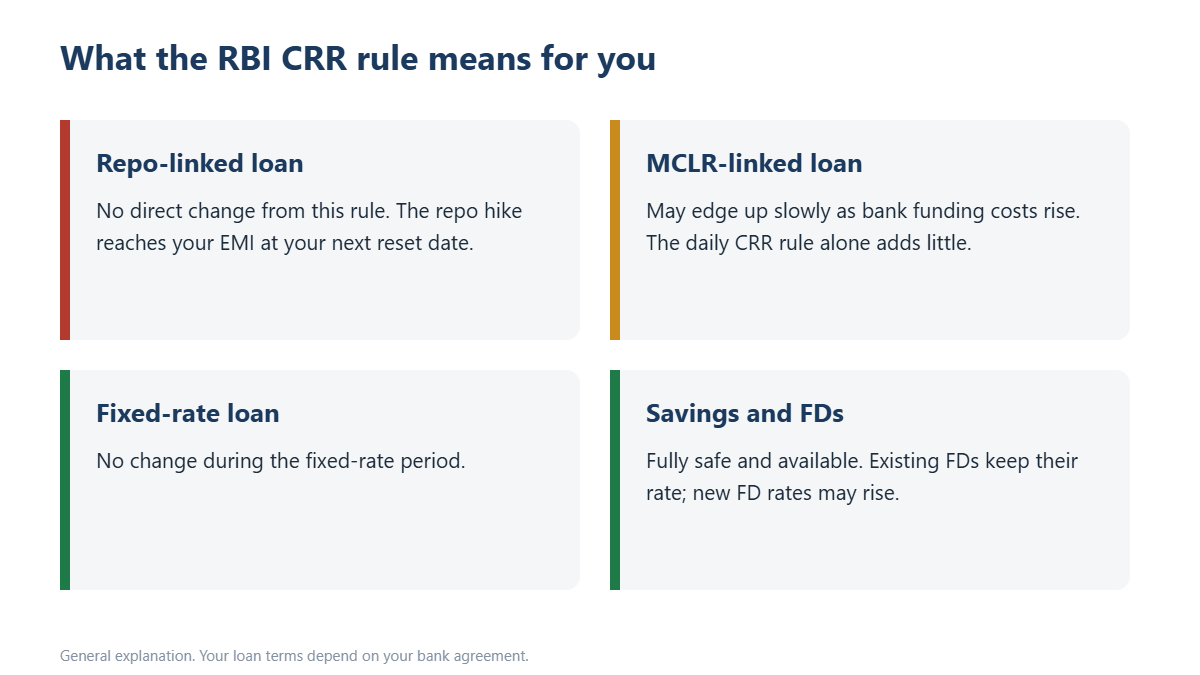
- Repo-linked (EBLR) home, car or MSME loans: these move with the repo rate. The repo hike from 5.25% to 5.50% is what will raise your rate, at your next reset date. Several banks have already raised their repo-linked lending rates. Our post on the October 2026 repo rate hike shows the EMI effect on different loan sizes.
- MCLR-linked loans: MCLR reflects a bank’s overall cost of funds, so tighter liquidity can push it up gradually. The daily CRR rule on its own adds only a small cost, because the average CRR a bank holds hasn’t changed.
- Fixed-rate loans: unaffected during the fixed-rate period.
Does the RBI CRR rule affect your deposits and FDs?
Your deposits are safe and fully available. The rule is about the cash a bank keeps with the RBI, not about your account. If anything, a tighter money market can encourage banks to compete for deposits, and some lenders have already raised fixed deposit rates after the repo hike. Existing FDs keep their contracted rate until maturity.
RBI CRR rule: myths vs facts
| Viral claim | Fact |
|---|---|
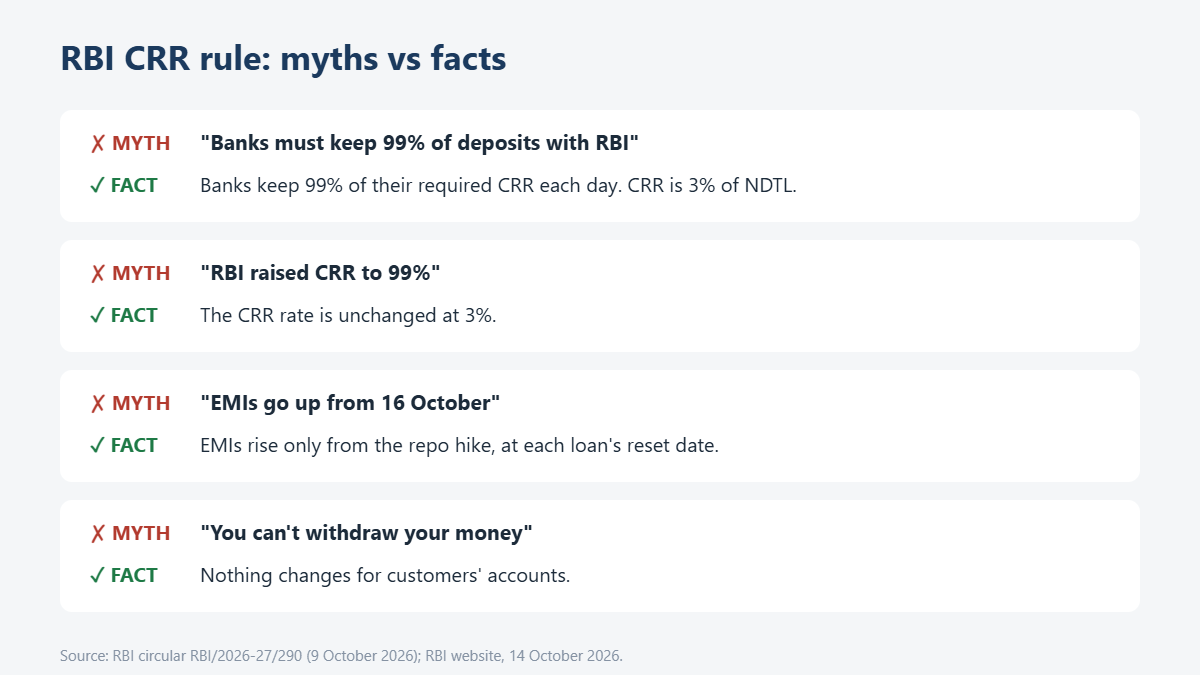
| “Banks must keep 99% of deposits with RBI.” | No. Banks must keep 99% of their required CRR on every day. The CRR itself is 3% of net demand and time liabilities. |
| “RBI raised CRR to 99%.” | No. The CRR rate is unchanged at 3%. |
| “Your EMI goes up from 16 October.” | Not because of this rule. EMIs on repo-linked loans rise because of the repo hike, at each loan’s reset date. |
| “You won’t be able to withdraw your money.” | False. Nothing changes for customers’ accounts. |
What you can do now
- Check your loan’s benchmark and reset date in your sanction letter or loan statement. That tells you when the repo hike will reach your EMI.
- Decide between a higher EMI and a longer tenure if your rate rises. Keeping the EMI the same and extending the tenure usually costs more interest overall.
- Consider prepaying if you have surplus funds. RBI rules don’t allow prepayment charges on floating-rate loans to individuals for non-business purposes.
- Compare FD rates before you book or renew, since rates may rise further in the coming weeks.
- Ignore forwards that don’t link to an RBI circular. RBI notices are published at rbi.org.in.
What to watch next
- Your bank’s lending rate notices. Banks announce changes to their repo-linked and MCLR rates on their websites. Several public sector banks raised repo-linked rates from 8 October.
- FD rate revisions. If banks compete harder for deposits, new FD rates can rise over the coming weeks.
- RBI liquidity operations. More reverse repo auctions or bond sales would signal that the RBI still wants to drain surplus money.
- The next policy meeting, 2–4 December 2026. The Monetary Policy Committee will decide whether further rate action is needed.
Frequently asked questions
What is the current CRR rate?
3% of net demand and time liabilities, as shown on the RBI’s website on 14 October 2026. The 16 October change doesn’t alter it.
What does “99% daily CRR maintenance” mean?
Banks must keep at least 99% of their required CRR balance with the RBI on every day of the fortnight, instead of 90%. They still have to meet 100% on average over the fortnight.
Does the RBI CRR rule apply to all banks?
The circular is addressed to all scheduled banks, which must keep CRR with the RBI under Section 42(1) of the RBI Act, 1934.
Is the RBI likely to raise rates again?
The Monetary Policy Committee changed its stance to “calibrated tightening” on 7 October, which leaves room for further action if inflation risks persist. The next policy meeting is scheduled for 2–4 December 2026.
What is NDTL?
Net demand and time liabilities. It’s mainly a bank’s deposits: savings, current and fixed deposits, plus some other liabilities, after certain adjustments. CRR and SLR are calculated as a percentage of NDTL.
Will FD rates go up after the RBI CRR rule?
The rule doesn’t set FD rates. But together with the repo hike, tighter liquidity can lead banks to offer more on new deposits. Some lenders have already raised FD rates since 7 October. Existing FDs keep their contracted rate until maturity.
Related reading
Sources
- RBI, Section 42(1) of the RBI Act, 1934 – Change in Daily Minimum Cash Reserve Maintenance Requirement (9 October 2026)
- RBI, RBI announces OMO sale of Government of India securities (9 October 2026) and auction result (13 October 2026)
- RBI, Regulatory measures for the foreign exchange market (10 October 2026)
- RBI, Monetary Policy Statement, October 2026
This article explains an RBI regulatory change for general understanding. Your loan and deposit terms are set by your bank’s agreement with you.