
A project report for bank loan applications is the document that tells the bank what you plan to set up, what it will cost, how you will fund it and how the loan will be repaid. For a new unit or an expansion, it is usually the first thing a branch asks for, and the quality of the report often decides how quickly the proposal moves. This guide explains the standard project report format banks expect, what goes into each section, a worked example of project cost and break-even, and the mistakes that most often send a report back.
What is a project report for a bank loan?
It is a structured business plan written for a lender. Where a general business plan aims to persuade, a bank project report aims to let a credit officer check three things quickly:
- Is the project viable? Will it make a profit at a realistic level of sales?
- Is the cost right and fully funded? Are the cost estimates backed by quotations, and is your own contribution in place?
- Can it repay? Will cash earnings cover the instalments every year, with a margin to spare?
Banks usually ask for a project report for term loans to start or expand a business, such as buying machinery, setting up a unit or buying a commercial vehicle. Many government-linked schemes also ask for one with the application.
Project report for bank loan: format and sections banks expect
There is no single format that every bank prescribes, but most project reports for bank loans follow this order.
1. Summary of the proposal
One page with the essentials: name and constitution of the business, activity, location, total project cost, loan amount asked for, your contribution, expected sales, employment and key ratios such as DSCR and break-even. Many credit officers read this page first, so it must match the numbers inside.
2. Promoter profile
Who is behind the project: qualifications, experience in this line of business, other businesses and their track record, and net worth. Relevant experience is one of the strongest points in a proposal.
3. Project description and market
What you will make or sell, who will buy it, why there is demand, who your competitors are and how you will reach customers. Order copies, letters of intent or existing customer relationships are far more convincing than general statements about a growing market.
4. Location, premises and approvals
Where the unit will be, whether the premises are owned or rented, power and water arrangements, and the registrations and licences needed, such as Udyam registration, GST registration and any industry-specific approvals. Udyam registration is free on the government portal.
5. Technical details
Machinery list with specifications and suppliers, installed capacity, production process, raw materials and their sources, and staffing. Every major cost should be supported by a quotation.
6. Cost of project and means of finance
The total cost broken into land and building, plant and machinery, installation, furniture, preliminary and pre-operative expenses, contingency, and margin money for working capital. Against it, the means of finance: your own contribution, the term loan and any subsidy. The two must add up exactly.
7. Working capital requirement
How much stock, receivables and expenses you will need to fund once production starts, and how much of it you will ask the bank to finance as a cash credit limit. Our guide to CMA data for bank loans explains how banks work out this limit.
8. Profitability projections
Projected sales, cost of production, expenses, depreciation, interest, tax and net profit for each year of the loan, usually with a projected balance sheet and cash flow statement. Capacity use normally starts lower in the first year and rises gradually.
9. Repayment schedule and DSCR
The proposed loan tenure, any moratorium, the instalment schedule and the debt service coverage ratio for each year. See our DSCR ratio guide for how banks calculate it and what they look for.
10. Break-even analysis and risks
The level of sales at which the business stops making a loss, and the main risks with how you will handle them, such as dependence on one customer, raw material prices or seasonal demand.
Worked example: cost of project and means of finance
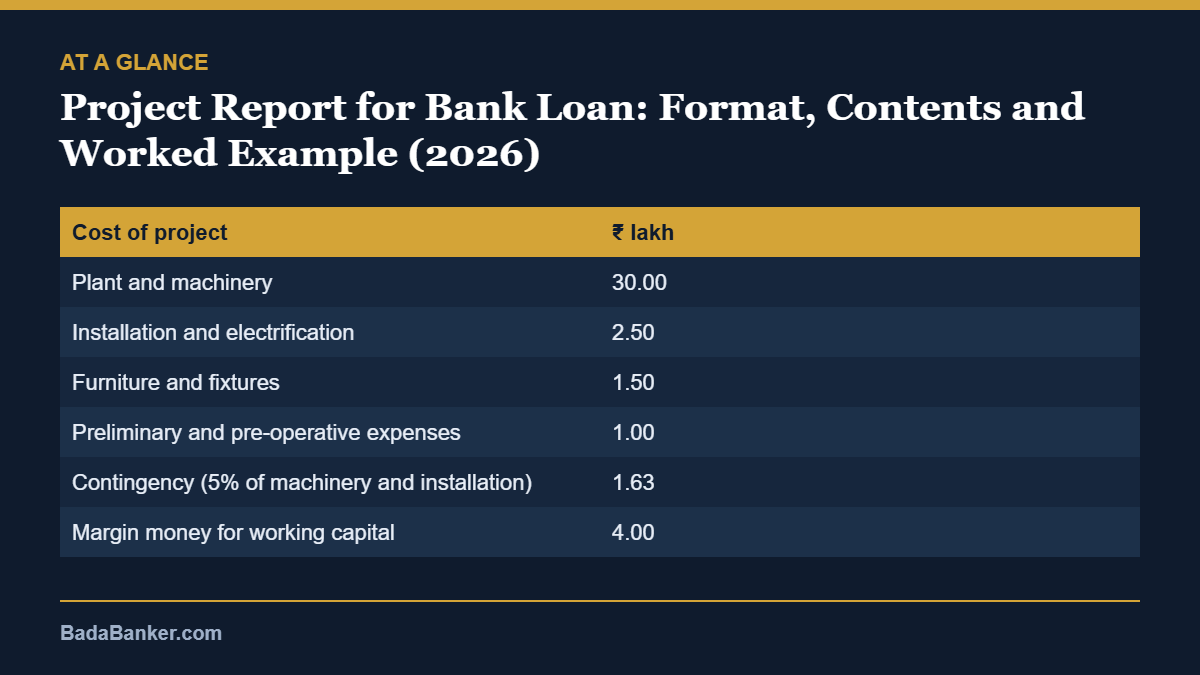
Take a small manufacturing unit in rented premises. Its project cost might look like this:
| Cost of project | ₹ lakh |
|---|---|
| Plant and machinery | 30.00 |
| Installation and electrification | 2.50 |
| Furniture and fixtures | 1.50 |
| Preliminary and pre-operative expenses | 1.00 |
| Contingency (5% of machinery and installation) | 1.63 |
| Margin money for working capital | 4.00 |
| Total cost of project | 40.63 |
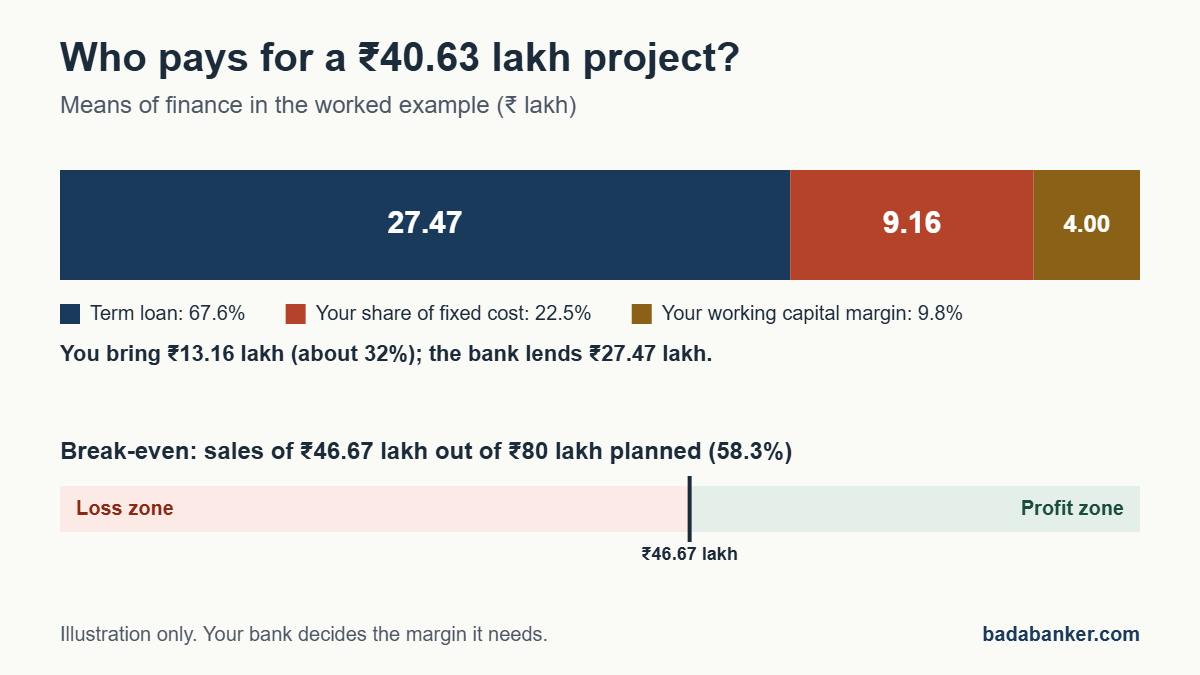
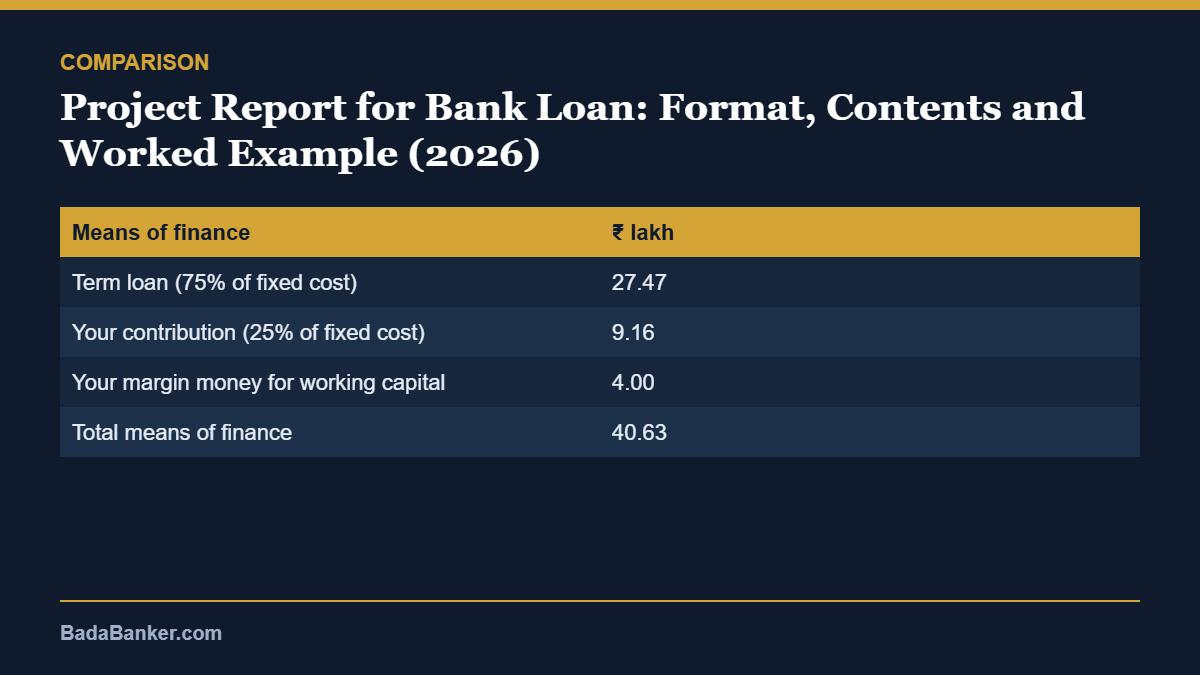
Suppose the bank finances 75% of the fixed cost, which is ₹36.63 lakh without the working capital margin. The means of finance then works out as follows:
| Means of finance | ₹ lakh |
|---|---|
| Term loan (75% of fixed cost) | 27.47 |
| Your contribution (25% of fixed cost) | 9.16 |
| Your margin money for working capital | 4.00 |
| Total means of finance | 40.63 |
So you would need to bring in ₹13.16 lakh, about 32% of the total project cost. The margin your bank asks for depends on its policy and on any scheme you apply under, so confirm it before you finalise the report.
Break-even example
Suppose the unit expects sales of ₹80 lakh in a year. Variable costs, such as raw material, power and packing, are 70% of sales, which is ₹56 lakh. That leaves a contribution of ₹24 lakh. Fixed costs, including salaries, rent, depreciation and interest, are ₹14 lakh.
Break-even point = fixed costs ÷ contribution = 14 ÷ 24 = 58.3% of the planned sales, or about ₹46.67 lakh of sales. Below that level the unit makes a loss; above it, it makes a profit. A lower break-even point gives the bank more comfort that the unit can survive a slow start.
Common mistakes in a project report for bank loan applications
- Costs without quotations. Round-figure estimates for machinery look guessed. Attach supplier quotations.
- Full capacity from year one. Few new units sell at full capacity straight away. Banks expect a gradual ramp-up.
- Means of finance that don’t add up to the project cost, or own contribution that is not shown to be available.
- Forgetting working capital. A unit with machinery but no money for raw material and receivables cannot run.
- Projections that don’t match the repayment schedule. The interest and depreciation in the profit projections must match the loan and asset figures elsewhere in the report.
- A copied report. Generic reports downloaded from the internet, with another business’s numbers or location left in, are easy for a credit officer to spot and damage credibility.
Documents to attach with the project report
- KYC of the business and promoters, as listed by your bank;
- Udyam registration, GST registration and other licences;
- quotations for machinery and equipment;
- rent agreement or ownership documents for the premises;
- proof of your own contribution, such as bank statements;
- for an existing business, audited financial statements and income tax returns for the last two or three years;
- order copies or letters of intent from customers, if you have them.
Need a bank-ready project report?
BadaBanker prepares project reports for MSME term loans, with cost of project, means of finance, projections, DSCR and break-even worked out and cross-checked the way a bank’s credit team will read them. A ready-to-use project report Excel template is also available to buy.
Email msmebanktool@gmail.com with your business activity, project cost and loan amount. Please don’t send account numbers, passwords or OTPs.
Frequently asked questions
What is the difference between a project report and CMA data?
A project report explains a new project or expansion as a whole: what it is, what it costs, how it is funded and how it repays. CMA data is a standard set of financial forms used mainly to assess working capital. A proposal for a new unit with both a term loan and a cash credit limit often needs both.
Who can prepare a project report for a bank loan?
You can prepare it yourself, or use a chartered accountant or a consultant. What matters is that the figures are realistic, supported by documents and consistent throughout. If your bank or scheme asks for a CA-certified report, a chartered accountant must sign it.
For how many years should the projections be made?
Usually for the full repayment period of the term loan, including any moratorium. For a five-year loan, that means at least five years of projected profit and loss, balance sheet and cash flow.
Is a project report needed for small loans?
For small loans, many banks accept a short project profile instead of a full report. The requirement depends on the bank, the loan amount and the scheme, so ask your branch what it needs.
Does a good project report guarantee the loan?
No. A clear, well-supported report makes your proposal easier to assess, but the bank decides after its own appraisal of the project, your credit history, security and its lending policy.
Related reading
- Mudra loan 2026: Shishu, Kishor, Tarun and Tarun Plus explained
- PMEGP loan 2026: subsidy, eligibility and how to apply
- Gujarat MSME scheme 2026: 7% interest subsidy and how to claim
- CMA Data for Bank Loan: Format, the 6 Forms and MPBF Explained (2026)
- DSCR Ratio for Bank Loan: Formula, Ideal Ratio and Worked Example (2026)
- MSME Working Capital Calculator 2026 — Nayak Method, Tandon Method, DSCR, Interest Subvention
This guide explains what banks commonly expect in a project report. It is general information, not advice for your specific project. Your bank’s own policy and appraisal decide your loan.