
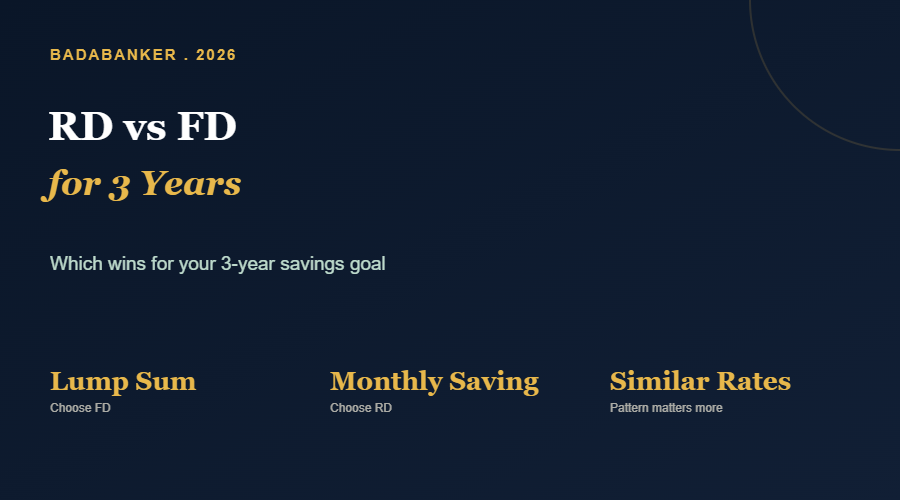
For a specific 3-year goal — a wedding, a down payment, a planned purchase — clients often ask whether to save via RD or FD. The honest answer depends on whether you already have the lump sum or need to build it up.
Quick Fact Check — RD vs FD for 3 Years
- FD (Fixed Deposit): You invest a lump sum upfront; ideal if you already have the money and want it to grow with a locked-in rate.
- RD (Recurring Deposit): You invest a fixed amount monthly; ideal if you’re building savings gradually rather than starting with a lump sum.
- Interest rates are typically similar between RD and FD at the same bank for the same tenure — the real difference is about your savings pattern, not the rate itself.
- Both are fully taxable as per your income slab, with TDS deducted if interest exceeds ₹40,000/year (₹50,000 for senior citizens) per bank.
Similar Rates
RD and FD rates are usually comparable
Lump Sum
FD is best if you have it upfront
Monthly Savings
RD is best if you are building the amount
The Real Decision Factor: What You Have Today
If you already have ₹3 lakh sitting in your savings account for a 3-year goal, an FD locks in today’s rate on the full amount immediately — waiting and drip-feeding it into an RD instead would mean most of your money earns less for longer. If you don’t have the lump sum and need to save ₹8,000/month to reach a similar goal, an RD forces disciplined monthly saving with a bank-guaranteed return, which beats leaving it in a low-interest savings account.
Archana’s Tip: If you have part of the amount already and expect to add more monthly, consider a combination — put the lump sum in an FD now, and start an RD for future monthly savings. There’s no rule that says you must choose only one.
Our Verdict
📋 Our Verdict — RD vs FD for a 3-Year Goal
“This isn’t really an FD-vs-RD rate question — it’s a ‘what do I have today’ question. Lump sum in hand: choose FD. Building up gradually: choose RD. Both are genuinely safe, and both beat leaving the money idle in a savings account.”
RD vs FD — FAQs
Q: Can I break an FD or RD early if my goal changes?
A: Yes, both allow premature withdrawal, typically with a penalty (reduced interest rate) — RDs sometimes have stricter penalty terms than FDs, so check your bank’s specific policy.
Q: Do senior citizens get a better rate on RD or FD?
A: Both typically offer a similar additional rate (commonly 0.25%-0.50% higher) for senior citizens on either product.
To compare exact numbers for your goal, try our FD and RD Calculators, or browse more Fixed Deposits coverage on BadaBanker.
📎 Sources: RBI guidance on TDS thresholds for deposit interest; standard bank FD/RD product terms, 2026. For informational purposes only — compare specific bank rates before deciding.