
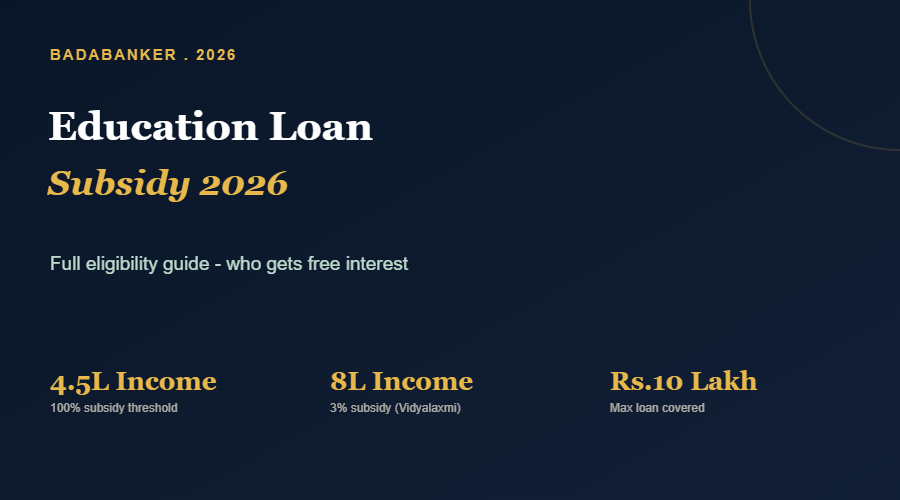
Most families take an education loan and never check if they qualify for a subsidy — and end up paying interest during the moratorium period that the government would have covered entirely. Here’s exactly who qualifies for what in 2026.
Quick Fact Check — Education Loan Subsidy 2026
- Family income up to ₹4.5 lakh/year: 100% interest subvention during the moratorium period, on loans up to ₹10 lakh, under the Central Sector Interest Subsidy (CSIS) scheme, for NAAC/NBA-accredited technical and professional courses.
- Family income up to ₹8 lakh/year: 3% interest subvention during moratorium on loans up to ₹10 lakh, under the newer PM Vidyalaxmi scheme.
- Above ₹8 lakh family income: No interest subsidy, but you can still get a collateral-free education loan backed by a 75% government credit guarantee.
- You cannot combine this subsidy with any other government scholarship or interest subvention scheme for the same loan.
₹4.5L Income
100% interest subsidy threshold
₹8L Income
3% subsidy threshold (PM Vidyalaxmi)
₹10 Lakh
Max loan amount covered under subsidy
75%
Credit guarantee even without subsidy
What “Moratorium Period” Actually Means Here
The subsidy only covers interest during the moratorium — the course duration plus a grace period (typically 6-12 months) after completion, before EMI repayment begins. Once repayment starts, you pay interest as normal; the subsidy doesn’t continue into the repayment phase.
A Real Example
A family earning ₹4 lakh/year takes a ₹9 lakh education loan for their child’s NAAC-accredited engineering degree at 9% interest, with a 4-year course plus 1-year grace period (5 years total moratorium). Without the subsidy, interest alone during this period would be roughly ₹4,05,000. Under CSIS, with family income under ₹4.5 lakh, that entire amount is covered by the government — a genuinely substantial saving before the student has even graduated.
Archana’s Tip: Apply through the PM-Vidyalaxmi portal at the time of taking the loan, not after — retroactive subsidy claims are far harder to process. Keep your income certificate and admission proof ready before applying.
Our Verdict
📋 Our Verdict — Education Loan Subsidy 2026
“If your family income is under ₹8 lakh, always check subsidy eligibility before finalizing your education loan — it’s free money you’re otherwise leaving on the table. Even above that threshold, the 75% credit guarantee makes education loans genuinely accessible without collateral for most middle-class families.”
Education Loan Subsidy — FAQs
Q: Does the subsidy apply to loans for studying abroad?
A: CSIS and PM Vidyalaxmi primarily cover domestic institutions; separate schemes like Padho Pardesh exist for specific categories studying abroad — check current scheme-specific eligibility.
Q: Who calculates “family income” for eligibility?
A: Typically parents’/guardians’ combined annual income, verified through an income certificate from a competent authority.
Q: What happens if I don’t apply for the subsidy at loan origination?
A: You may lose the benefit for that period — always apply for subsidy consideration when you first take the loan.
To calculate your loan EMI, try our Loan Calculators, or browse more Loans coverage on BadaBanker.
📎 Sources: PM Vidyalaxmi Scheme guidelines, Department of Higher Education; PM-USP Central Sector Interest Subsidy (CSIS) scheme norms. For informational purposes only — verify current eligibility on the official PM Vidyalaxmi portal.