
The Gujarat MSME scheme 2026 gives manufacturing MSMEs a 7% interest subsidy on bank term loans for five years, a capital subsidy of 25% to 35% of their investment, and help with power bills, so that total support can reach 35% to 45% of the eligible investment. The Gujarat MSME scheme 2026, formally the Viksit Gujarat Industrial Policy 2026 Scheme for Assistance to MSMEs, applies to units that start commercial production between 1 June 2026 and 31 May 2031. This guide explains who qualifies, how the subsidies and their limits work on a real loan, and how to apply.
Based on the Industries and Mines Department’s government resolution (GR) of 25 September 2026 and the state’s policy announcement of 15 June 2026. Checked 18 October 2026.
Gujarat MSME scheme 2026 at a glance
- Who: micro, small and medium manufacturing enterprises (including job work) setting up a new unit or expanding or diversifying an existing one. Service and trading businesses are not covered.
- When: commercial production must start between 1 June 2026 and 31 May 2031. Investment counts from assets bought and paid for on or after 1 January 2026.
- Interest subsidy: 7% a year on the bank term loan for 5 years, up to 10% of the eligible investment. Women entrepreneurs, registered manufacturing startups and first-generation entrepreneurs get 1% more.
- Capital subsidy: 35% of eligible investment in Category-A talukas and 25% in Category-B talukas. Micro units get it in the first year; small and medium units over 5 years.
- Overall limit: 45% of eligible investment in Category-A talukas and 35% in Category-B, with yearly limits.
- Loans from NBFCs do not qualify for the interest subsidy. The term loan must come from a bank or an RBI-recognised financial institution.
Who is eligible for the Gujarat MSME scheme
The scheme uses its own MSME size test, based only on the gross investment in plant and machinery across all your units in India:
| Category | Investment in plant and machinery |
|---|---|
| Micro | Up to ₹2.5 crore |
| Small | Above ₹2.5 crore, up to ₹25 crore |
| Medium | Above ₹25 crore, up to ₹125 crore |
- New units need Udyam registration (or an IEM or other recognised registration) and separate books for the project.
- Expansion means raising investment in the same premises by at least 50%, with at least 60% of it in plant and machinery, and raising capacity by at least 50%. The existing unit must have used at least 75% of its capacity in one of the previous three years.
- Diversification means adding at least 25% to investment (50% for medium units) for a new product line, with at least 60% in plant and machinery.
- Units that started production before 1 June 2026 stay under the earlier Aatmanirbhar Gujarat scheme of 2022 and cannot switch.
- Local jobs: at least 85% of employees, and 60% of managerial and supervisory staff, must be domiciled in Gujarat.
Gujarat MSME scheme subsidies: capital, interest and power
You can take any one of the three components or combine them, as long as each stays within its own limit and the total stays within the overall ceiling for your taluka.
| Category-A taluka | Category-B taluka | |
|---|---|---|
| Capital subsidy | 35% of eligible investment | 25% of eligible investment |
| Interest subsidy | 7% on term loan for 5 years, up to 10% of eligible investment | 7% on term loan for 5 years, up to 10% of eligible investment |
| Power tariff | ₹2 per unit for 5 years, up to 25% of eligible investment | ₹1 per unit for 5 years, up to 25% of eligible investment |
| Overall ceiling | 45% of eligible investment | 35% of eligible investment |
| Yearly ceiling, micro | 37% in year 1, then 2% a year | 27% in year 1, then 2% a year |
| Yearly ceiling, small and medium | 9% a year | 7% a year |
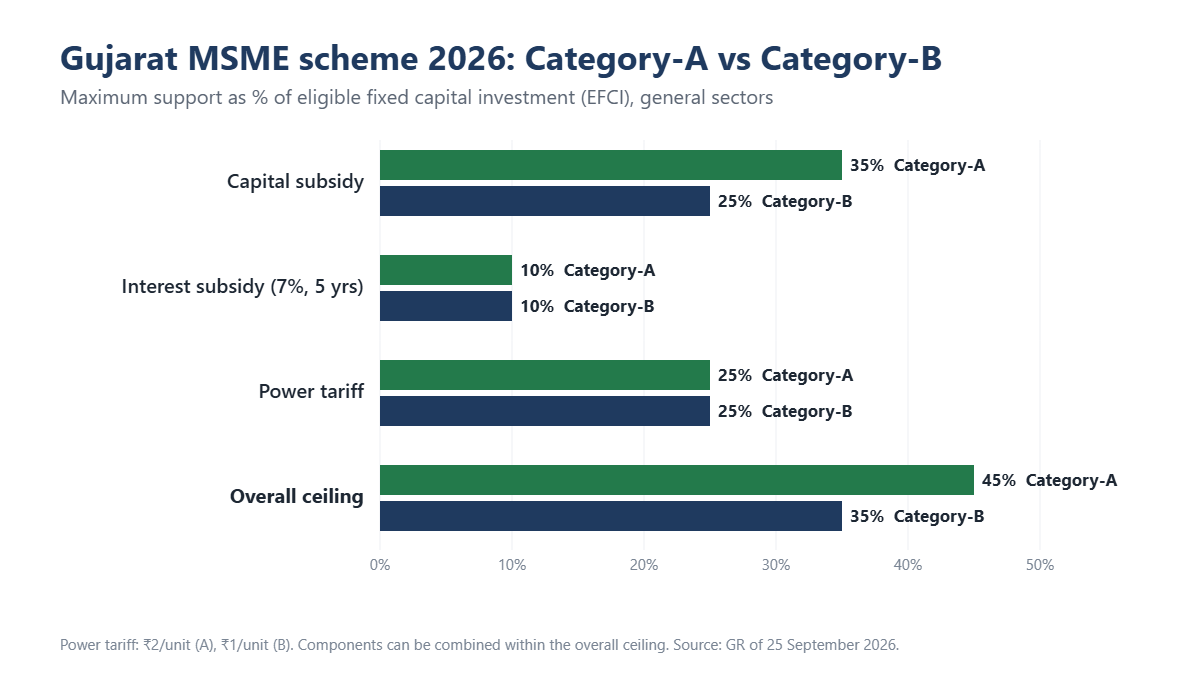
For the Gujarat MSME scheme, the state’s 268 talukas have been classified into 130 Category-A and 138 Category-B talukas under a separate order of 8 September 2026. Category-A talukas get the higher incentives. Your District Industries Centre (DIC) can confirm your taluka’s category.
Five selected thrust sectors (sports goods, toys, footwear, robots and drones) get more: an overall ceiling of 50% (Category-A) or 45% (Category-B), the interest subsidy up to 20% of investment, and extras such as full reimbursement of stamp duty on land.
How the 7% interest subsidy works on your loan
- It is a reimbursement. You pay the bank its full interest and EMI, then claim the subsidy. Plan your cash flow for this gap.
- Only regular payers qualify. If your account falls into default under RBI norms, you lose the subsidy for that period, and that time is deducted from your 5-year subsidy period.
- You must bear at least 2% interest. On a loan at 8.5%, the subsidy is capped at 6.5 points. If you also get a central government interest subsidy, the state’s subsidy is reduced so that you still pay at least 2%.
- Only disbursed loan amounts count, and only the part used for eligible fixed investment. Penal interest and other charges are not reimbursed.
- CGTMSE fee refund: micro and small units with a collateral-free loan under CGTMSE get 100% of the annual guarantee fee reimbursed for 5 years, paid with the interest subsidy once a year.
Worked example: a micro unit in a Category-B taluka
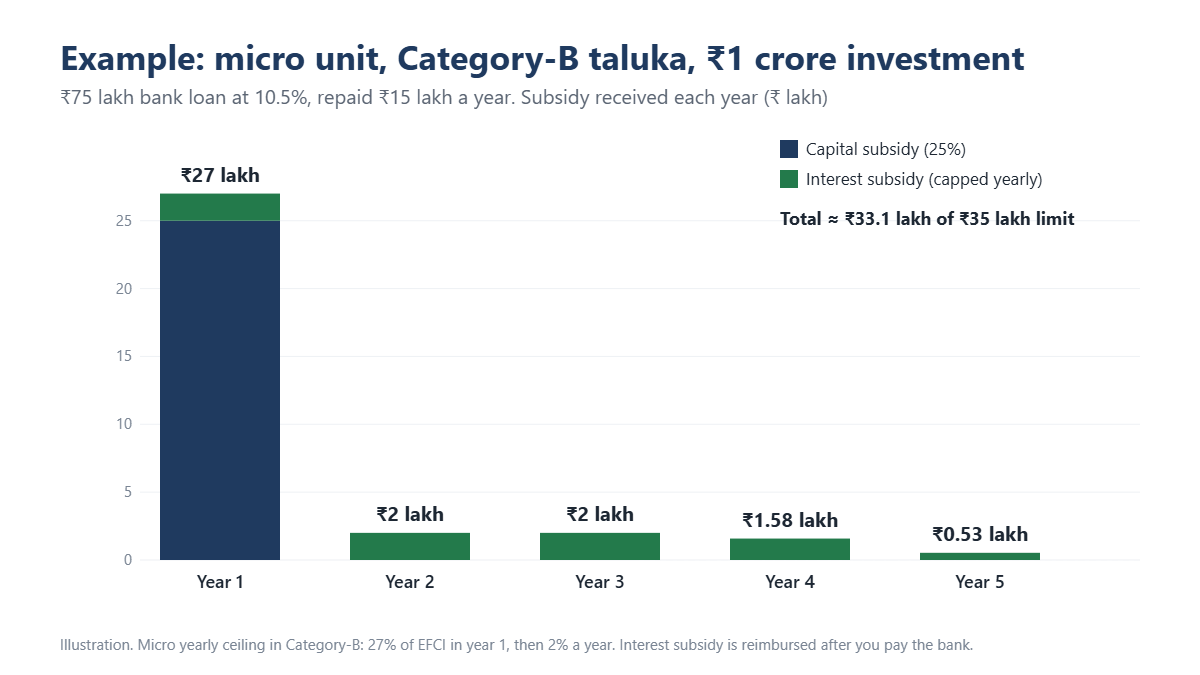
Say a micro unit invests ₹1 crore in building and machinery (its eligible investment) with a ₹75 lakh bank term loan at 10.5%, repaid at ₹15 lakh a year. It takes the 25% capital subsidy plus the interest subsidy:
| Year | 7% of average loan outstanding | Yearly room left after capital subsidy | Interest subsidy received |
|---|---|---|---|
| 1 | ₹4.73 lakh | ₹2 lakh (27% ceiling minus ₹25 lakh capital subsidy) | ₹2 lakh |
| 2 | ₹3.68 lakh | ₹2 lakh | ₹2 lakh |
| 3 | ₹2.63 lakh | ₹2 lakh | ₹2 lakh |
| 4 | ₹1.58 lakh | ₹2 lakh | ₹1.58 lakh |
| 5 | ₹0.53 lakh | ₹2 lakh | ₹0.53 lakh |
Total support: ₹25 lakh capital subsidy plus about ₹8.1 lakh interest subsidy, or about ₹33.1 lakh against the overall limit of ₹35 lakh. The yearly ceilings mean the interest subsidy is smaller than the headline 7% suggests in the early years. A unit in a Category-A taluka would have ₹2 lakh more room in year 1 and a 35% capital subsidy.
What counts as eligible investment under the Gujarat MSME scheme
- Counts: new building (on own land, a GIDC plot or land on a lease covering the incentive period), compound walls and internal roads, new plant and machinery including installation and electrification, pollution control and water treatment plants, captive power within the premises, and half the cost of facilities such as worker housing, a feeder road or a training centre.
- Does not count: land, working capital, second-hand machinery, rented or leased assets, interest capitalised during construction, goodwill, royalty, and preliminary and pre-operative expenses.
- Cost check: the subsidy is calculated on the lower of your actual investment and the cost certified by your bank (or a CA for self-financed projects) or verified by the DIC.
Other assistance under the Gujarat MSME scheme
| Assistance | Support |
|---|---|
| EPF for new employees | 100% of employer’s EPF share for 5 years, up to ₹1,800 a month per man, ₹2,500 per woman, ₹3,000 per specially-abled employee |
| Rent for micro and small units | 65% of rent (75% if fully women-owned), up to ₹3 lakh a year for 5 years |
| Quality certification | 50% of certification fees and testing equipment, up to ₹10 lakh |
| ZED certification | 50% of charges after central support, up to ₹50,000 |
| ERP software | 65%, up to ₹1 lakh |
| ICT and Industry 4.0 equipment | 65%, up to ₹5 lakh |
| Technology acquisition | 65%, up to ₹50 lakh |
| Patent registration | 75%, up to ₹25 lakh |
| Energy and water saving | 75% of audit cost up to ₹50,000; 25% of equipment up to ₹20 lakh |
| Listing on an SME exchange | 25% of expenses, up to ₹5 lakh |
| Power connection (outside GIDC and approved parks) | 35% of charges, up to ₹5 lakh |
| Electricity duty | Exemption under the Gujarat Electricity Duty Act, 1958 |
How to apply for the Gujarat MSME scheme
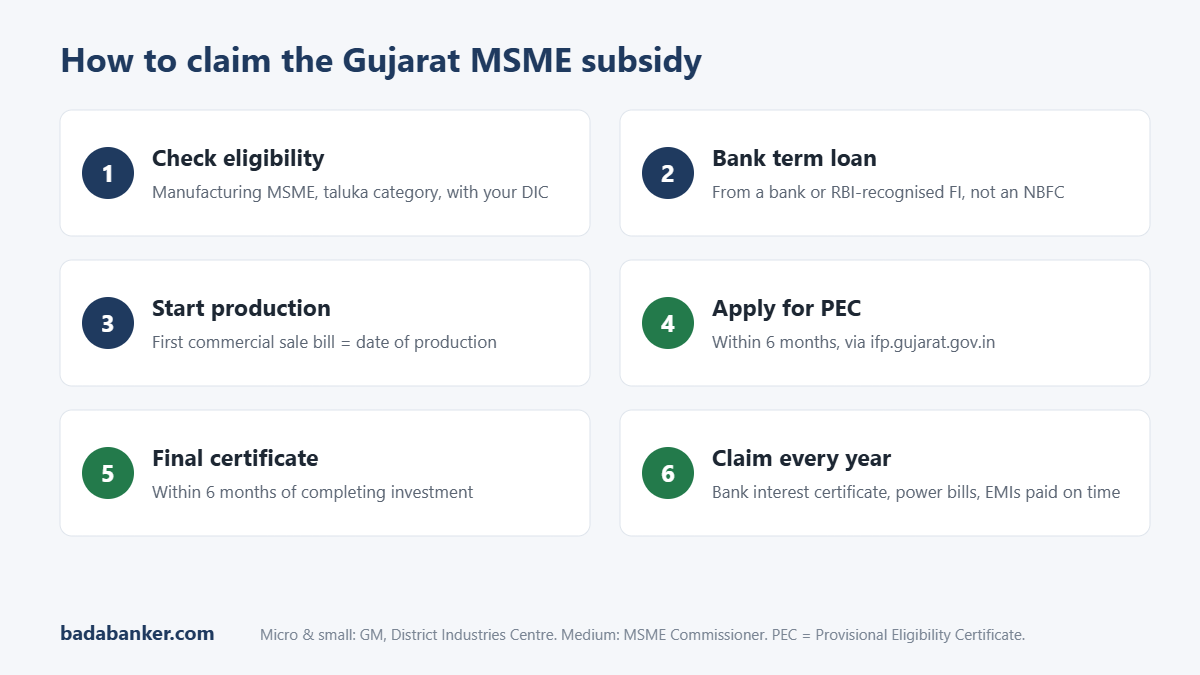
- Confirm your taluka category and eligibility with your District Industries Centre before you invest.
- Take the term loan from a bank or an RBI-recognised financial institution, not an NBFC, and keep the sanction letter and disbursement records.
- Start commercial production. The date of your first commercial sale bill is your date of commercial production.
- Apply for a Provisional Eligibility Certificate within six months of that date, or within six months of the GR (25 September 2026), whichever is later. Applications are made online through the state’s Investor Facilitation Portal (ifp.gujarat.gov.in), which the MSME Commissionerate links for incentive applications.
- Apply for the Final Eligibility Certificate once the investment is complete, within six months of completion.
- Claim the subsidies each year with bank certificates of interest paid, electricity bills for the power subsidy, and other documents the DIC asks for.
Micro and small units apply to the General Manager of the District Industries Centre; medium units apply to the MSME Commissioner. Late applications (between six months and two years) get a proportionately smaller incentive, and nothing is paid after two years.
If your unit started production between 1 June and 25 September 2026, the six months run from the GR date, so apply by late March 2027. Units that had not started production before 1 June 2026 may choose the older 2022 scheme instead, but must exercise that choice within six months of the GR, and the choice is final.
Mistakes that can cost you the Gujarat MSME scheme subsidy
- Financing through an NBFC: the interest subsidy will not apply.
- Missing EMIs: no subsidy for the period of default.
- Buying second-hand machinery: it is excluded from eligible investment.
- Missing the six-month deadlines: late claims are reduced, and claims after two years are rejected.
- Stopping production: the unit must stay in production through the incentive period. If any condition is broken, the state can recover the incentives with 18% interest a year.
- Double-dipping: you cannot claim another state scheme for the same investment, and central plus state incentives together cannot exceed your eligible investment.
Your bank will appraise the project on its own merits, so a strong project report and a comfortable debt service coverage ratio matter as much as the subsidy. Do not build the subsidy into your repayment plan, because it arrives only after you have paid the bank.
Frequently asked questions
What is the interest subsidy under the Gujarat MSME scheme 2026?
7% a year on the bank term loan for 5 years, up to 10% of the eligible fixed investment (20% for selected thrust sectors). Women entrepreneurs, registered manufacturing startups and first-generation entrepreneurs get an extra 1%. You must still pay at least 2% interest yourself.
Can service or trading businesses apply for the Gujarat MSME scheme?
No. The scheme covers enterprises engaged in manufacturing, production, processing or job work. The rent and CGTMSE assistance specifically exclude service and trading activities.
Does a loan from an NBFC qualify?
No. The GR says loans from NBFCs are not eligible. Term loans from banks, RBI-recognised financial institutions, government institutions such as GSFS, and external commercial borrowings qualify.
My unit started production in April 2026. Can I use the new scheme?
No. Units that began commercial production before 1 June 2026 can claim only under the earlier Aatmanirbhar Gujarat scheme for MSMEs (2022), subject to its conditions.
Is the Gujarat MSME scheme capital subsidy paid all at once?
For micro units, it is paid in the first year. For small and medium units, it is paid over five years, within the yearly ceiling of 9% (Category-A) or 7% (Category-B) of eligible investment.
Related reading
Sources
- Industries and Mines Department, Government of Gujarat, Viksit Gujarat Industrial Policy 2026 – Scheme for assistance to MSMEs, Resolution No. IMD/WRT/e-file/9/2026/2630/CH, 25 September 2026 (via the MSME Commissionerate)
- Government of Gujarat, Government of Gujarat announces Gujarat Industrial Policy 2026 (15 June 2026)
- MSME Commissionerate, Gujarat, Viksit Gujarat Industrial Policy 2026 documents
- Devdiscourse, New classification of 268 talukas in Gujarat
This is a summary of the government resolution for general information. The GR, any guidelines issued by the MSME Commissioner and your DIC’s assessment decide your actual eligibility and amount.
Thank you for explaining the Gujarat MSME scheme so clearly, especially the point that the 7% interest subsidy is a reimbursement rather than an upfront discount. The worked example for a micro unit really helped me understand how the yearly ceilings limit what is actually received each year. I also found the warning about NBFC loans not qualifying and the six-month deadlines very useful for anyone planning to apply.