
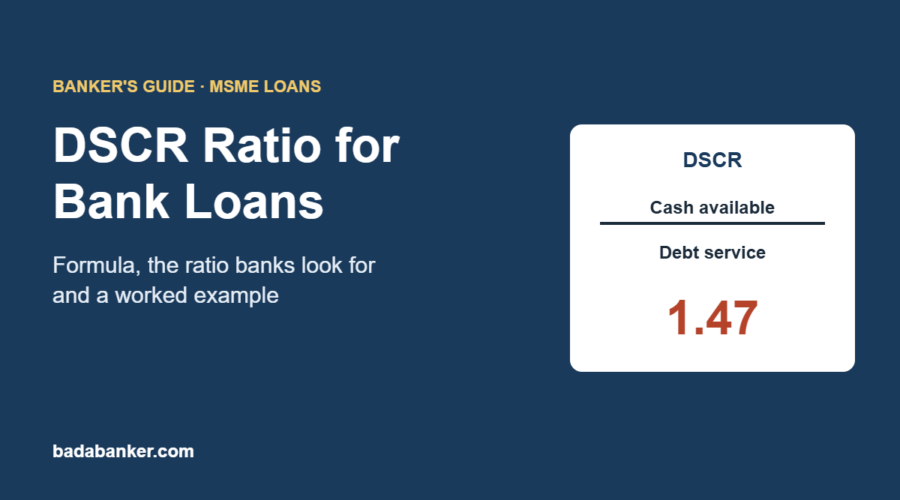
The DSCR ratio, or debt service coverage ratio, is the single number a bank looks at most closely before it sanctions a term loan. It answers one question: will your business earn enough cash each year to pay the loan’s instalments and interest, with something to spare? This guide explains the DSCR ratio formula banks in India use, what ratio they look for, how to calculate it year by year with a worked example, and how to improve it honestly.
What is DSCR? (DSCR full form in banking)
DSCR stands for debt service coverage ratio. “Debt service” means what you must pay on your loans in a year: the principal instalments plus the interest. “Coverage” means how many times your cash earnings cover that amount.
- DSCR of 1.0 means your cash earnings exactly equal your loan payments, with nothing left over.
- DSCR below 1.0 means you would not be able to pay the loan from the business’s earnings.
- DSCR above 1.0 means there is a cushion. The higher it is, the safer the loan looks to the bank.
DSCR ratio formula used by banks
For term loans to businesses, Indian banks usually calculate the DSCR ratio for each year of the loan like this:
DSCR = (Net profit after tax + Depreciation + Interest on term loan) ÷ (Interest on term loan + Term loan principal repaid in the year)
The top line is the cash available to service the loan. The bottom line is the debt service due that year.
A few points about this formula:
- Depreciation is added back because it is an accounting charge, not cash leaving the business.
- Term loan interest is added back on top and included below, because the ratio measures cash available before paying that interest against the full payment due.
- Interest on working capital limits stays as an expense. It is already deducted in arriving at net profit and is not part of the debt service in the denominator.
- For an EMI loan, interest plus principal for the year simply equals twelve EMIs.
Some banks add other non-cash expenses to the top line, or include all term debt of the business in the bottom line, not just the new loan. Ask your bank how it calculates the DSCR ratio, and make sure your project report follows the same method.
What is a good DSCR ratio for a bank loan?
The RBI does not set one DSCR ratio that every bank must use. Each bank sets its own threshold in its loan policy, and it can differ by loan type, amount and industry. In practice, banks usually look at two numbers:
- Average DSCR over the whole repayment period. Many banks are comfortable when this is around 1.5 or more.
- Minimum DSCR in any single year. Banks want to see that even the weakest year, often the first, stays comfortably above 1, commonly around 1.2 or more.
Treat these as typical comfort levels, not rules. A strong promoter, good security or a CGTMSE guarantee may make a bank accept a lower DSCR ratio, while a risky project may need a higher one.
DSCR ratio calculation: a worked example
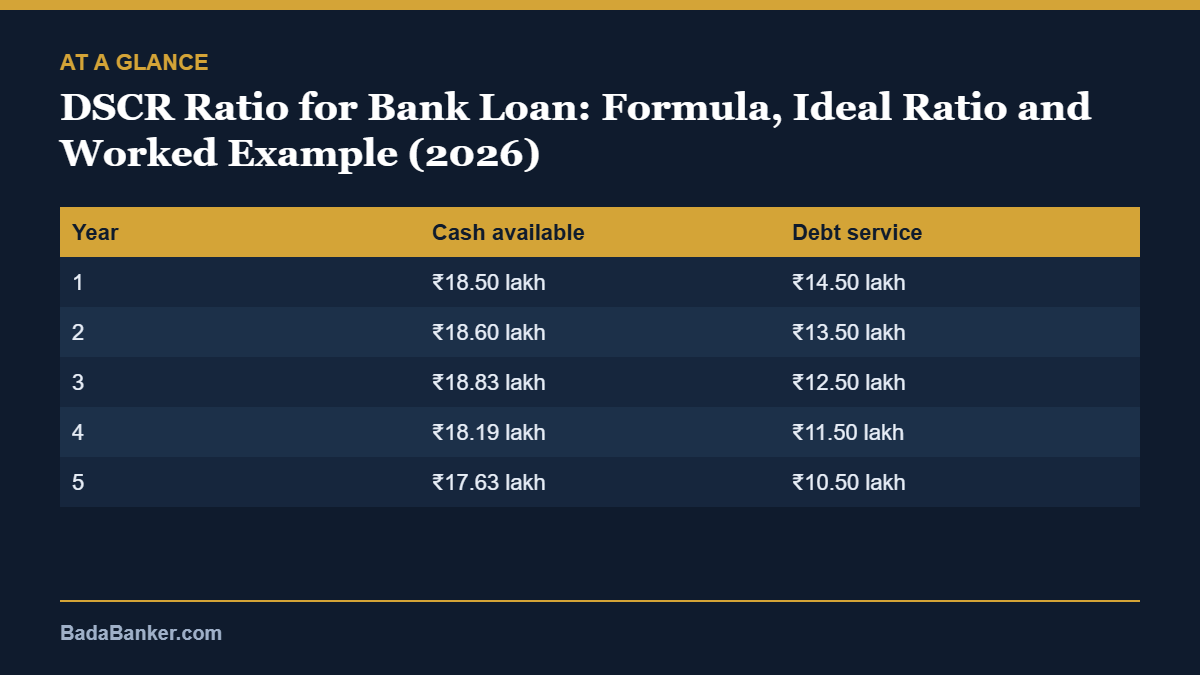
Take a manufacturer borrowing a ₹50 lakh term loan at 10% to buy machinery, repaid in equal principal instalments of ₹10 lakh a year over five years. The machinery costs ₹40 lakh and is depreciated at 15% a year on the written-down value. Projected net profit after tax rises from ₹8 lakh in year 1 to ₹14 lakh in year 5. For simplicity, interest is worked out on the average balance outstanding in each year.
| Year | Cash available | Debt service | DSCR |
|---|---|---|---|
| 1 | ₹18.50 lakh | ₹14.50 lakh | 1.28 |
| 2 | ₹18.60 lakh | ₹13.50 lakh | 1.38 |
| 3 | ₹18.83 lakh | ₹12.50 lakh | 1.51 |
| 4 | ₹18.19 lakh | ₹11.50 lakh | 1.58 |
| 5 | ₹17.63 lakh | ₹10.50 lakh | 1.68 |
In year 1, cash available is ₹8 lakh profit plus ₹6 lakh depreciation plus ₹4.5 lakh term loan interest, which is ₹18.5 lakh. Debt service is ₹4.5 lakh interest plus ₹10 lakh principal, which is ₹14.5 lakh. So DSCR is 18.5 ÷ 14.5 = 1.28.
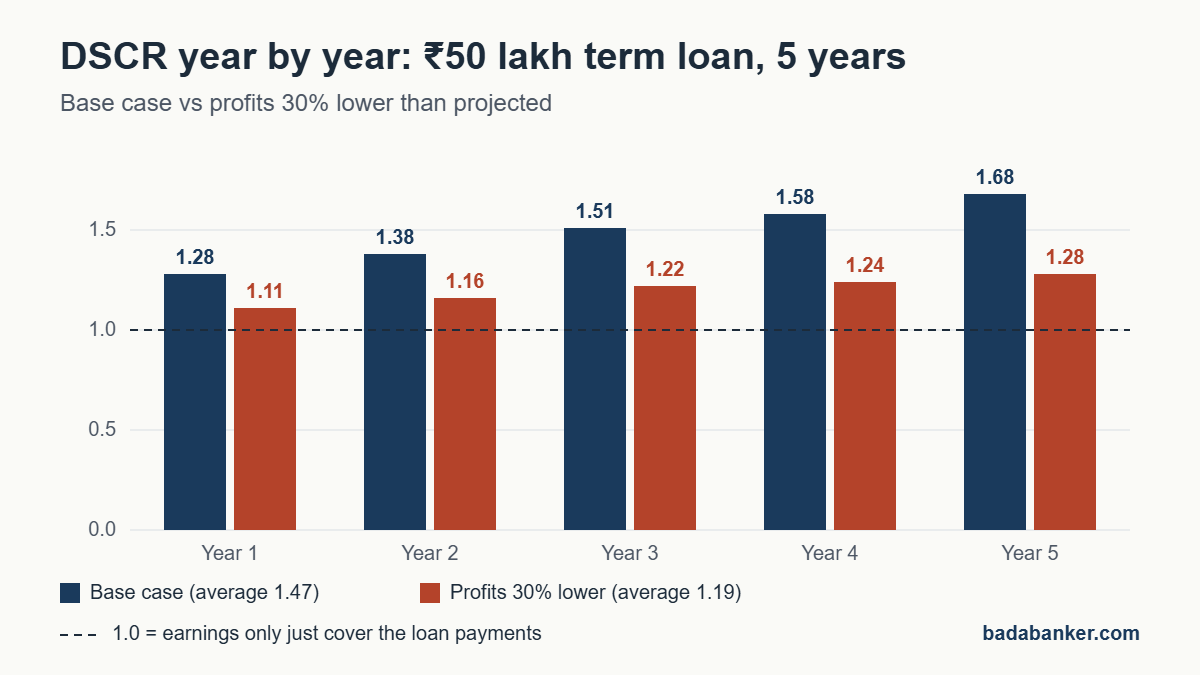
The average DSCR is total cash available divided by total debt service over the five years: 1.47. The minimum DSCR is 1.28, in year 1. Many banks would see this as acceptable but not generous, so they would look closely at how realistic the year 1 profit is.
What if profits come in lower?
Banks test what happens if the business does worse than planned. If net profit in every year is 30% lower than projected, the DSCR ratio falls to 1.11 in year 1 and averages only 1.19. That thin cushion is why banks question projections that look optimistic.
What if the loan is repaid over seven years instead?
Spreading the same ₹50 lakh over seven years cuts the yearly principal to about ₹7.14 lakh. Assuming profit stays at ₹14 lakh in years 6 and 7, the year 1 DSCR rises to 1.58 and the average to 1.92. A longer tenure costs more interest in total, but it can make a viable project fit the bank’s norms.
You can test your own numbers with the DSCR section of our MSME working capital and DSCR calculator.
How to improve your DSCR ratio honestly
- Ask for a suitable tenure. Match the repayment period to the life of the asset and the time the project needs to stabilise.
- Ask for a moratorium if the project needs time to start earning. The first instalment then falls in a year with income.
- Bring more of your own money. A smaller loan means a smaller debt service.
- Repay costly short-term debt first. Clearing expensive unsecured loans frees up cash.
- Base projections on evidence. Orders in hand, past sales and installed capacity make the bank trust your profit figures. Inflated projections usually backfire, because the bank will apply its own lower estimates.
DSCR, CMA data and the project report
DSCR is usually presented in your project report, calculated from the same projections as your CMA data. The bank checks that the profit, depreciation and loan figures in the DSCR table match your projected profit and loss account and repayment schedule. If they don’t match, the proposal comes back with queries. Read our guide to CMA data for bank loans to see how the projections fit together.
Need a project report with a bank-ready DSCR?
BadaBanker prepares project reports and CMA data for MSME term loans, with DSCR worked out year by year and checked the way a bank’s credit team will read it.
Email msmebanktool@gmail.com with your loan amount, purpose and business details. Please don’t send account numbers, passwords or OTPs.
Frequently asked questions
What is the full form of DSCR?
DSCR stands for debt service coverage ratio. It measures how many times a business’s cash earnings cover its loan principal and interest due in a year.
What is the ideal DSCR ratio?
There is no single ideal figure set by the RBI. Many banks look for an average DSCR of around 1.5 or more, with no year falling much below about 1.2, but each bank’s policy decides. Ask your bank for its norm before you finalise your projections.
What happens if DSCR is below 1?
It means the business is not projected to earn enough to pay the loan. A bank is unlikely to sanction the loan as proposed. Options include a smaller loan, a longer tenure, a moratorium or more of your own capital.
Is DSCR used for working capital limits?
DSCR is mainly used for term loans, which are repaid in instalments. Cash credit and overdraft limits are assessed mostly through working capital methods such as the turnover method or MPBF, along with ratios like the current ratio.
What is the difference between DSCR and interest coverage ratio?
The interest coverage ratio only checks whether earnings cover interest. DSCR is stricter, because it checks whether earnings cover both interest and principal repayments.
Related reading
This guide explains how banks commonly calculate and use DSCR. It is general information, not advice for your specific loan. Your bank’s own policy and appraisal decide what DSCR it accepts.