

A PMEGP loan is a bank loan for a new micro enterprise that comes with a government subsidy of 15% to 35% of the project cost, under the Prime Minister’s Employment Generation Programme. The PMEGP loan covers projects of up to ₹50 lakh in manufacturing and ₹20 lakh in services, and the scheme is still disbursing subsidies in 2026-27. This guide explains who qualifies, how much subsidy you get, how the subsidy actually works on your loan, and how to apply.
Based on the Ministry of MSME’s releases and the scheme terms published by lending banks. Checked 18 October 2026.
PMEGP loan at a glance
- What it is: a credit-linked subsidy scheme of the Ministry of MSME, run by the Khadi and Village Industries Commission (KVIC) with state KVI boards and District Industries Centres.
- Project size: up to ₹50 lakh for manufacturing and ₹20 lakh for business or service units. Land is not counted in the project cost.
- Subsidy (called margin money): 15% to 35% of the project cost, depending on your category and whether the unit is in a rural or urban area.
- Your contribution: 10% of the project cost for the general category, 5% for special categories. The bank lends the rest.
- Only for new units. Existing businesses can get a second PMEGP loan only to upgrade a unit already financed under PMEGP, REGP or Mudra.
Is the PMEGP scheme still running in 2026?
Yes. The Ministry of MSME’s performance dashboard shows margin money subsidy of ₹504.68 crore disbursed to 22,259 units in 2026-27, with data up to 31 August 2026. The scheme’s last formal approval covered 2021-22 to 2025-26, so watch for any change in terms for the new period, but applications are being processed. Since inception in 2008-09, more than 10.71 lakh micro enterprises have been assisted, according to the Ministry’s year-end review of December 2025.
PMEGP loan subsidy rates
| Category | Your contribution | Subsidy, urban | Subsidy, rural |
|---|---|---|---|
| General | 10% | 15% | 25% |
| Special: SC, ST, OBC, minorities, women, ex-servicemen, persons with disabilities, transgender persons, North-East, hill and border areas, aspirational districts | 5% | 25% | 35% |
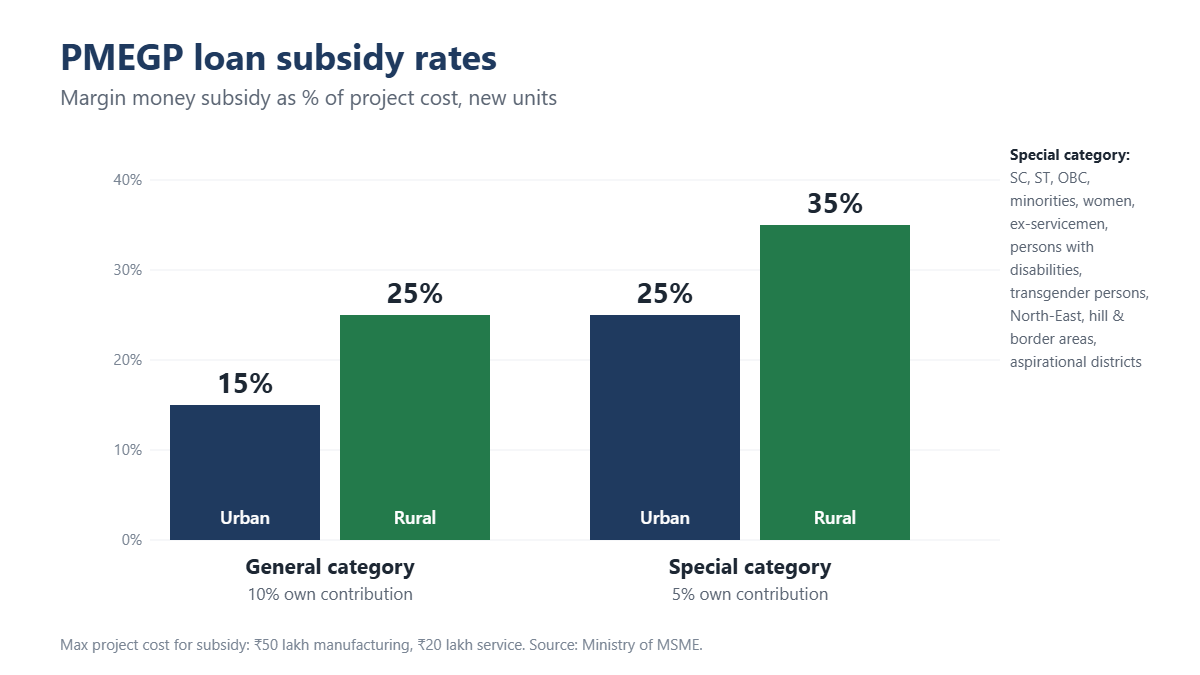
If your project costs more than ₹50 lakh (manufacturing) or ₹20 lakh (service), the bank can lend the extra amount, but no subsidy is paid on it.
Who is eligible for a PMEGP loan
- Any individual aged 18 or above. There is no income ceiling.
- At least an 8th-standard pass for projects above ₹10 lakh in manufacturing or above ₹5 lakh in business or service.
- Only one person per family (self and spouse) can take a PMEGP loan.
- Self-help groups, charitable trusts, societies and production co-operative societies can also apply, subject to the scheme’s conditions.
- Not eligible: existing units, units that have already taken a subsidy under another central or state government scheme, and projects with no capital expenditure.
- Animal husbandry activities such as dairy, poultry, aquaculture, beekeeping and sericulture are allowed. Some activities are on the scheme’s negative list, so check your activity before you prepare the project.
How the subsidy works on your PMEGP loan
This is the part most borrowers misunderstand. The subsidy does not come to you in cash, and it does not reduce your loan on day one.
- After the bank releases the first loan instalment, it claims the margin money from the implementing agency.
- The bank keeps the subsidy in a term deposit in your name for three years. You earn no interest on this deposit.
- In return, the bank charges no interest on an equal part of your loan for those three years.
- After three years from the first disbursement, the deposit is credited to your loan account, reducing what you owe, provided the unit is running.
- The subsidy is worked out on actual capital spending. If you spend less than the project report said, the excess goes back to the agency.
Worked example: a ₹25 lakh manufacturing project
| Woman entrepreneur, rural (special category) | General category, urban | |
|---|---|---|
| Project cost | ₹25 lakh | ₹25 lakh |
| Your contribution | ₹1.25 lakh (5%) | ₹2.5 lakh (10%) |
| Bank loan | ₹23.75 lakh | ₹22.5 lakh |
| Subsidy held as 3-year deposit | ₹8.75 lakh (35%) | ₹3.75 lakh (15%) |
| Loan on which you pay interest in the first 3 years | ₹15 lakh | ₹18.75 lakh |
| Interest you avoid over 3 years at 10% | About ₹2.6 lakh | About ₹1.1 lakh |
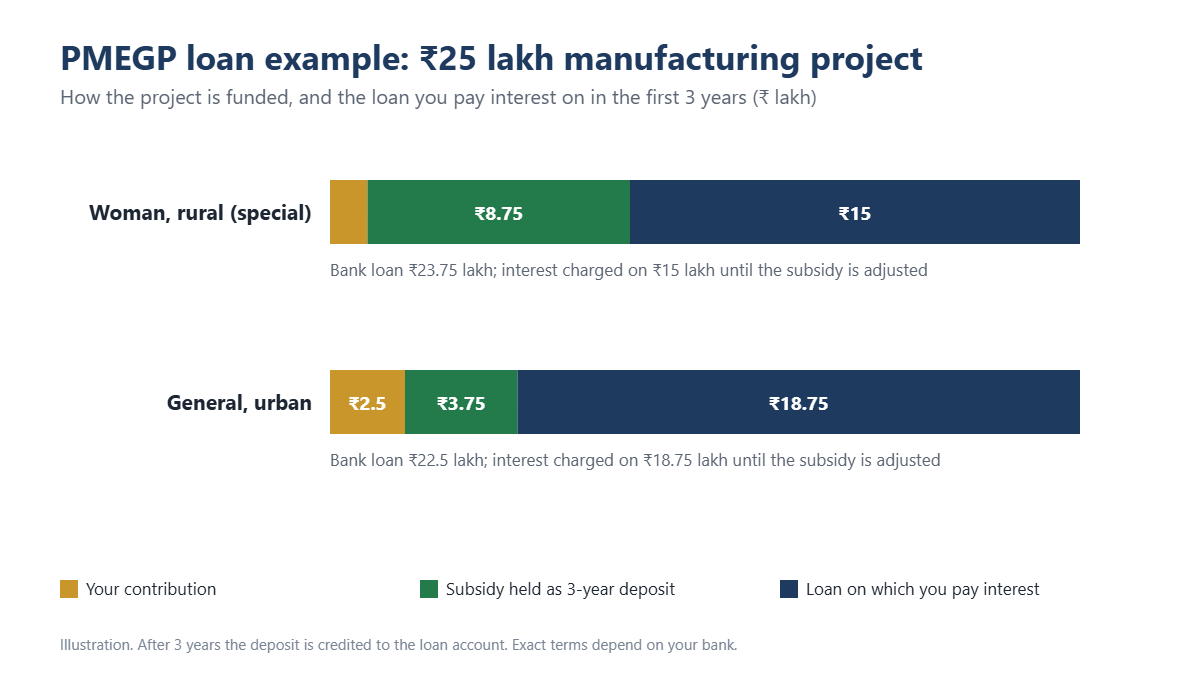
For the woman entrepreneur, the subsidy is worth ₹8.75 lakh off the loan after three years, plus about ₹2.6 lakh of interest she never pays. That is why PMEGP is one of the most valuable schemes for a first-time manufacturer, as long as the unit keeps running.
Loan terms: repayment, interest and collateral
- Repayment: 3 to 7 years after an initial moratorium, as fixed by your bank.
- Interest: the bank’s normal MSME lending rate, usually linked to its repo-linked lending rate. There is no interest concession beyond the zero-interest portion described above.
- Collateral: under RBI rules, banks must not ask for collateral on loans to micro and small enterprises of up to ₹10 lakh. Larger PMEGP loans are commonly covered by a credit guarantee from CGTMSE instead of collateral; ask your bank.
- Working capital: the project cost can include working capital for one cycle of operations, as assessed by the bank, in addition to capital expenditure.
Entrepreneurship training (EDP)
Before the loan is fully released, you must complete an Entrepreneurship Development Programme (EDP) run by the implementing agency. Training is not mandatory for projects up to ₹2 lakh, and a shorter course of up to five days applies for projects up to ₹5 lakh. Larger projects need the full course. Complete it early, because banks generally release the loan only after the training certificate is uploaded.
How to apply for a PMEGP loan online
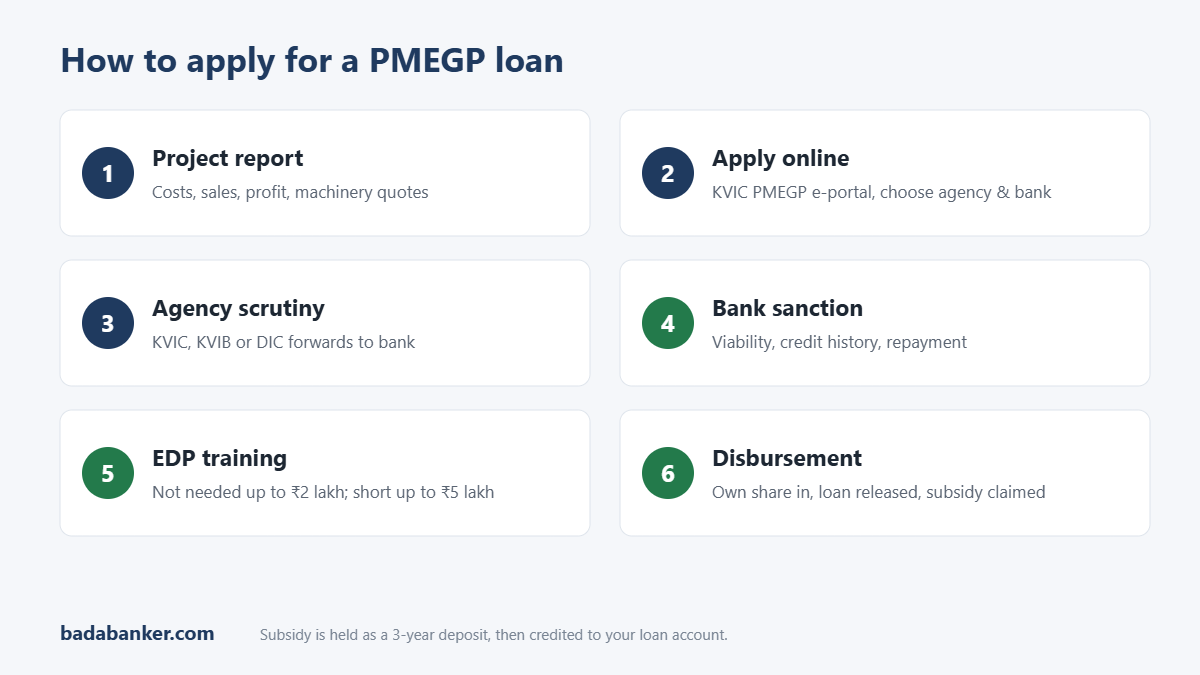
- Prepare a project report with the cost of machinery, building, working capital, expected sales and profit. Our guide to project reports for bank loans shows the format banks expect.
- Apply online on the PMEGP e-portal run by KVIC (kviconline.gov.in/pmegpeportal). Choose KVIC, the state KVI board or the District Industries Centre as your agency, and your preferred bank branch. Since June 2025, the form is also available in 19 regional languages.
- The agency scrutinises your application and forwards it to the bank.
- The bank appraises and sanctions the loan. It checks the project’s viability, your credit history and repayment capacity.
- Complete the EDP training if your project needs it.
- Bring in your own contribution and receive the first loan instalment. The bank then claims the margin money subsidy.
- Start the unit and keep it running. The subsidy is adjusted against the loan after three years.
Keep these ready: Aadhaar and PAN, caste or special-category certificate if applicable, education certificate (for larger projects), rural-area certificate if applicable, the project report, quotations for machinery, and the rent agreement or ownership papers for the premises.
Second PMEGP loan for upgrading a unit
Units already set up under PMEGP, REGP or Mudra that are performing well (turnover, profit and loan repayment) can take a second loan to upgrade or expand:
- Maximum project cost: ₹1 crore for manufacturing and ₹25 lakh for service.
- Subsidy: 15% of project cost for all categories (20% in the North-East and hill states), so up to ₹15 lakh for manufacturing and ₹3.75 lakh for service.
- Your contribution: 10%.
Why PMEGP loan applications get rejected
- Weak project report: unrealistic sales, missing machinery quotations, or a project that cannot repay the loan from its own cash flow.
- Poor credit history: recent defaults or a low credit score. Check your report first; our guide to the CIBIL score banks check for business loans explains what matters.
- Ineligible applicant or unit: an existing business, a second family member, or an activity on the negative list.
- Earlier government subsidy: units that have already taken a subsidy under another government scheme are not eligible, so check with your District Industries Centre before combining PMEGP with state schemes such as the Gujarat MSME scheme.
- Incomplete documents or a project location the bank cannot service.
Frequently asked questions
What is the maximum PMEGP loan amount?
The subsidy applies to projects of up to ₹50 lakh in manufacturing and ₹20 lakh in business or service. The bank lends 90% to 95% of that, and can lend more without subsidy if the project costs more.
How much PMEGP subsidy will I get?
15% (urban) or 25% (rural) for the general category, and 25% (urban) or 35% (rural) for special categories such as women, SC, ST, OBC and minorities. On a ₹50 lakh rural manufacturing project, a special-category applicant gets up to ₹17.5 lakh.
Is a PMEGP loan available for an existing business?
Not for the first loan, which is only for new units. An existing unit set up under PMEGP, REGP or Mudra can apply for a second loan to upgrade, with a 15% subsidy.
Do I get the PMEGP subsidy in my bank account?
No. It is held by the bank as a three-year deposit in your name and then credited to your loan account. You pay no interest on that part of the loan in the meantime.
Is collateral needed for a PMEGP loan?
Not for micro and small enterprise loans of up to ₹10 lakh, under RBI rules. For larger loans, banks commonly use a CGTMSE guarantee; your bank decides.
Related reading
Sources
- Ministry of MSME, Year End Review 2025 (30 December 2025)
- Ministry of MSME, Performance of KVIC: PMEGP subsidy rates and eligibility (1 August 2024)
- Ministry of MSME, PMEGP margin money subsidy disbursed, performance dashboard
- Bank of Maharashtra, PMEGP scheme terms
- KVIC, PMEGP e-portal
Scheme terms can change. The implementing agency and your bank decide eligibility, the loan and the subsidy. This is general information, not advice on a specific project.
The explanation of how margin money actually works — parked as a three-year deposit in the borrower’s name rather than landing in the bank account — is the most honest breakdown of PMEGP I have come across online. The Rs. 25 lakh worked example comparing the woman entrepreneur’s Rs. 8.75 lakh subsidy with the general category’s Rs. 3.75 lakh makes the rural and special-category math crystal clear. The confirmation that the scheme is still disbursing in 2026-27, with Rs. 504.68 crore released so far, is genuinely reassuring for applicants.