

Cash credit vs overdraft is the most common choice a business faces when it asks a bank for working capital. Both let you withdraw money as needed up to a limit and pay interest only on what you use, but a cash credit is secured by your stock and receivables and tied to your business cycle, while an overdraft is usually secured by a fixed deposit, property or your account history. This guide explains the cash credit vs overdraft differences, how interest and drawing power work, the RBI rules that can turn either account into an NPA, and which one suits your business.
Cash credit vs overdraft: the short answer
- Cash credit (CC) is a working capital limit for traders and manufacturers, secured by hypothecation of stock and book debts. How much you can draw (your drawing power) moves with the stock and receivables you report every month.
- Overdraft (OD) lets you withdraw more than your account balance up to a fixed limit, usually against a fixed deposit, property, salary or a strong account history. The limit does not depend on stock.
- In both, interest is charged only on the amount you use, calculated on the daily balance.
- Choose cash credit if your business holds inventory and sells on credit. Choose an overdraft for short, irregular cash gaps, or if you have a fixed deposit or property to offer.
Cash credit vs overdraft: key differences
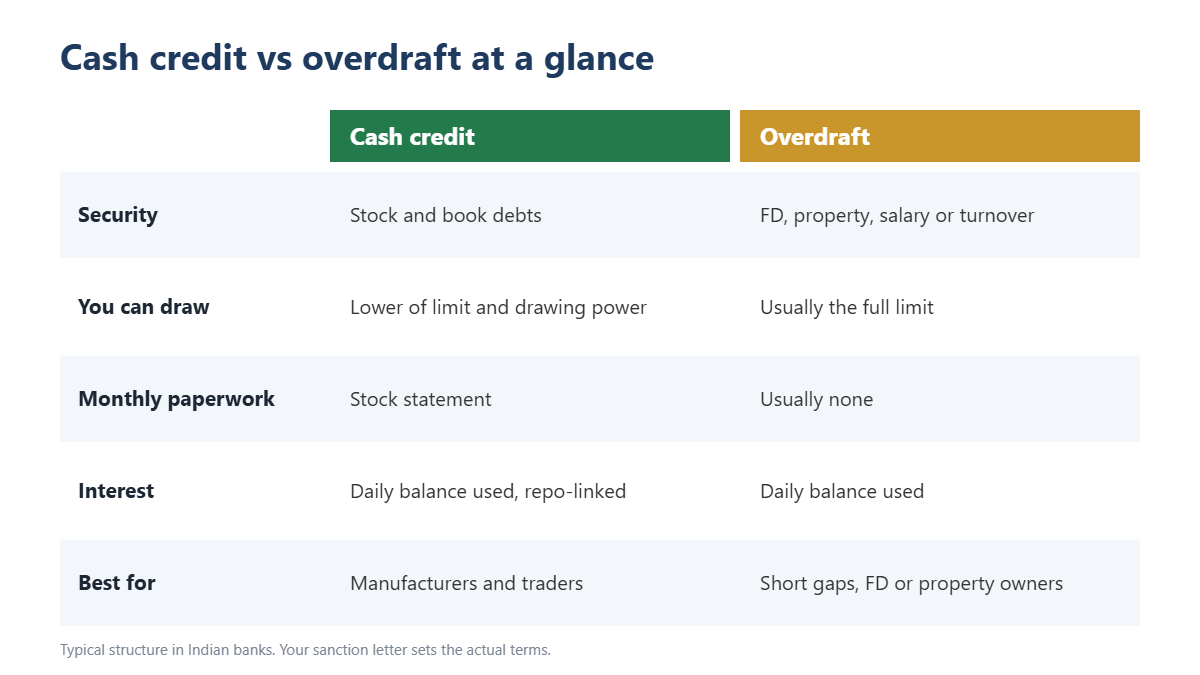
The table below sets out cash credit vs overdraft side by side, as Indian banks usually structure them.
| Feature | Cash credit | Overdraft |
|---|---|---|
| Who uses it | Manufacturers and traders with stock and debtors | Businesses, professionals and individuals |
| Security | Hypothecation of stock and book debts, often with collateral | Fixed deposit, property, shares, salary, or account turnover |
| How the limit is set | Working capital assessment: turnover method, CMA data or cash budget | A share of the security value, or the bank’s view of your income |
| What you can draw | The lower of the limit and your drawing power | Usually the full sanctioned limit |
| Monthly paperwork | Stock and book-debt statement every month | Usually none |
| Interest | On daily balance used; repo-linked for MSEs | On daily balance used; FD-linked rate for an OD against FD |
| Tenure | 12 months, renewed after an annual review | 12 months renewable, or the FD’s term |
| Typical size | Larger, sized to the business cycle | Smaller, sized to the security |
How a cash credit limit works
A cash credit limit is the bank’s main way of financing a business’s working capital cycle: buying raw material or goods, holding stock, and waiting for customers to pay. The bank first sets a limit based on your working capital need, and then lets you draw only up to your drawing power, which is worked out every month from the stock and receivables you report.
How banks set the limit
For micro and small enterprises needing fund-based working capital of up to ₹5 crore, RBI guidelines ask banks to assess the need at 25% of projected annual turnover. The borrower brings 5% of turnover as margin, and the bank finances at least 20%. On a projected turnover of ₹60 lakh, the working capital need is ₹15 lakh, of which the bank lends ₹12 lakh. Larger limits are assessed using CMA data and methods such as the maximum permissible bank finance. Our MSME working capital calculator runs both methods, and our guide to CMA data explains the projections banks ask for.
Drawing power: what you can actually withdraw
Each month you submit a stock statement listing stock, debtors and creditors. The bank deducts a margin from each and arrives at your drawing power. Here is a typical example, with margins of 25% on paid stock and 40% on debtors under 90 days:
| Item | Amount | Margin | Counts towards drawing power |
|---|---|---|---|
| Stock | ₹30 lakh | ||
| Less: unpaid creditors | ₹10 lakh | ||
| Paid stock | ₹20 lakh | 25% | ₹15 lakh |
| Debtors under 90 days | ₹20 lakh | 40% | ₹12 lakh |
| Drawing power | ₹27 lakh |
If the sanctioned limit is ₹25 lakh, you can draw up to ₹25 lakh, the lower of the two. If stock falls next month and drawing power drops to ₹18 lakh, any balance above ₹18 lakh becomes an irregularity you must bring down. Our stock statement and drawing power guide shows the format in detail.
How an overdraft works
An overdraft is simpler. The bank sanctions a limit on your current or savings account, and you can go below zero up to that limit. The common types are:
- Overdraft against a fixed deposit: the bank lends a share of your FD, often up to 90% depending on the bank, usually at a rate a little above the FD rate. Your FD keeps earning interest. This is the cheapest and quickest overdraft to get.
- Overdraft against property: a larger limit secured by a mortgage, used by businesses that don’t hold much stock, such as service firms.
- Business overdraft based on account turnover: some banks offer limits based on the credits flowing through your current account and your GST returns.
- Salary or personal overdraft: a small limit for individuals, based on salary.
Cash credit vs overdraft interest: how both are charged
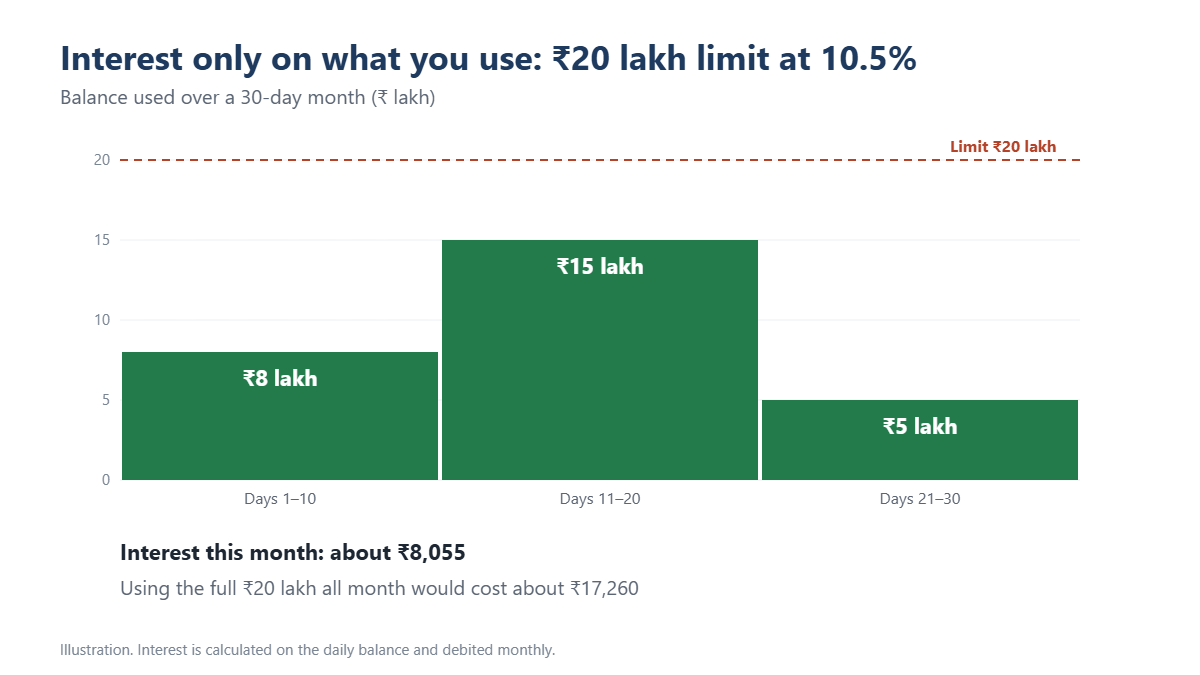
In both facilities, interest is calculated on the balance outstanding at the end of each day and debited to the account every month. You pay nothing on the unused part of the limit, unless your bank charges a commitment fee on large unused limits. Floating-rate loans to micro and small enterprises, including cash credit, are linked to an external benchmark such as the repo rate, so the October 2026 repo hike will raise these rates at the next reset.
For example, with a ₹20 lakh limit at 10.5%, if you use ₹8 lakh for 10 days, ₹15 lakh for 10 days and ₹5 lakh for 10 days in a month, the interest is about ₹8,055. Using the full ₹20 lakh all month would cost about ₹17,260.
RBI rules that can turn a CC or OD account into an NPA
A cash credit or overdraft account has no fixed EMI, so RBI uses a different test. The account is treated as out of order, and becomes an NPA, when:
- the balance stays above the sanctioned limit or drawing power continuously for 90 days; or
- the balance is within the limit, but there are no credits into the account continuously for 90 days; or
- the credits over the previous 90 days are not enough to cover the interest debited in that period.
An account is also treated as an NPA if the limit is not reviewed or renewed within 90 days of its due date. Late or missing stock statements cause a related problem: the bank cannot calculate a current drawing power, and the account can quickly become irregular. The practical rules are simple: route your sales receipts through the CC account, keep the balance within drawing power, submit stock statements on time, and give the bank your financials well before the renewal date.
Cash credit vs overdraft: which is better for your business?
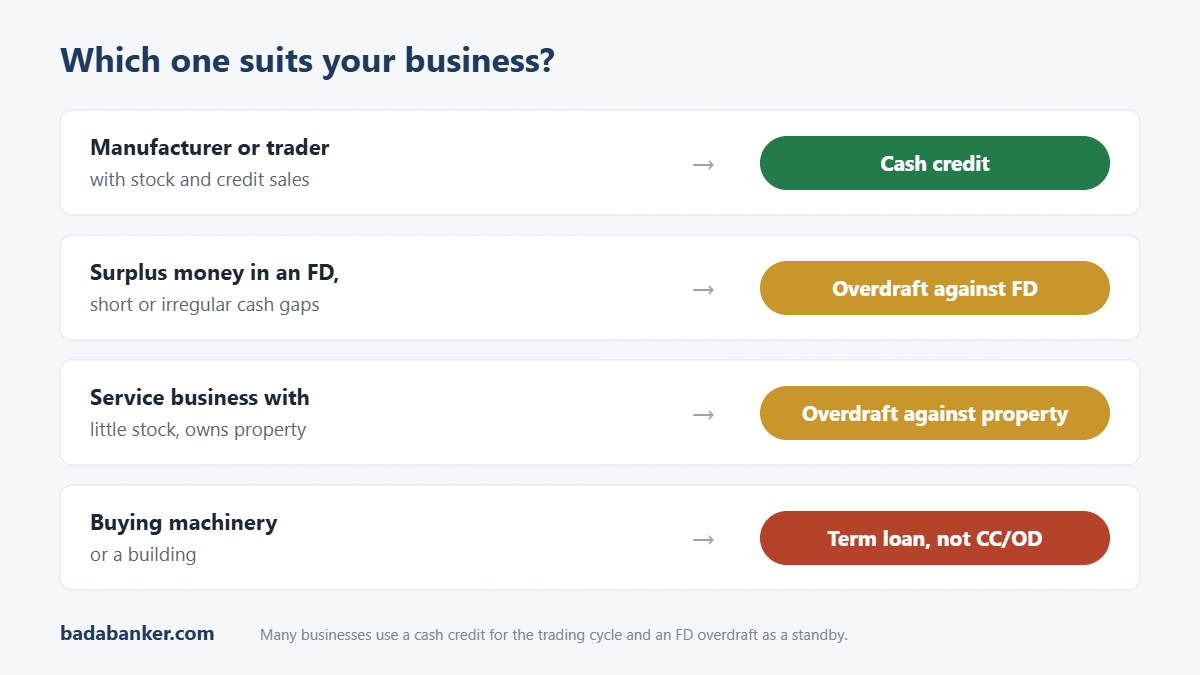
- Choose cash credit if you are a manufacturer or trader whose money is locked in stock and debtors. The limit grows with your business, and it is the standard way banks finance working capital.
- Choose an overdraft against FD if you have surplus money in a fixed deposit and need short-term funds. It is fast, needs little paperwork and is usually cheaper than an unsecured loan.
- Choose an overdraft against property if you run a service business with little stock but own property.
- Avoid using either for long-term assets. Machinery and buildings should be financed with a term loan; using a CC or OD for them blocks your working capital and can push the account out of order.
Many businesses use both: a cash credit for the regular trading cycle and an overdraft against FD as a standby for occasional peaks. Banks also look at your CIBIL score for business loans for either facility.
Documents banks ask for: cash credit vs overdraft
- For cash credit: KYC of the business and promoters, Udyam registration, GST returns, two to three years of financial statements, projections or CMA data for larger limits, bank statements, details of stock and debtors, and collateral documents if required.
- For an overdraft against FD: KYC and the FD receipt; the FD is marked as a lien in the bank’s favour.
- For an overdraft against property: KYC, income documents, and title and valuation papers for the property.
Frequently asked questions
What is the main difference between cash credit and overdraft?
Cash credit is secured by stock and receivables, and what you can draw depends on your monthly drawing power. An overdraft is secured by an FD, property or your account history, and you can usually draw the full limit without monthly stock statements.
Cash credit vs overdraft: which has a lower interest rate?
An overdraft against an FD is usually the cheapest, priced a little above the FD rate. Cash credit for MSEs is priced on the bank’s repo-linked lending rate plus a spread that depends on your rating. Unsecured overdrafts are usually the costliest.
Is interest charged on the full cash credit limit?
No. Interest is charged only on the daily balance you actually use. Some banks charge a small commitment fee on large unused limits, which your sanction letter will mention.
When does a cash credit account become an NPA?
When it is out of order: the balance stays above the limit or drawing power for 90 days, there are no credits for 90 days, or credits over 90 days do not cover the interest charged. It also becomes an NPA if the limit is not renewed within 90 days of the due date.
Can a service business get a cash credit limit?
Sometimes, if it has receivables a bank can take as security. More often, service businesses with little stock are given an overdraft against property or FD, or a limit secured by book debts alone.
Related reading
Sources
- RBI, Master Circular – Prudential norms on income recognition, asset classification and provisioning pertaining to advances (1 April 2025)
- RBI, Master Direction on lending to the MSME sector: FAQs
- RBI, FAQs on Micro, Small and Medium Enterprises (July 2025)
Banks set their own margins, rates and documentation within RBI rules. Your sanction letter is the final word on your facility. This is general information, not advice on a specific loan.