
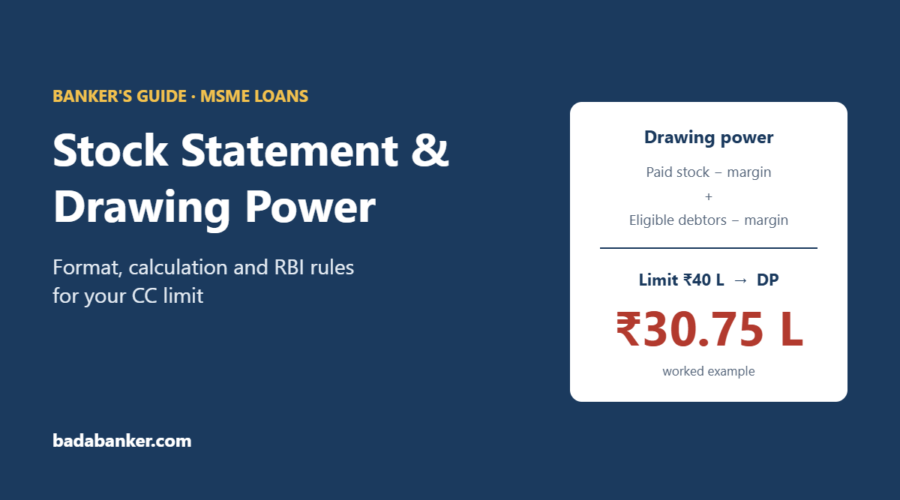
If your business has a cash credit (CC) limit, the bank asks for a stock statement every month. It isn’t paperwork for its own sake. The figures in it decide your drawing power, the amount you can actually draw from the limit. A late or wrong statement can freeze your account, and in the worst case push it into NPA. This guide explains the stock statement format for a bank, how banks calculate drawing power, with a worked example, what RBI rules say, and the mistakes that cause trouble.
Stock statement and drawing power: the key points
- Sanctioned limit is not the same as drawing power. The sanction letter sets the maximum. Drawing power, worked out from your latest stock statement, sets how much of it you can use at a time. You can draw the lower of the two.
- Drawing power = paid stock less margin + eligible debtors less margin. “Paid stock” means stock minus what you still owe suppliers for it.
- RBI rule: drawing power must be based on a current stock statement. If it’s based on a statement older than three months, the outstanding is treated as irregular.
- NPA risk: a CC account that stays irregular or above drawing power for 90 days in a row becomes a non-performing asset.
- Margins are set by your bank, commonly 25% on stock and 25–40% on debtors. Your sanction letter is the rule that applies to you.
What is a stock statement?
A stock statement is a monthly declaration by the borrower of the value of stock and receivables (book debts) that are hypothecated to the bank as security for the CC limit. It also shows what you owe suppliers for goods, and usually your purchases and sales for the month. The bank uses it to calculate drawing power and to keep track of the security behind the loan.
Most banks want it by a fixed date each month, often in the first two to three weeks for the previous month-end, in their own format, signed by the proprietor, partner or director. Some banks have relaxed formats or quarterly statements for small limits. Check the due date and format in your sanction letter.
Stock statement format for a bank
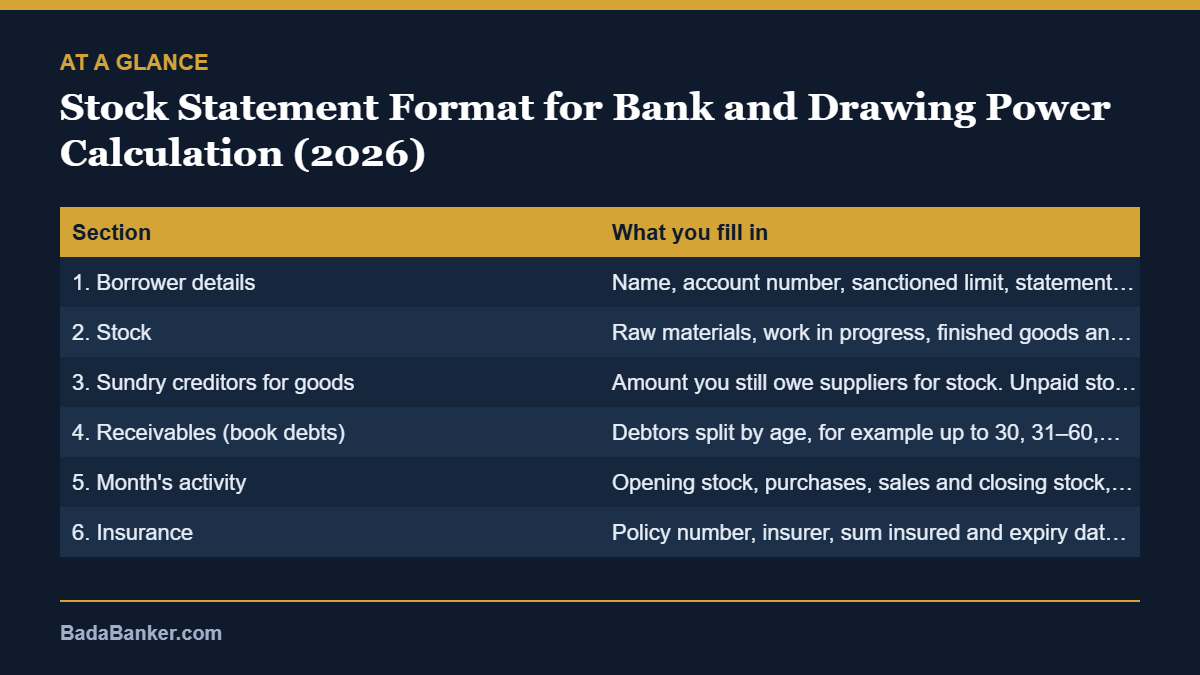
Each bank has its own form, but almost all of them ask for the same blocks of information:
| Section | What you fill in |
|---|---|
| 1. Borrower details | Name, account number, sanctioned limit, statement date (the month-end it relates to) |
| 2. Stock | Raw materials, work in progress, finished goods and, where allowed, stores and spares, each with quantity and value. Usually valued at cost or market price, whichever is lower |
| 3. Sundry creditors for goods | Amount you still owe suppliers for stock. Unpaid stock isn’t financed again by the bank |
| 4. Receivables (book debts) | Debtors split by age, for example up to 30, 31–60, 61–90 and over 90 days |
| 5. Month’s activity | Opening stock, purchases, sales and closing stock, so the bank can check the figures make sense |
| 6. Insurance | Policy number, insurer, sum insured and expiry date for the stock |
| 7. Declaration | That the stock is owned by you, fully paid except as shown, free of other charges, insured, and kept at the declared premises |
Your bank’s form will also show the margins from your sanction letter, and the bank calculates drawing power from your figures.
How drawing power is calculated
Drawing power = (Eligible stock − Sundry creditors for goods) × (1 − stock margin) + Eligible receivables × (1 − receivables margin)
You can draw the lower of the drawing power and the sanctioned limit.
Banks usually leave these items out of the calculation, as set out in their credit policy and your sanction terms:
- Obsolete, slow-moving or damaged stock, and stock not covered by insurance.
- Stock not at the declared premises, such as goods sent out on consignment, unless the sanction allows it.
- Old receivables, commonly those over 90 days, though a longer period may be allowed if it’s written into the sanction for your industry.
- Receivables from related concerns, such as sister firms or group companies.
- Bills already discounted or invoices already financed elsewhere, for example on TReDS, so the same receivable isn’t financed twice.
Worked example: drawing power for a trading business
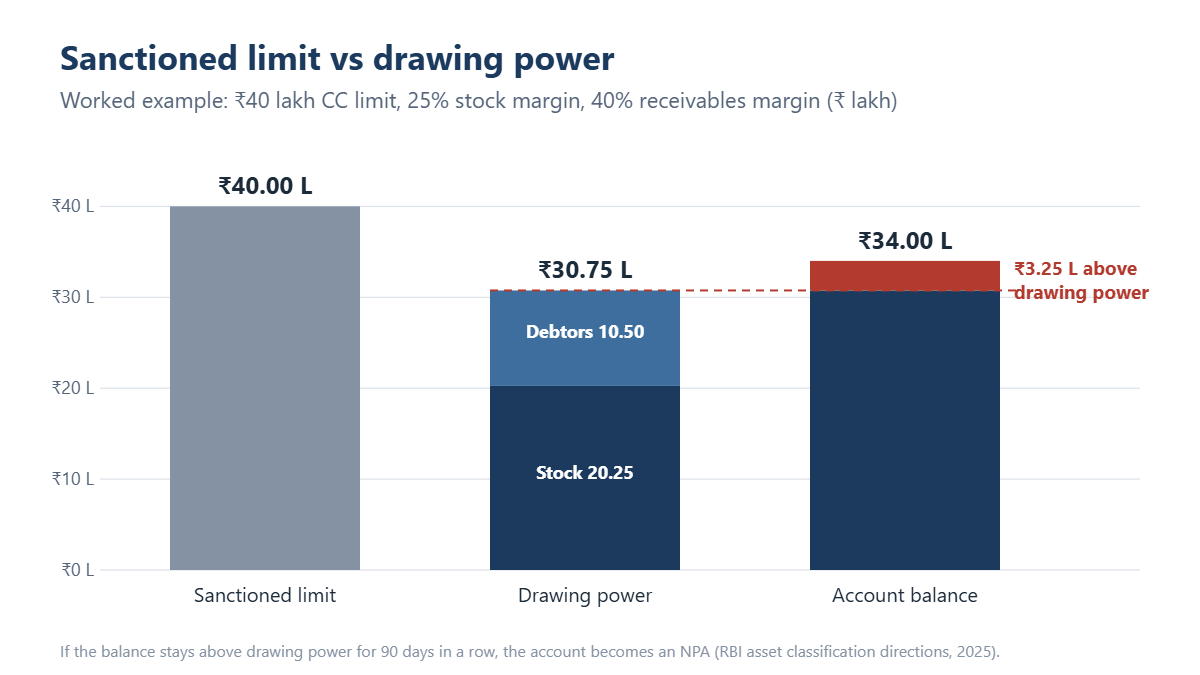
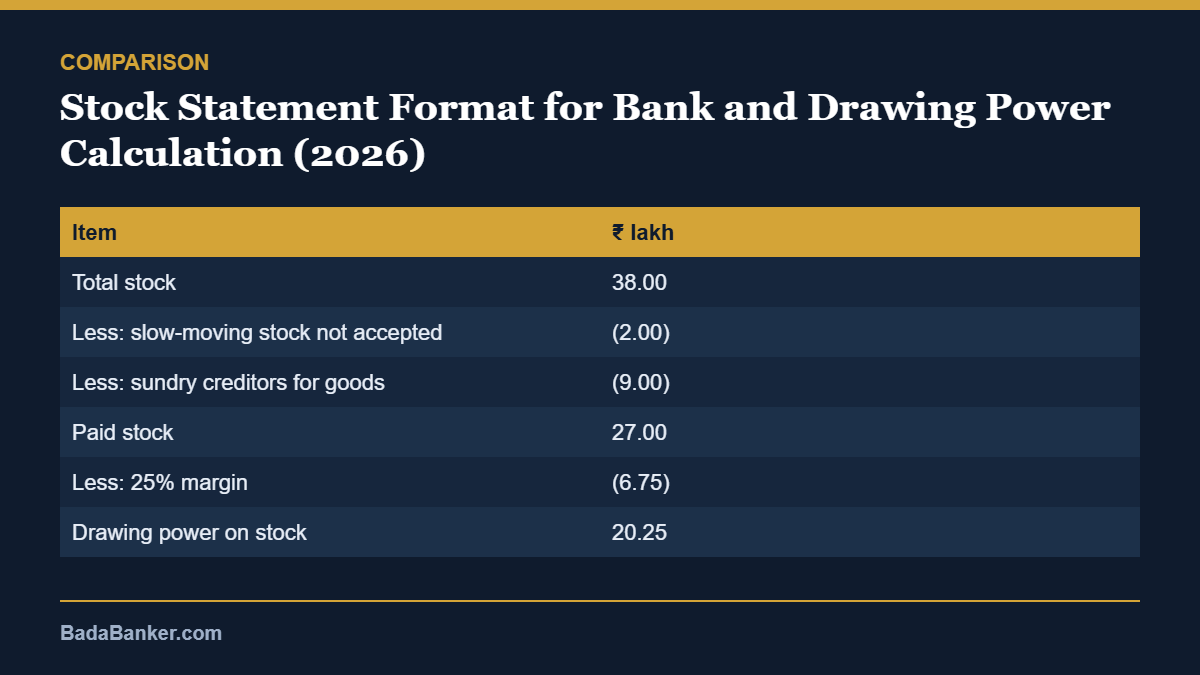
Take a distributor with a ₹40 lakh cash credit limit. The sanction letter sets a 25% margin on stock and 40% on receivables, and counts receivables up to 90 days. The stock statement for 30 September shows these figures (₹ lakh):
| Item | ₹ lakh |
|---|---|
| Total stock | 38.00 |
| Less: slow-moving stock not accepted | (2.00) |
| Less: sundry creditors for goods | (9.00) |
| Paid stock | 27.00 |
| Less: 25% margin | (6.75) |
| Drawing power on stock | 20.25 |
| Total receivables | 22.00 |
| Less: receivables over 90 days | (3.00) |
| Less: receivable from a sister concern | (1.50) |
| Eligible receivables | 17.50 |
| Less: 40% margin | (7.00) |
| Drawing power on receivables | 10.50 |
| Total drawing power | 30.75 |
Although the limit is ₹40 lakh, this business can draw only ₹30.75 lakh, the lower of the two. If the account balance is already ₹34 lakh, it’s ₹3.25 lakh above drawing power. That excess has to be brought down by depositing sales proceeds or by stock and receivables building up again. If the account stays above drawing power for 90 days in a row, it becomes an NPA, even though it’s within the sanctioned limit.
What RBI rules say
The RBI’s directions on income recognition and asset classification for commercial banks (2025) set the rules that make stock statements matter:
- Current statements only: drawing power must be arrived at from the stock statement that is current. Statements relied on for drawing power should not be older than three months, and the outstanding based on drawing power calculated from older statements is deemed irregular.
- “Out of order” accounts: a CC or OD account is out of order if the balance stays above the sanctioned limit or drawing power for 90 days in a row. It’s also out of order if the balance is within the limit but there are no credits for 90 days, or the credits aren’t enough to cover the interest charged.
- NPA: an account that stays out of order, or where irregular drawings are allowed for 90 days in a row, is classified as a non-performing asset.
- Stock audits: annual stock audits by external agencies are compulsory for NPAs of ₹5 crore and above. Many banks also order stock audits for larger standard accounts under their own policy.
Separately, under the RBI’s rules on penal charges, banks can levy a reasonable penal charge for breaking material terms of the loan, such as late stock statements, but can’t add it to the interest rate. The charge must be disclosed in your loan documents.
Common mistakes with stock statements
- Submitting late, or skipping months. A statement more than three months old makes the balance irregular, and the 90-day NPA clock can start.
- Leaving out creditors. Showing full stock without deducting what you owe suppliers overstates drawing power. Banks check this against your balance sheet and GST returns.
- Figures that don’t match other records. Stock and sales that are far apart from GST returns, the audited balance sheet or the CMA data invite queries and audits.
- Letting insurance lapse. Uninsured stock is usually excluded, which cuts drawing power.
- Counting old or related-party debtors. They’re excluded anyway, and including them looks careless.
- Inflating figures. Overstating stock to draw more money is a serious breach. Stock audits and inspections are designed to catch it, and it can lead to recall of the loan or worse. If you need more funds, ask for a limit review instead.
How to get a higher drawing power the right way
- Submit on time every month, so the latest stock and receivables count.
- Collect receivables faster. Debtors that cross 90 days drop out of drawing power.
- Keep insurance current, with the bank’s interest noted on the policy.
- Ask for a limit review if your turnover has grown. The bank will assess it using projections. Our guide to CMA data for bank loans explains how working capital limits are assessed, including the turnover method and MPBF.
- Discuss margins at renewal if your track record is good. Margins are set by bank policy and can sometimes be revised for strong accounts.
You can also estimate your eligible working capital limit with our MSME working capital calculator.
Need help with your stock statement or limit review?
BadaBanker prepares CMA data and project reports for MSME loan proposals and limit enhancements, checked the way a bank’s credit team will read them.
Email msmebanktool@gmail.com with your limit, bank and business details. Please don’t send account numbers, passwords or OTPs.
Frequently asked questions
What is the difference between sanctioned limit and drawing power?
The sanctioned limit is the maximum the bank has approved. Drawing power is how much of it your current stock and receivables support, after margins. You can use the lower of the two at any time.
How often do I have to submit a stock statement?
Usually every month, by the date in your sanction letter. Some banks accept quarterly statements for small limits. Whatever the frequency, drawing power must not rest on a statement older than three months under RBI rules.
Why are creditors deducted from stock?
Stock you haven’t paid for is already financed by your supplier. Deducting creditors for goods ensures the bank finances only the part of the stock that you’ve paid for, the “paid stock”.
What margin do banks keep on stock and debtors?
It’s set by each bank’s credit policy and written into your sanction letter. Margins of 25% on stock and 25–40% on receivables are common, but they vary by bank, industry and borrower.
Can my CC account become an NPA even if I pay interest?
Yes. If the balance stays above drawing power for 90 days in a row, or drawings rely on stock statements older than three months for that long, the account can be classified as an NPA even though interest is being paid.
Is a stock statement required for a Mudra or small CC limit?
It depends on the bank and the type of facility. Many banks ask for simpler or less frequent statements for small working capital limits, while others use the standard monthly format. Check your sanction letter.
Related reading
Sources
- RBI, Reserve Bank of India (Commercial Banks – Income Recognition, Asset Classification and Provisioning) Directions, 2025 (updated 1 October 2026): drawing power and stock statements, “out of order” accounts, NPA classification, stock audits
- RBI, Fair Lending Practice – Penal Charges in Loan Accounts (18 August 2023)
- RBI, FAQs on lending to the MSME sector
This guide explains how banks commonly calculate drawing power. Margins, eligible items and due dates are set by each bank’s credit policy and your sanction letter, which always take precedence.