
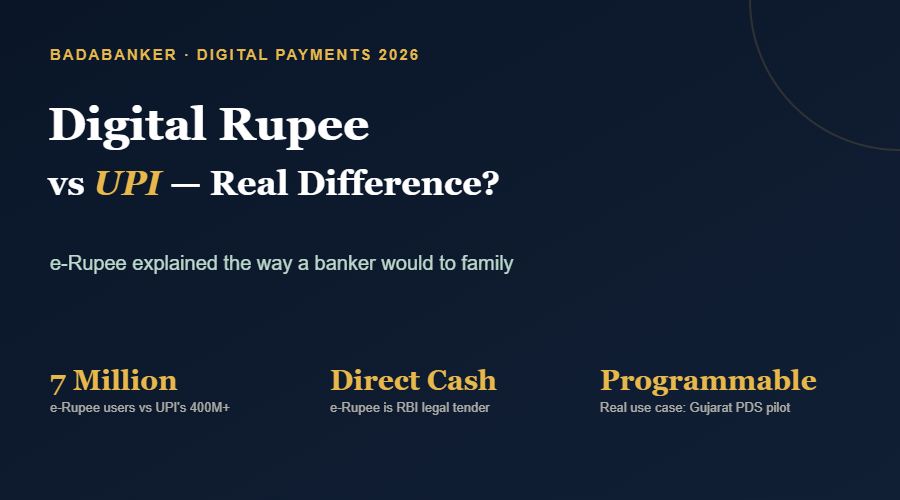
I get asked this constantly: “Sir, digital rupee aur UPI mein farak kya hai? Dono toh phone se paisa bhejte hain.” Fair question — on the surface, both let you pay by scanning a QR code on your phone. But they’re fundamentally different things, and understanding why matters more than most people realize.
Let me explain it the way I would to my own family.
Quick Fact Check — Digital Rupee 2026
- e₹ is direct digital cash — a liability of the RBI itself, exactly like the currency notes in your wallet, just in digital form. UPI is not currency; it’s a payment system that moves money between bank accounts.
- Adoption gap is enormous: e₹ retail has around 7 million users as of early 2026, compared to UPI’s 400+ million users processing 14+ billion transactions a month.
- e₹ is interoperable with UPI QR codes — you can scan any existing UPI merchant QR code and pay using your e₹ wallet, so acceptance isn’t a separate infrastructure problem.
- Programmable money is real and already in use: a Gujarat public distribution system pilot (February 2026) gives beneficiaries e₹ that can only be redeemed at government-approved ration shops — something UPI money simply cannot restrict.
~7 Million
e₹ retail users, early 2026
400+ Million
UPI users for comparison
Direct Cash
e₹ is a legal tender, RBI liability
Payment Rail
UPI moves bank deposits, isn’t currency
The Core Difference: Cash vs a Payment Rail
Think of it this way: when you pay via UPI, your bank account balance decreases and the recipient’s bank account balance increases — the money itself never left the banking system, UPI just instructed the transfer. When you pay using e₹, you’re handing over actual digital currency issued directly by the RBI — the same legal status as a currency note, just without the paper. This is the same distinction as paying with cash from your wallet versus writing a cheque against your bank account.
Where e₹ Actually Has a Real Advantage
Programmable, purpose-restricted payments. Because e₹ can be coded with conditions, government welfare programs can issue money that’s usable only for specific purposes — the Gujarat PDS pilot is a working example, where beneficiaries receive e₹ that can only be spent at approved fair-price shops. This kind of restriction is structurally impossible with a UPI transfer, since once money lands in someone’s bank account, it’s fully fungible and can be spent anywhere.
Offline transactions. RBI has been actively testing offline e₹ payments — meaning you could potentially transact without an active internet connection, closer to how physical cash works. UPI fundamentally requires connectivity to authenticate and process a transaction in real time.
No intermediary bank exposure. Holding e₹ is a direct claim on the RBI, similar to holding cash — there’s no commercial bank standing between you and your money. A UPI-linked bank balance is technically a claim on your bank (protected by DICGC insurance up to ₹5 lakh, but still a bank liability, not central bank money).
Why UPI Still Wins for Almost Everyone, Today
Archana’s Tip: For 99% of daily transactions, UPI remains the better choice simply because of scale — every merchant, every app, every use case is already built around it. e₹’s advantages (programmability, offline capability, no bank exposure) are real, but they matter most in specific situations: targeted government transfers, low-connectivity areas, or if you specifically want to hold central bank money rather than bank deposits. For everyday spending, there’s no practical reason to switch away from UPI right now.
e₹ vs UPI — Side by Side
| Digital Rupee (e₹) | UPI | |
|---|---|---|
| What it actually is | Digital form of legal tender (RBI liability) | Payment system moving bank deposits |
| Users (2026) | ~7 million | 400+ million |
| Works offline | Being piloted | Requires internet |
| Can be purpose-restricted | Yes (programmable money) | No — fully fungible once received |
| Merchant acceptance | Wherever UPI QR is accepted (interoperable) | Near-universal |
| Counterparty exposure | None — direct RBI claim | Bank deposit (DICGC insured to ₹5L) |
Our Verdict
📋 Our Verdict — Digital Rupee vs UPI 2026
“They’re not competitors, they’re solving different problems. UPI is the payment rail that will keep dominating daily transactions for the foreseeable future. e₹ is genuinely new financial infrastructure — most valuable right now for programmable government transfers and offline-capable payments, not for replacing your everyday UPI habits. Try it if you’re curious; don’t expect it to change how you pay day-to-day just yet.”
Digital Rupee — FAQs
Q: Do I need a separate bank account to use e₹?
A: You need a digital rupee wallet, typically provided through a participating bank’s app, but the e₹ itself sits outside your regular bank account as a direct RBI-issued token.
Q: Can I convert e₹ back to regular bank balance anytime?
A: Yes, e₹ can generally be converted back to your bank deposit through your wallet-providing bank, similar to depositing cash.
Q: Is e₹ the same as cryptocurrency like Bitcoin?
A: No. e₹ is issued and backed entirely by the RBI as legal tender, with a stable value equal to the physical rupee. Cryptocurrencies are decentralized, not issued by any central bank, and have no guaranteed value.
Q: Which banks currently offer e₹ wallets?
A: Several major public and private sector banks participate in the retail e₹ pilot, with the list expanding as RBI broadens the program — check your own bank’s app to see if e₹ is available.
To learn about related digital payment safety, check our UPI Fraud Red Flags guide, or browse more Digital Payments coverage on BadaBanker.
📎 Sources: RBI Central Bank Digital Currency (CBDC) pilot updates; press coverage of the Gujarat PDS e₹ pilot, February 2026. For informational purposes only — features and availability of e₹ are still evolving as the pilot expands.