
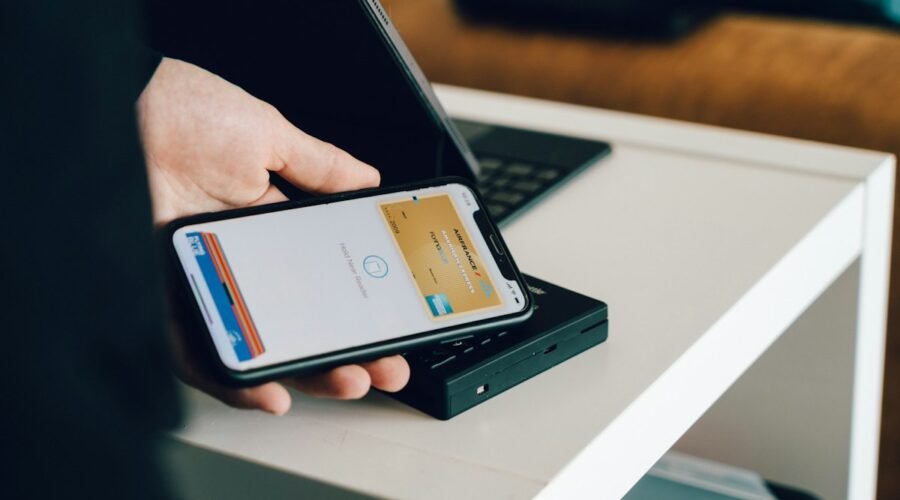
The digital rupee (e₹) and UPI both let you pay by scanning a QR code on your phone, so it’s easy to assume they are the same thing. They aren’t. The e₹ is money itself, issued by the RBI. UPI is a way of moving money between bank accounts. This guide explains the difference, what e₹ can do that UPI can’t, and whether it’s worth using in 2026.
Digital rupee vs UPI at a glance
- e₹ is digital cash. The RBI describes it as the digital form of the rupee, legal tender and a liability of the RBI, at par with currency notes.
- UPI is a payment system. It moves deposits between bank accounts. In September 2026, it handled about 24 billion transactions worth about ₹29.4 lakh crore (NPCI data).
- The digital rupee (e₹) is still a pilot. The RBI says retail e₹ is being piloted, with 19 banks offering wallets as of October 2026. Retail e₹ in circulation was ₹771.7 crore on 31 March 2026, down from ₹1,016.5 crore a year earlier (RBI Annual Report 2025-26).
- e₹ wallets can scan UPI QR codes, so you can pay most UPI merchants from an e₹ wallet.
Legal tender
e₹ is an RBI liability, like a note
19 banks
Offering e₹ wallets (RBI, Oct 2026)
₹0
Charges for using e₹ wallets
No interest
Paid on e₹ wallet balances

The core difference: money vs a payment rail
When you pay by UPI, your bank account goes down and the receiver’s account goes up. The money stays as bank deposits, and UPI only carries the instruction. When you pay with e₹ to a CBDC QR code or another e₹ wallet, digital currency moves from your wallet to theirs and settles instantly, without passing through either bank account. It’s like the difference between handing over a note and paying from your bank account.
The RBI’s FAQ makes a second point: e₹ is also a store of value. You can withdraw e₹ from your bank account and keep it in the wallet, as you would keep cash at home.
How the digital rupee (e₹) works in practice
- Opening a wallet: download your bank’s e₹ app and register. The wallet is currently linked to your savings account, which takes care of KYC. Beneficiaries of some government schemes paid through programmable e₹ can register with their mobile or Aadhaar number instead.
- Loading and redeeming: move money between your bank account and the e₹ wallet at any time, 24×7.
- Denominations and change: e₹ is held in the same denominations as notes, but the app makes change automatically. For example, if you pay ₹15 with a ₹20 token, ₹15 goes to the merchant and ₹5 stays in your wallet.
- Cost and interest: there are no charges for using e₹, and no interest is paid on the balance, just as with cash.
- Lost phone: the RBI says the balance is safe and the wallet can be recovered on a new device using the same phone number.
Where the digital rupee has an advantage
Programmable payments. e₹ can be issued with conditions, such as an expiry date, a location, a type of merchant or specific merchants. In February 2026, Gujarat began crediting public distribution system (PDS) food entitlements as programmable e₹, which can be redeemed only for eligible foodgrains at fair price shops. Once money reaches a bank account through UPI, it can be spent on anything.
Offline use. The RBI is exploring offline e₹ for places with weak or no internet. It isn’t a standard feature yet, so don’t rely on it.
Central bank money. e₹ is a direct claim on the RBI. A bank balance is a claim on your bank, insured by DICGC up to ₹5 lakh per depositor per bank. For ordinary balances in a sound bank, this difference rarely matters in practice.
A worked example: the cost of holding e₹
Say you move ₹20,000 from a savings account paying 2.5% into an e₹ wallet and keep it there for a year. You give up about ₹500 of interest, because e₹ balances earn nothing. For spending money you’d hold as cash anyway, that cost doesn’t matter. As a place to park savings, e₹ makes no sense.
Digital rupee vs UPI: side by side
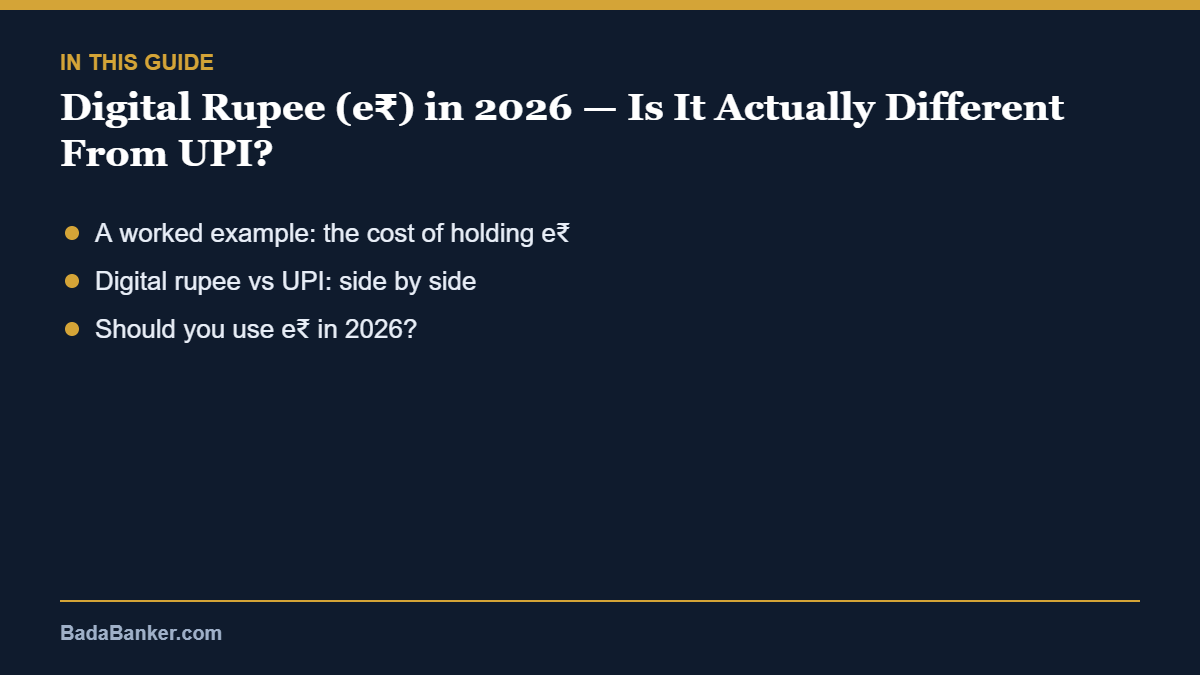
| Digital rupee (e₹) | UPI | |
|---|---|---|
| What it is | Digital form of the rupee, an RBI liability | Payment system that moves bank deposits |
| Where the money sits | In your e₹ wallet | In your bank account |
| Interest on balance | None | Savings account interest |
| Settlement | Instant between e₹ wallets. On UPI timelines when paying a UPI QR | Real time through NPCI and banks |
| Purpose restrictions | Possible (programmable e₹) | No |
| Offline use | Being explored | Needs connectivity (except limited features such as UPI Lite and USSD) |
| Status | Pilot, 19 banks | Fully live, near-universal acceptance |
Should you use the digital rupee in 2026?
For everyday payments, UPI is still the practical choice: every merchant and app supports it, and your money earns interest until you spend it. e₹ is worth trying if your bank offers it and you’re curious. It matters most if you receive government benefits as programmable e₹, or if you want to hold a small amount of central bank money the way you’d hold cash.
Digital rupee FAQs
Q: Do I need a bank account to use e₹?
A: For most users, yes. Wallets are currently linked to savings accounts. Beneficiaries of some government schemes paid through programmable e₹ can register with a mobile or Aadhaar number instead.
Q: Can I convert e₹ back to my bank balance?
A: Yes. You can redeem e₹ to your linked bank account at any time, 24×7.
Q: Is e₹ the same as cryptocurrency?
A: No. e₹ is issued by the RBI, is legal tender and is always worth the same as the physical rupee. Cryptocurrencies are not issued by a central bank and their value fluctuates.
Q: Which banks offer e₹ wallets?
A: As of October 2026, the RBI lists 19 banks, including SBI, HDFC Bank, ICICI Bank, Axis Bank, Bank of Baroda, Canara Bank, PNB, Union Bank of India and Kotak Mahindra Bank. The RBI’s e₹ FAQ has the full list with app links.
Q: Are there charges for using e₹?
A: The RBI says there are no charges or fees for using e₹ or e₹ wallets.
To stay safe with digital payments, read our UPI fraud red flags guide, or browse more Digital Payments coverage on BadaBanker.
📎 Sources: RBI: Digital Rupee (e₹) FAQs, updated 1 October 2026; RBI Annual Report 2025-26 (e₹ in circulation); NPCI UPI product statistics. This article is for general information. e₹ is a pilot, and its features may change.
Your money versus payment rail distinction finally made this click for me, since I had assumed e-rupee was just another UPI app. The note about no interest on e-rupee balances, compared with savings account interest on UPI-linked money, is an important trade-off I had not considered. I also found the programmable payment and offline use possibilities interesting, even though UPI remains the practical choice for daily spending right now.