
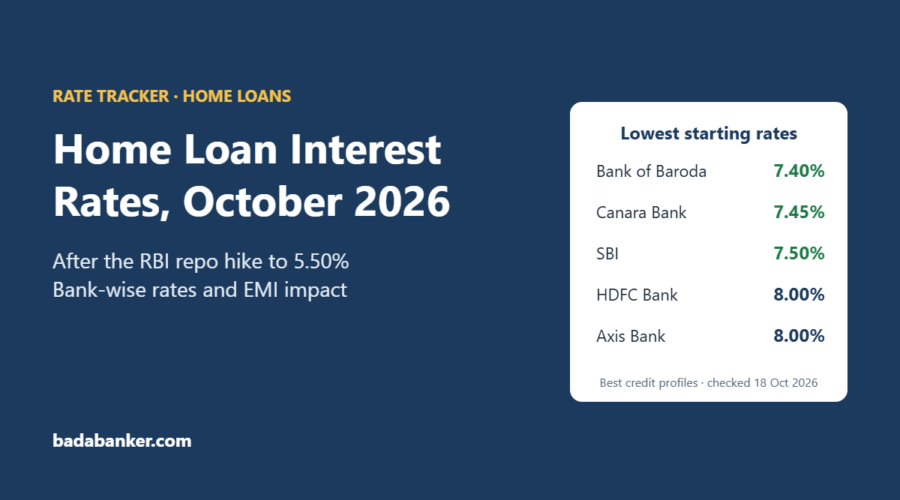
Home loan interest rates in India are rising again. After the RBI raised the repo rate from 5.25% to 5.50% on 7 October 2026, banks began lifting their repo-linked lending rates within days. This page tracks the home loan interest rates that SBI, Bank of Baroda, Canara Bank, HDFC Bank, ICICI Bank, Axis Bank and other lenders have published since the hike, what it means for your EMI, and how to get the best rate your profile allows.
Last checked: 18 October 2026, from each bank’s own website or stock-exchange filing. Rates change often, so confirm with your bank before you apply.
Home loan interest rates after the repo hike: the key points
- The repo rate is now 5.50%, up 0.25 percentage points. It’s the first hike since February 2023.
- Most public sector banks have already raised their repo-linked lending rates by 0.25 points, effective between 7 and 15 October 2026.
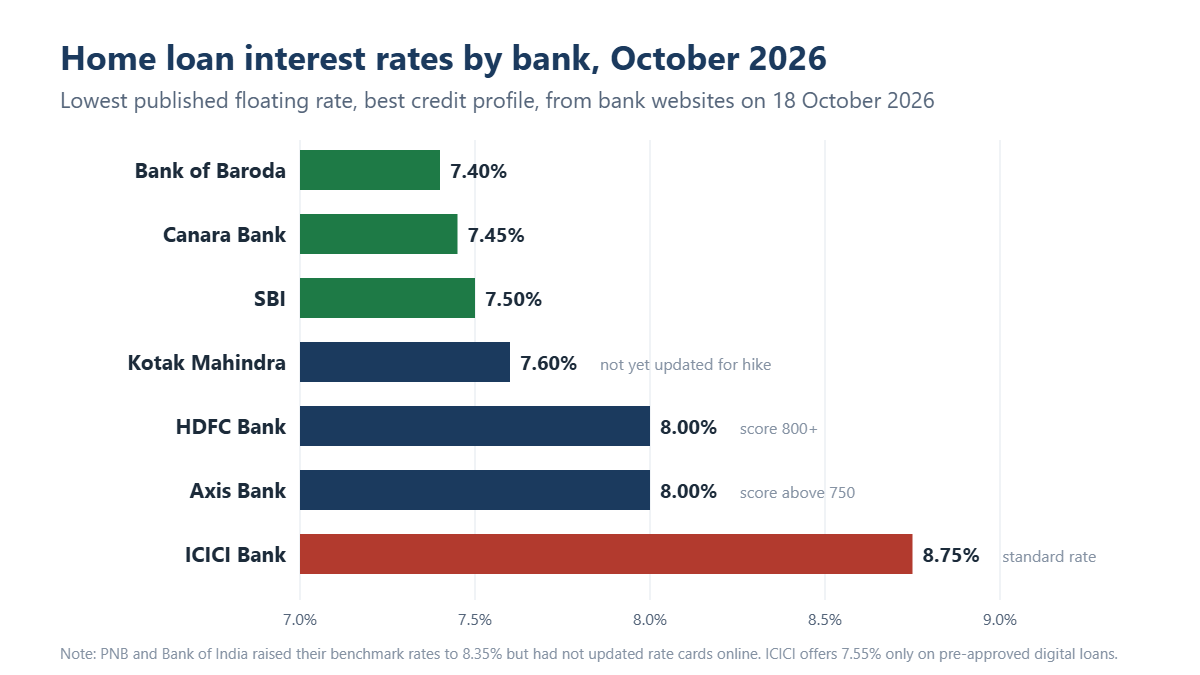
- Lowest published starting rates are now around 7.40%–7.50% at public sector banks, for borrowers with the best credit profiles. Private banks start around 8.00%.
- Existing borrowers on repo-linked loans will see the rise at their next reset date. On a ₹50 lakh, 20-year loan, a 0.25-point rise adds about ₹775 a month to the EMI.
- The advertised “starting” rate needs a strong credit score. Most people pay somewhere above it.
Bank-wise home loan interest rates, October 2026
| Bank | Benchmark lending rate | Home loan rate (floating) | Source and date |
|---|---|---|---|
| State Bank of India | EBLR 8.15% + premiums (was 7.90%) | From 7.50% | SBI website, effective 15 Oct 2026 |
| Bank of Baroda | BRLLR 8.15% (was 7.90%) | 7.40% – 9.15% (up to ₹75 lakh); 7.65% – 9.40% above ₹75 lakh | BoB website, effective 8 Oct 2026 |
| Canara Bank | RLLR 8.25% | 7.40% – 10.25%, by loan size, credit grade and borrower type | Canara Bank website, effective 9 Oct 2026 |
| Punjab National Bank | RLLR 8.35% (was 8.10%) | Rate card not yet updated online | Exchange filing, effective 8 Oct 2026 |
| Bank of India | RBLR 8.35% (was 8.10%) | Rate card not yet updated online | Exchange filing, effective 7 Oct 2026 |
| HDFC Bank | Repo 5.50% + 2.50% to 7.95% | 8.00% – 13.45% (lowest for credit score 800+) | HDFC Bank website, October 2026 |
| ICICI Bank | Repo 5.50% | 8.75% – 10.05% standard; 7.55% only for pre-approved digital loans | ICICI Bank website, valid to 31 Oct 2026 |
| Axis Bank | Repo + 2.50% to 3.60% | 8.00% – 8.85% (score above 750); 8.20% – 9.10% (750 or below) | Axis Bank website, October 2026 |
| Kotak Mahindra Bank | Repo-linked | From 7.60% (page still shows the old 5.25% repo) | Kotak website, not yet updated |
“Benchmark lending rate” is the rate each bank links its floating loans to, such as the repo-linked lending rate (RLLR) or external benchmark lending rate (EBLR). Your actual rate is the benchmark plus or minus a spread that depends on your credit score, loan amount, income type and the bank’s risk grading. That’s why the same bank can quote you 7.50% and your neighbour 8.50%.
How the repo hike reaches your EMI
Since October 2019, banks have had to link new floating-rate home loans to an external benchmark, usually the RBI’s repo rate. When the repo rate rises, the bank’s repo-linked lending rate rises by the same amount, and your loan follows at its next reset. RBI rules require these loans to be reset at least once every three months. Some banks reset monthly; others on fixed dates. Axis Bank, for example, says it passes repo changes on the 25th of the last month of each quarter.
Older loans linked to MCLR or base rate move differently. They follow the bank’s cost of funds, so they change more slowly and not always by the full 0.25 points.
EMI at today’s home loan interest rates
| Interest rate | ₹30 lakh, 20 years: EMI | Total interest | ₹50 lakh, 20 years: EMI | Total interest |
|---|---|---|---|---|
| 7.40% | ₹23,985 | ₹27.56 lakh | ₹39,974 | ₹45.94 lakh |
| 7.50% | ₹24,168 | ₹28.00 lakh | ₹40,280 | ₹46.67 lakh |
| 8.00% | ₹25,093 | ₹30.22 lakh | ₹41,822 | ₹50.37 lakh |
| 8.75% | ₹26,511 | ₹33.63 lakh | ₹44,186 | ₹56.05 lakh |
The gap between a 7.50% and an 8.75% rate on a ₹50 lakh loan is about ₹3,900 a month, and over ₹9 lakh of interest across 20 years. Your credit score and the bank you choose matter more than the 0.25-point hike itself.
Existing borrower: higher EMI or longer tenure?
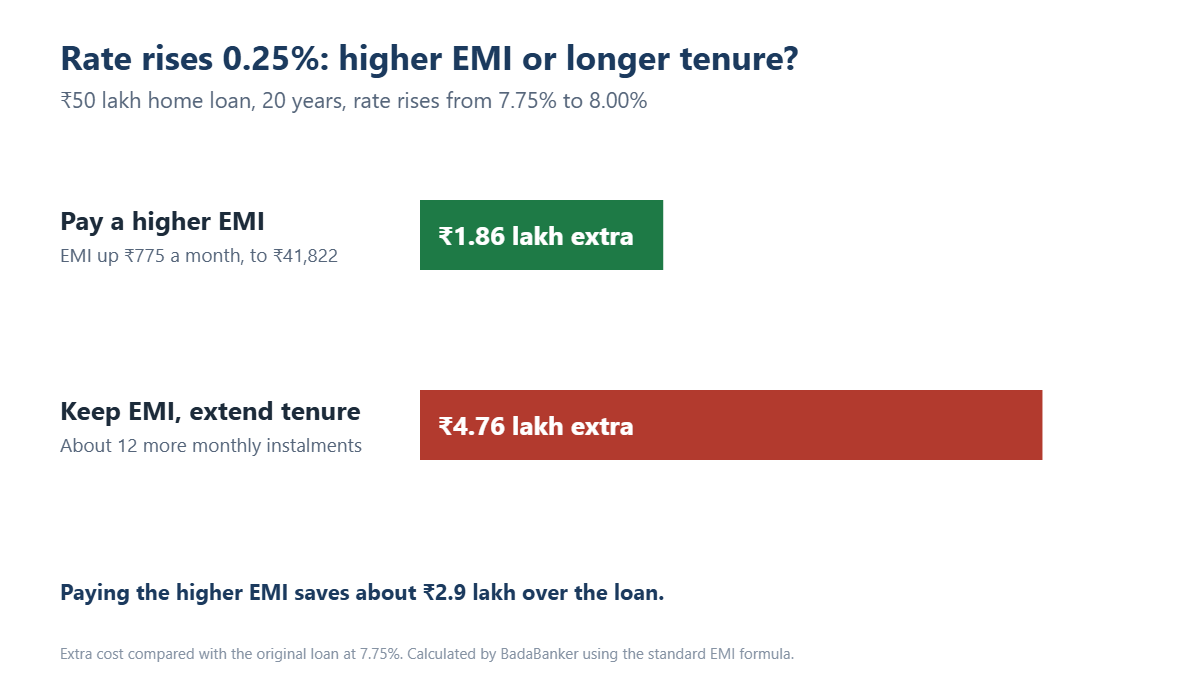
Take a ₹50 lakh loan for 20 years at 7.75%, with an EMI of ₹41,047. If the rate rises to 8.00%:
- Option 1, pay a higher EMI: the EMI rises by about ₹775, to ₹41,822. Over 20 years, that’s about ₹1.86 lakh more.
- Option 2, keep the EMI and extend the tenure: the loan runs about 12 months longer. Those extra instalments cost about ₹4.76 lakh.
Banks often choose the longer tenure by default because it keeps the EMI unchanged. If you can afford it, ask your bank to raise the EMI instead. It costs far less overall. Under RBI rules on floating-rate EMI loans, banks must tell you about the reset and give you the option to choose between a higher EMI and a longer tenure.
How your credit score changes your rate
Banks price home loans by risk. The published rate cards show how much difference that makes:
- HDFC Bank: its lowest rate is for credit scores of 800 and above; the spread over repo can be anything from 2.50% to 7.95%.
- Axis Bank: borrowers with scores above 750 start at 8.00%; those at 750 or below, or with no credit history, start at 8.20%.
- Canara Bank: on loans up to ₹50 lakh, its best credit grade pays 7.55% and its lowest grade 10.25%, a gap of 2.7 points.
If your score is below 750, a few months spent fixing errors and reducing card balances can save far more than shopping between banks. Our guide to CIBIL scores for loans explains what lenders look at and how to correct mistakes.
How to get lower home loan interest rates
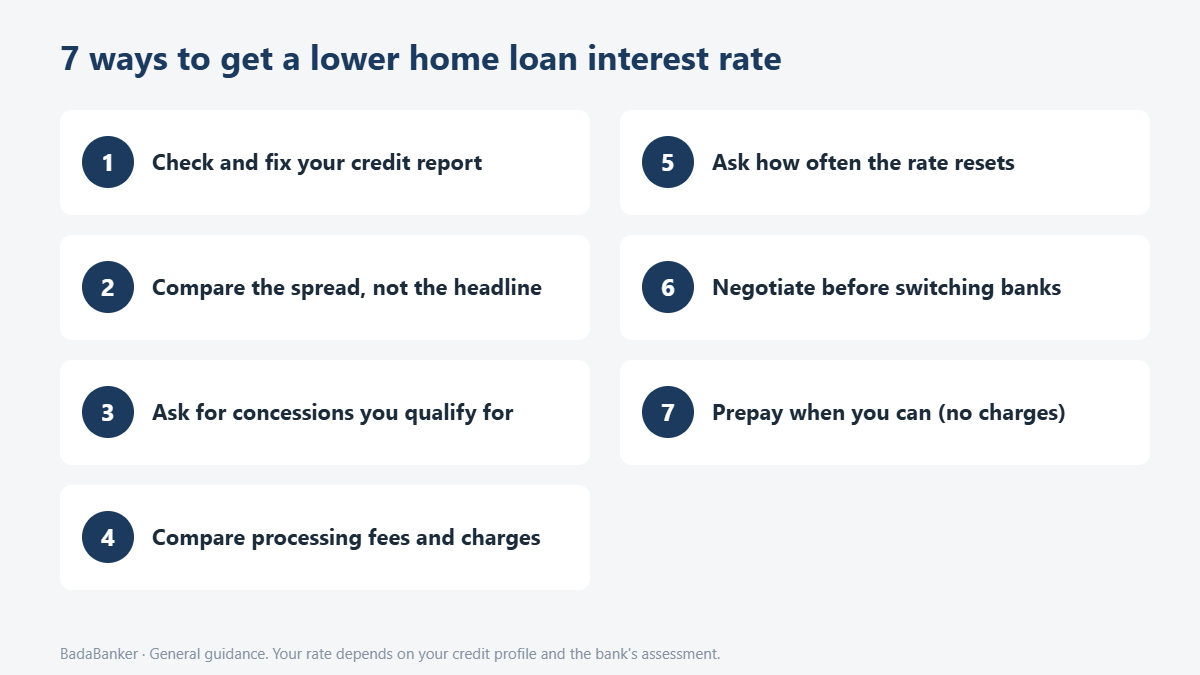
- Check your credit report first, and correct any errors before you apply.
- Compare the spread, not just the headline. Ask each bank what spread over its benchmark it will offer you, and what your final rate will be.
- Look for concessions. Canara Bank, for example, gives 5 basis points off for women borrowers, and another 5 for salary account holders of government bodies, PSUs and large companies.
- Check the processing fee and other charges, not just the rate.
- Ask about reset dates. A bank that resets quarterly passes on changes later than one that resets monthly, in both directions.
- Negotiate with your current bank before switching. Many banks will lower your spread on request, or for a small conversion fee. If not, compare a home loan balance transfer.
- Prepay when you can. RBI rules don’t allow prepayment charges on floating-rate home loans to individual borrowers.
PMAY-Urban 2.0: interest subsidy for first homes
The old PMAY credit-linked subsidy, with its 6.5%, 4% and 3% rates, has ended. Its replacement, the Interest Subsidy Scheme under PMAY-Urban 2.0, applies to home loans sanctioned and disbursed from 1 September 2024:
- Who: EWS, LIG and MIG households with annual income up to ₹3 lakh, ₹6 lakh and ₹9 lakh respectively, buying their first pucca house.
- Loan and house limits: loan up to ₹25 lakh, for a house worth up to ₹35 lakh.
- Subsidy: 4% on the first ₹8 lakh of the loan, for a tenure of up to 12 years, up to ₹1.80 lakh in total, paid in five yearly instalments.
Apply through your lender or the official PMAY-U portal. The subsidy is calculated pro rata for smaller loans or shorter tenures.
Fixed or floating rate?
Truly fixed home loans are rare and usually priced well above floating rates. Most “fixed” options fix the rate for the first few years and then switch to floating. With the RBI now in a “calibrated tightening” stance, a fixed rate can protect you from further hikes, but you pay a premium for that certainty and lose the benefit if rates fall later. For most borrowers, a floating rate with the option to prepay remains the cheaper choice over a long loan.
Frequently asked questions
Which bank has the lowest home loan interest rate in October 2026?
Among the published rate cards checked on 18 October 2026, Bank of Baroda starts at 7.40%, Canara Bank at 7.45% (7.40% for women borrowers on larger loans) and SBI at 7.50%. These starting rates apply to borrowers with the strongest credit profiles.
When will my EMI go up after the repo hike?
At your loan’s next reset date, which is set in your loan agreement. Repo-linked loans must be reset at least every three months.
Will home loan interest rates rise further?
That depends on the RBI. Its Monetary Policy Committee moved to a “calibrated tightening” stance on 7 October, and the next meeting is on 2–4 December 2026.
Is it better to switch my home loan to another bank now?
Only if the saving clearly beats the costs of switching, such as processing and legal fees. First ask your current bank to reduce your spread. If your rate is 0.50 points or more above the market for your profile, a transfer is usually worth pricing.
Does the repo hike affect fixed-rate home loans?
Not during the fixed-rate period. If your loan is fixed for a few years and then becomes floating, the new benchmark will apply when it switches.
Related reading
Sources
- SBI, External Benchmark based Lending Rate (effective 15 October 2026)
- Bank of Baroda, Retail loans interest rates (BRLLR effective 8 October 2026)
- Canara Bank, Retail lending schemes linked to RLLR (effective 9 October 2026)
- HDFC Bank, Home loan interest rates
- ICICI Bank, Home loan interest rates
- Axis Bank, Home loan interest rates and charges
- Kotak Mahindra Bank, Home loan interest rates
- PNB and Bank of India: revisions disclosed to stock exchanges, 7–8 October 2026
- RBI, Monetary Policy Statement, October 2026
- Ministry of Housing and Urban Affairs, PMAY-U 2.0 Interest Subsidy Scheme
Rates are as published by each bank on the date checked and apply to new loans for the borrower categories stated. Your rate depends on your credit profile and the bank’s assessment. This is general information, not advice on a specific loan.