
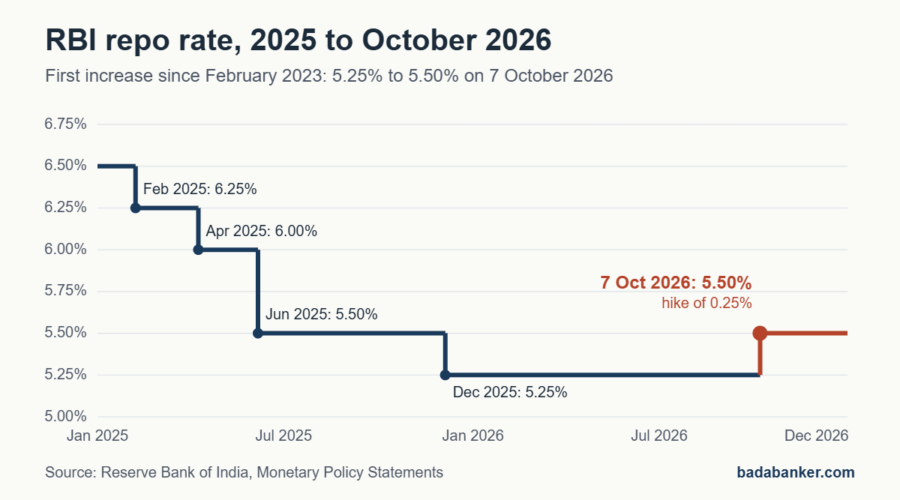
The RBI’s repo rate hike of 7 October 2026 takes the rate from 5.25% to 5.50%. The Reserve Bank of India’s Monetary Policy Committee (MPC) voted unanimously for the 25 basis point increase. It is the RBI’s first rate increase since February 2023, and it comes after the repo rate was cut by a total of 1.25 percentage points during 2025. The MPC also changed its stance from neutral to calibrated tightening.
Here is what changed, why the RBI did it, and what it means for your home loan EMI, your fixed deposits and your business loan.
RBI policy rates after the October 2026 meeting
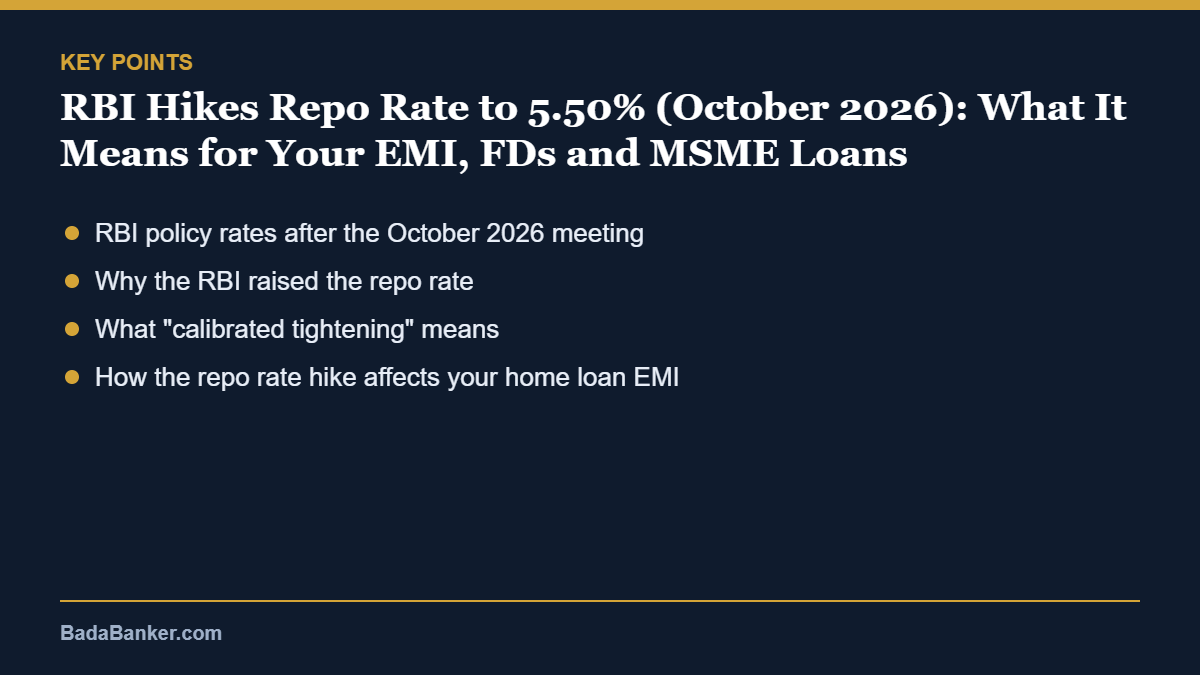
| Rate | Before | From 7 October 2026 |
|---|---|---|
| Repo rate | 5.25% | 5.50% |
| Standing Deposit Facility (SDF) rate | 5.00% | 5.25% |
| Marginal Standing Facility (MSF) rate | 5.50% | 5.75% |
| Bank Rate | 5.50% | 5.75% |
| Policy stance | Neutral | Calibrated tightening |
All six MPC members voted for the repo rate hike. On the stance, two members, Dr. Nagesh Kumar and Prof. Ram Singh, preferred to keep it neutral. The minutes of the meeting will be published on 21 October 2026, and the next MPC meeting is scheduled for 2 to 4 December 2026.
Why the RBI announced a repo rate hike
The short answer is inflation. In the RBI’s words, inflation and its outlook “are not benign as they were last year”.
- Prices are rising faster. CPI inflation rose to 4.8% in August 2026, from 4.5% in July. Core inflation, which leaves out food and fuel, rose to 4.2%.
- Price increases are spreading. Food price increases have become more broad based, with spikes in items such as sugar and onion. About 37% of the CPI basket, by weight, saw inflation above 4% in August.
- Supply risks. The RBI pointed to a deficient south-west monsoon, strong El Niño conditions, and volatile crude oil prices linked to the renewed conflict in West Asia.
- Global rates are rising. The US Federal Reserve raised its rate by 25 basis points in September, and other major central banks have tightened too.
The RBI now projects CPI inflation at 5.2% for 2026-27: 4.9% in the July–September quarter, 6.0% in October–December and 5.7% in January–March. It expects headline inflation to average almost 5.8% over the next three quarters.
Growth, on the other hand, is strong. Real GDP grew 7.8% in April–June 2026, and the RBI projects 7.1% growth for the full year 2026-27. A strong economy gives the RBI room to raise rates to control inflation.
What “calibrated tightening” means
The MPC explained that the new stance means rate cuts are off the table for now. Its next move can only be another increase or a pause, depending on how inflation and growth develop. It did not commit to any further increase, and said the length and size of this cycle will depend on the data.
For borrowers, the practical message is simple: do not plan your finances around loan rates falling in the next few months.
How the repo rate hike affects your home loan EMI
Whether your EMI changes, and when, depends on how your loan’s interest rate is set. Check your sanction letter or loan statement for the benchmark.
- External benchmark (EBLR or RLLR) loans. These are linked to an outside rate. For many banks this is the repo rate. RBI rules require the rate on these loans to be reset at least once every three months, so the increase usually reaches your loan within a quarter. Since 1 October 2019, new floating-rate home and other retail loans from banks have had to use an external benchmark.
- MCLR loans. Older loans linked to the bank’s MCLR change only on your reset date, often every 6 or 12 months, and only if the bank’s MCLR has moved by then.
- Fixed-rate loans. Your rate does not change during the fixed period. Many car and personal loans are fixed-rate.
EMI examples for a 0.25% repo rate hike
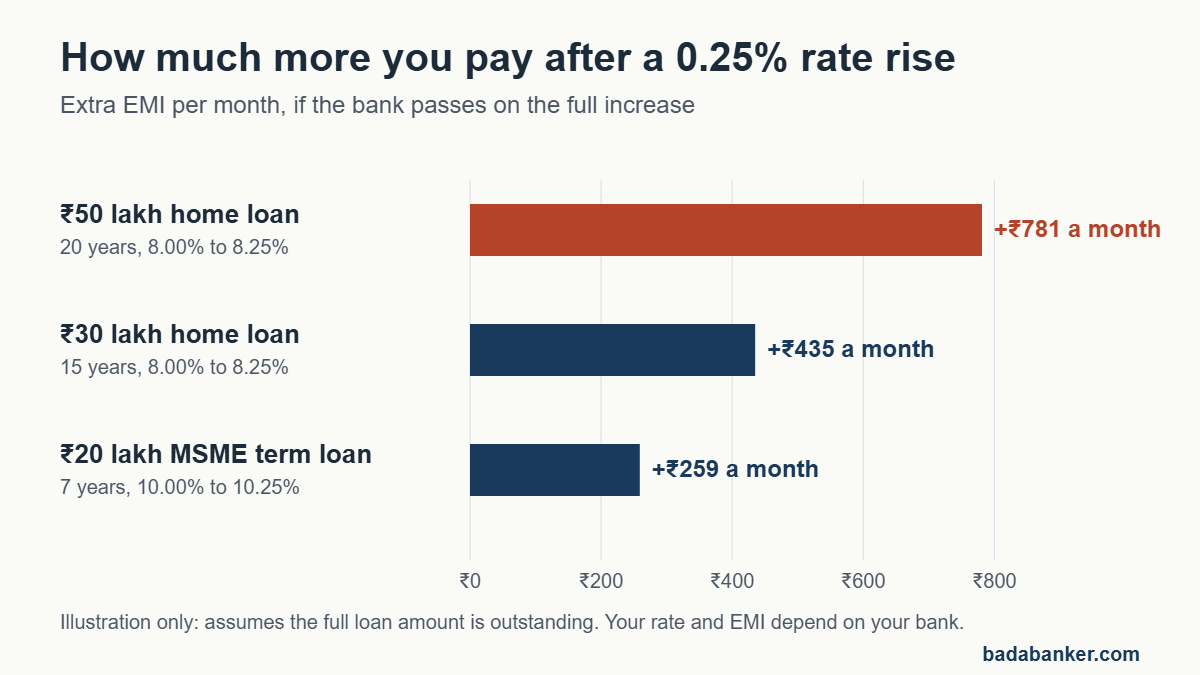
The examples below assume your bank passes on the full 0.25% and the whole loan amount is still outstanding. Your own interest rate depends on your bank and your profile, so treat these as illustrations, not quotes.
- ₹50 lakh home loan, 20 years (8.00% to 8.25%): EMI rises from ₹41,822 to ₹42,603, which is ₹781 more a month.
- ₹30 lakh home loan, 15 years (8.00% to 8.25%): EMI rises from ₹28,670 to ₹29,104, which is ₹435 more a month.
- ₹20 lakh MSME term loan, 7 years (10.00% to 10.25%): EMI rises from ₹33,202 to ₹33,461, which is ₹259 more a month.
If your bank keeps the EMI the same and extends the loan instead, the effect is larger than it looks. On the ₹50 lakh, 20-year example, keeping the EMI at ₹41,822 would add roughly 12 more EMIs to the loan.
Free tool
Work out the new EMI on your own loan amount, rate and tenure with the loan EMI calculator, or see how a part-prepayment changes your loan with the prepayment calculator.
Estimates only. Your bank’s loan statement shows your actual rate and EMI.
Your options after the repo rate hike
Under the RBI’s August 2023 rules on resetting floating rates on EMI-based personal loans, which include home loans, your lender must tell you straight away when your EMI or tenure goes up. At a reset, it must let you choose to:
- increase the EMI, extend the tenure, or do a combination of both;
- prepay the loan, in part or in full, at any point during the loan. Any prepayment charge must follow RBI’s rules.
Your lender may also offer a switch to a fixed rate under its own policy. Since 1 October 2025 this is optional for lenders, so ask whether your bank offers it and what it charges. Charges for these options must be disclosed in your sanction letter.
Your lender must also give you a statement at the end of every quarter showing the principal and interest paid so far, your EMI, the number of EMIs left and the annual interest rate. If you can afford it, choosing a higher EMI instead of a longer tenure usually means paying less interest overall.
What the repo rate hike means for fixed deposits
A repo rate hike does not raise FD rates automatically. Banks set their own deposit rates, and they often raise them when policy rates go up and they need deposits to fund loans. Rates on deposits you have already booked do not change.
If you are about to book a new FD, compare rates across banks over the next few weeks. Splitting money across several FDs of different tenures, called laddering, lets you reinvest part of it later if rates rise further. Small finance banks often pay more, but check the safety points in our safe FD checklist before you choose one.
What the repo rate hike means for MSME loans
Since 1 October 2019, new floating-rate bank loans to micro and small enterprises have had to be linked to an external benchmark. That means most MSME cash credit, overdraft and term loans will reflect this repo rate hike at their next reset, within three months.
On a fully used cash credit limit of ₹25 lakh, a 0.25% increase adds about ₹6,250 of interest a year. It is a small amount on its own, but it adds to other costs that are already rising, such as fuel and raw materials.
- Check your next reset date and the benchmark named in your sanction letter.
- Tighten the working capital cycle. Collecting receivables faster lowers how much of the limit you use, which lowers the interest.
- Update your projections. If you are applying for a new loan or a renewal, use the current rate in your CMA data and project report, so your DSCR is realistic.
- Talk to your bank early if a higher EMI will strain your cash flow, before any instalment is missed.
You can test the effect on your own numbers with our MSME working capital and DSCR calculator.
Other announcement: account aggregators
The RBI also announced that account aggregators will be made interoperable, so you can access and share your financial information through any account aggregator of your choice. Depositories will also be able to show your bank deposit balances in the Consolidated Account Statement (CAS) along with your demat holdings. Both changes are expected by 31 December 2026.
Frequently asked questions
Will my home loan EMI go up immediately after the repo rate hike?
Not necessarily on the same day. It changes when your loan’s rate is next reset. For external benchmark loans that is at least once every three months; for MCLR loans it is your reset date. Your bank may also extend the tenure instead of raising the EMI, and it must inform you either way.
Does the repo rate hike affect a fixed-rate loan?
No. A fixed rate stays the same for the fixed period stated in your loan agreement. Check whether your loan is fully fixed or fixed only for the first few years.
Will there be another repo rate hike?
The RBI has not committed to it. Under the calibrated tightening stance, its next move can be an increase or a pause, depending on inflation and growth. The next MPC decision is due after the 2 to 4 December 2026 meeting.
After the repo rate hike, is this a good time to book a fixed deposit?
That depends on your needs, and nobody can predict rates with certainty. If you want to keep the option of reinvesting at higher rates, consider splitting your money across different tenures instead of locking it all in at once.
Related reading
Sources
- RBI, Monetary Policy Statement, 2026-27: Resolution of the MPC, October 5 to 7, 2026
- RBI, Governor’s Statement, October 7, 2026
- RBI, Statement on Developmental and Regulatory Policies, October 7, 2026
- RBI, Reset of Floating Interest Rate on EMI based Personal Loans (August 18, 2023, updated October 1, 2025)
- RBI, External Benchmark Based Lending (September 4, 2019)
This article explains the RBI’s announcement for general understanding. It is not personal financial advice. Your loan and deposit terms are set by your bank’s written agreement.