
Every few months, someone at the branch asks me why their Paytm or mobile wallet suddenly got frozen or stopped letting them add money. It’s almost always the same answer: KYC. Digital wallets in India run on a two-tier KYC system most people don’t fully understand until it locks them out — and RBI has a genuinely new draft framework in the pipeline that could reshape these rules soon.
Here’s what’s actually in effect today, and what’s proposed for later in 2026.
Quick Fact Check — Wallet KYC 2026
- Two tiers exist: Minimum KYC (small PPI) wallets and Full KYC wallets, with very different limits and facilities.
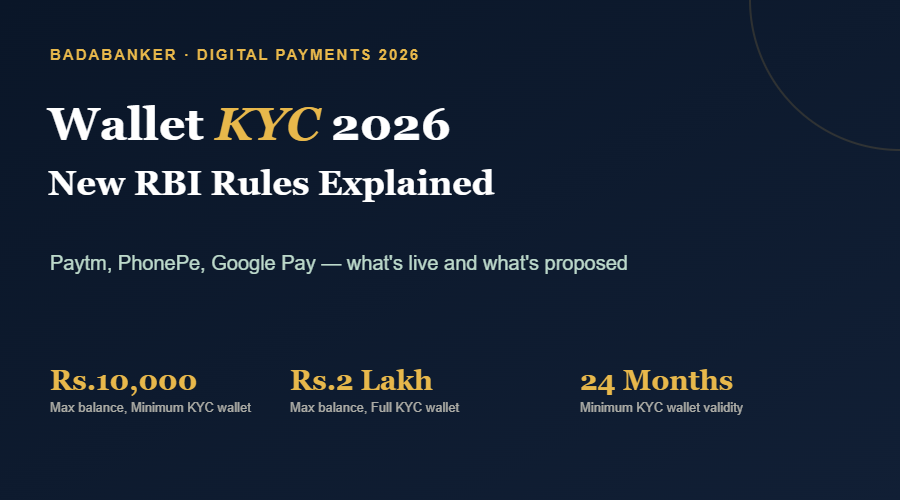
- Minimum KYC wallets: Max balance ₹10,000, max ₹10,000/month loading, no cash withdrawal, no peer-to-peer transfers — merchant payments only. Valid for 24 months, only one allowed per person across all wallet apps.
- Full KYC wallets: Max balance ₹2 lakh, full facilities including fund transfers, subject to completing proper identity verification (Aadhaar/PAN/video KYC).
- New in 2026 (still draft, not yet final): RBI released a draft Master Direction on Prepaid Payment Instruments in April 2026, proposing full interoperability of wallets with UPI and card networks, tighter capital/escrow norms for wallet companies, and simplified, consolidated KYC rules. Public comments closed in May 2026, but as of this writing it has not yet been notified as final.
₹10,000
Max balance, Minimum KYC wallets
₹2,00,000
Max balance, Full KYC wallets
24 Months
Validity of Minimum KYC wallets
1 Per Person
Minimum KYC wallets allowed, across all apps
Why Your Wallet Gets Frozen
Most wallet freezes happen for one of two reasons: your Minimum KYC wallet hit its 24-month validity limit without being upgraded to Full KYC, or you’re trying to do something a Minimum KYC wallet simply isn’t allowed to do — like receiving money from a friend or withdrawing cash. This isn’t a glitch or a punishment; it’s the wallet correctly enforcing the tier you’re registered under.
Minimum KYC vs Full KYC — What You Can Actually Do
| Minimum KYC (Small PPI) | Full KYC | |
|---|---|---|
| Max balance at any time | ₹10,000 | ₹2,00,000 |
| Max monthly loading | ₹10,000 | No RBI-mandated cap (issuer-dependent) |
| Cash withdrawal | Not allowed | Allowed (bank-issued PPIs) |
| Peer-to-peer transfer (sending to another person) | Not allowed | Allowed |
| Validity | 24 months, then must upgrade | No fixed expiry (subject to periodic re-KYC) |
| Onboarding requirement | OTP-verified mobile + self-declared identity | Aadhaar/PAN-based verification or video KYC |
Archana’s Tip: If you use a wallet regularly for anything beyond small merchant payments — splitting bills with friends, receiving refunds, or keeping more than ₹10,000 in it — upgrade to Full KYC proactively. Waiting until your Minimum KYC wallet expires and locks you out mid-transaction is a completely avoidable inconvenience.
What’s Actually Changing: The April 2026 Draft (Not Yet Final)
RBI’s draft Master Direction on Prepaid Payment Instruments, released in April 2026, proposes some meaningful changes — but it’s important to be clear this was still open for public comment as of May 2026 and has not been confirmed as finalized at the time of writing:
- Full interoperability: Full-KYC wallets would be required to work seamlessly across UPI and card payment networks, not just within their own app ecosystem.
- Consolidated rulebook: The draft aims to replace a patchwork of older PPI circulars (some dating back to 2017) with a single, simplified direction.
- Stronger capital and escrow norms for wallet-issuing companies, aimed at improving safety of customer funds held in wallets.
Until RBI formally notifies a final version, the existing 2021 Master Direction rules described above remain fully in effect — don’t assume anything has changed yet based on this draft alone.
Our Verdict
📋 Our Verdict — Wallet KYC 2026
“If you’re using a wallet only occasionally for small payments, a Minimum KYC wallet is fine — just remember its 24-month clock. If a wallet is part of your regular financial life, complete Full KYC now rather than dealing with a freeze later. And keep an eye on RBI’s PPI Master Direction — when it’s finalized, expect wallets to become far more interoperable with UPI, which will genuinely make day-to-day use easier.”
Wallet KYC — FAQs
Q: Can I have a Minimum KYC wallet on Paytm and another on PhonePe at the same time?
A: No. RBI rules allow only one Minimum KYC (small PPI) wallet per person across all issuers, tracked via your mobile number. Having multiple violates the framework, even if technically possible to open.
Q: What happens to my wallet balance if I don’t upgrade before the 24-month expiry?
A: Your wallet typically gets frozen for further loading and usage, though your existing balance usually remains accessible for withdrawal or refund to your bank account — you cannot add more money or transact until you complete Full KYC.
Q: Is video KYC accepted for upgrading to Full KYC on wallets?
A: Yes, most major wallet providers offer RBI-compliant video KYC as an option alongside physical document verification, making the upgrade process quick and fully digital.
Q: Do these rules apply to UPI itself, or only to wallets?
A: These specific balance and KYC-tier rules apply to Prepaid Payment Instruments (wallets), not to UPI, which works directly with your bank account and follows separate RBI guidelines.
To manage your digital payments better, browse more Digital Payments coverage on BadaBanker.
📎 Sources: RBI Master Direction on Prepaid Payment Instruments, 2021 (currently in effect); RBI Draft Master Direction on Prepaid Payment Instruments, April 2026 (proposed, not yet finalized). For informational purposes only — always verify current requirements with your wallet provider or RBI’s official notifications.