
A colleague’s father was hospitalized last year, and the family assumed their health insurance would cover everything. The claim came back partially rejected — not because of fraud, not because of a technicality buried in fine print, but because of a room rent clause almost nobody reads until they need it. This happens more often than insurers like to admit, and most of the reasons are entirely predictable if you know what to look for.
Here are the 7 real reasons health insurance claims get rejected or reduced in India, and — just as important — the protections you actually have in 2026 that most policyholders don’t know about.
Quick Fact Check — Health Insurance Claims 2026
- Pre-existing disease (PED) waiting period is capped at 3 years — IRDAI reduced this from 4 years; no policy can impose a longer PED waiting period.
- 5-year moratorium protection: After 60 continuous months of coverage with no break, insurers cannot reject your claim for non-disclosure or misrepresentation — except in cases of proven fraud.
- Non-disclosure is the single biggest cause of claim rejection in India — bigger than any other reason combined.
- Insurers cannot refuse a policy purely because of a serious pre-existing illness like heart disease or cancer — they can only underwrite (adjust premium/waiting period), not outright refuse, subject to conditions.
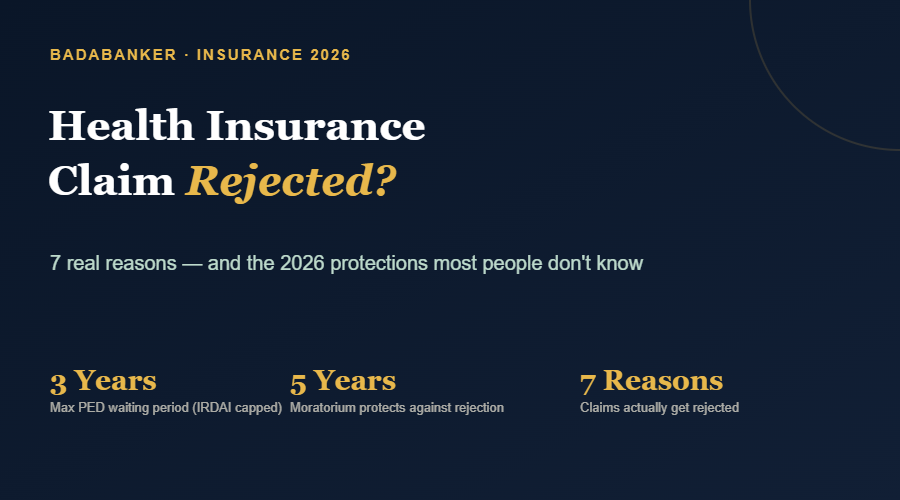
3 Years
Max PED waiting period (IRDAI capped)
5 Years
Moratorium — claims can’t be denied for non-disclosure after this
#1 Reason
Non-disclosure of material facts
7 Reasons
Covered in this guide
The 7 Reasons Claims Actually Get Rejected
1. Non-Disclosure at the Proposal Stage
This is the single largest cause of rejected claims. If you didn’t disclose a known condition — even something that felt minor, like borderline blood pressure or a family history you weren’t asked about directly — and it’s later found to be “material” to your hospitalization, the insurer can reject the claim. Always fill the proposal form yourself, in detail, rather than letting an agent fill it for you based on a quick phone call.
2. Claiming During the Waiting Period
Every health policy has waiting periods: typically 30 days for any illness (except accidents) right after buying the policy, up to 3 years for pre-existing diseases, and often 2 years for specific conditions like cataracts, hernia, or joint replacement. Claims filed within these windows for the relevant condition are legitimately rejected — not a scam, just a contractual term everyone should read before buying.
3. The Room Rent Sub-Limit Trap
This is the one that catches families off guard the most. If your policy has a room rent sub-limit (say, 1% of sum insured per day) and you choose a room that costs more, many insurers apply “proportionate deduction” — reducing your ENTIRE claim, not just the room charges, by the same percentage you exceeded the limit. A family expecting near-full reimbursement can see a significant chunk deducted purely because of the room category chosen, often without realizing it during admission.
4. Late Claim Intimation
Policies specify a window for informing the insurer — often within 24-48 hours for cashless treatment, and a few days to weeks for reimbursement claims. Delaying this, even for a genuine medical emergency, can be used as grounds for rejection or reduced settlement, especially without a documented reason for the delay.
5. Hospital Doesn’t Meet the Policy’s Definition
Insurance policies define what counts as a “Hospital” — typically requiring a minimum number of beds, round-the-clock medical staff, and proper registration under local health authorities. Treatment at a small clinic or an unregistered nursing home, however genuine, may not qualify for reimbursement under this definition.
6. Standard Policy Exclusions
Most policies exclude cosmetic treatments, dental care (unless due to an accident), non-allopathic treatment (unless specifically covered), and maternity (unless a maternity rider was purchased). These aren’t hidden traps — they’re standard exclusions listed in every policy document, but rarely read before a claim is needed.
7. Lapsed Policy Due to Missed Premium
Most insurers offer a grace period (commonly 15-30 days) to renew after the due date, but a claim event occurring after this grace period has lapsed, with the policy not renewed, is simply not covered — the policy has ended. This is entirely avoidable with a renewal reminder.
Your Real Protection: The 5-Year Moratorium
Archana’s Tip: The most underused protection in Indian health insurance is the 5-year moratorium rule. Once you’ve held a policy continuously for 60 months without a break, the insurer loses the right to reject your claim for non-disclosure or misrepresentation — the only exception is proven fraud. This is exactly why continuous, uninterrupted renewal matters more than people realize: even a single missed renewal can reset this protection.
Our Verdict
📋 Our Verdict — Health Insurance Claim Rejections 2026
“Most rejected claims aren’t insurer bad faith — they’re predictable outcomes of things policyholders didn’t read or didn’t disclose. Fill your proposal form honestly and in detail, understand your room rent sub-limit before you’re admitted, intimate your insurer immediately, and never let your policy lapse. And remember the 5-year moratorium — it’s real protection, but only if you keep your policy continuously renewed to earn it.”
Health Insurance Claims — FAQs
Q: Can an insurer reject my claim for a condition I genuinely didn’t know I had?
A: Rejection for non-disclosure requires the insurer to show the undisclosed condition was material and contributed to the hospitalization. Genuinely unknown conditions are harder to reject on this basis, especially after the 5-year moratorium period.
Q: What should I do if my claim is rejected unfairly?
A: First escalate to the insurer’s grievance redressal officer, then approach the Insurance Ombudsman if unresolved — this is a free, faster alternative to going to court for claims within the Ombudsman’s monetary limits.
Q: Does buying a higher room rent sub-limit cost much more in premium?
A: Usually not significantly more relative to the protection it provides. Given how the proportionate deduction clause can shrink an entire claim, opting for a policy with no room rent sub-limit (or a generous one) is often worth the modest extra premium.
Q: Has the pre-existing disease waiting period actually reduced, or is it insurer-specific?
A: It’s a hard cap set by IRDAI — no insurer can impose a PED waiting period longer than 3 years on any policy issued or renewed after the May 2024 master circular.
To plan around your own coverage, check our Term vs Endowment Insurance comparison, or browse more Insurance coverage on BadaBanker.
📎 Sources: IRDAI Master Circular on Health Insurance Business (May 2024); IRDAI Insurance Products Regulations, 2024. For informational purposes only — always read your specific policy wording and consult your insurer or a licensed advisor for claim-specific guidance.