
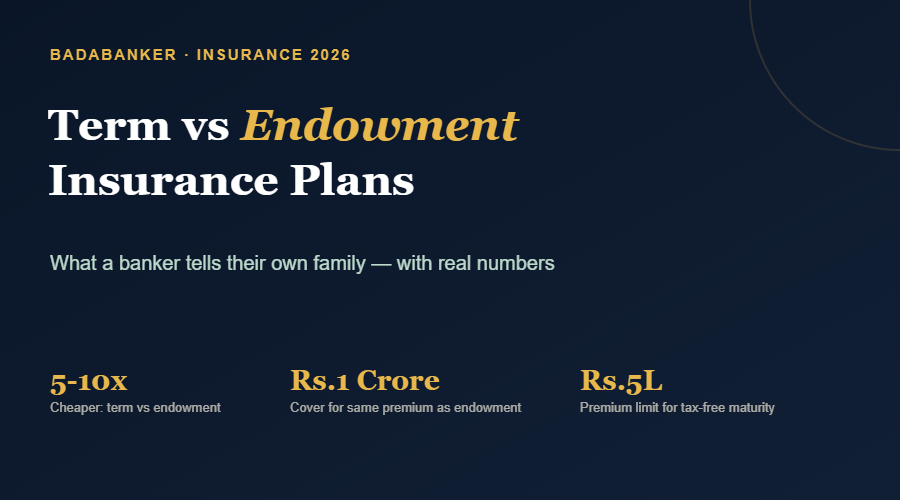
My uncle called me last month, excited about an endowment plan an agent had shown him — “guaranteed returns, insurance included, what could be better?” I had to walk him through the math before he signed. This is the conversation I have with almost every relative who’s been sold an endowment plan, so let me have it with you too.
Both term insurance and endowment plans protect your family if something happens to you. The difference is what happens if it doesn’t — and that difference is worth lakhs of rupees over your lifetime.
Quick Fact Check — Term vs Endowment 2026
- Term insurance: Pure protection. No payout if you survive the term. Extremely cheap because the insurer only pays out on death.
- Endowment plans: Insurance + forced savings bundled together. You get a maturity payout if you survive the term, but premiums are 5-10x higher for the same cover.
- Both qualify for Section 80C deduction (up to ₹1.5 lakh combined with other 80C investments) — but only under the old tax regime.
- Maturity tax rule: Under Section 10(10D), endowment maturity proceeds stay tax-free only if your total annual premium across all non-ULIP life policies is ₹5 lakh or less. Death benefit is always 100% tax-free, regardless of premium size.
- Typical returns: Endowment plans historically deliver 4-6% annual returns. Term insurance has no return — it’s pure insurance cost, same as your car or health insurance premium.
5-10x
Cheaper: term vs endowment premium for same cover
4-6%
Typical endowment plan returns (IRR)
₹5,00,000
Premium threshold for tax-free maturity
100%
Death benefit always tax-free, both plans
Why Agents Prefer Selling You Endowment Plans
I’ll be direct about something most people don’t know: agent commissions on endowment plans are dramatically higher than on term insurance — often 15-35% of the first year’s premium, compared to a much smaller percentage on term plans. This isn’t a conspiracy, it’s just how the products are structured. It also explains why you rarely see endowment plans advertised as “compare and buy online” the way term insurance is — they’re sold face-to-face, through relationships, not shopped around.
The Real Comparison: Same Premium, Not Same Cover
The mistake most people make is comparing term and endowment at the same sum assured. Nobody actually decides that way — families decide based on what they can afford to pay each year. So let’s compare what a 30-year-old can get for the same ₹50,000 annual premium over 20 years, two different ways.
| Option A: Endowment Plan | Option B: Term + Invest the Difference | |
|---|---|---|
| Annual premium | ₹50,000 | ₹50,000 total (₹15,000 term + ₹35,000 invested) |
| Life cover | ≈ ₹10-12 lakh | ₹1 crore |
| What happens if you survive 20 years | Maturity payout ≈ ₹12-14 lakh | Investment corpus ≈ ₹20-22 lakh (at ~10% avg return) |
| Return type | Guaranteed / bonus-based | Market-linked, not guaranteed |
Archana’s Tip: The “term + invest” route needs one thing endowment plans don’t: discipline. If you’re the kind of person who will genuinely invest that ₹35,000 every year instead of spending it, the math strongly favors term insurance. If you know yourself well enough to admit you won’t invest consistently without a forced structure, an endowment plan’s guaranteed, locked-in savings might genuinely suit you better — even at a lower return. This is a personality question as much as a financial one.
The Tax Angle Most People Get Wrong
People often justify endowment plans purely on the 80C tax deduction. But term insurance premiums qualify for the exact same 80C deduction — so the tax benefit isn’t a point in endowment’s favor at all. It only matters if you haven’t already used up your ₹1.5 lakh 80C limit through other instruments like PPF, ELSS, or your EPF contribution. For most salaried professionals with an EPF deduction already happening automatically, the 80C limit is often already full before insurance premiums even enter the picture.
When Endowment Plans Actually Make Sense
I won’t pretend endowment plans are always wrong. They can genuinely suit someone who wants zero market exposure, values a guaranteed (if modest) return, and knows they lack the discipline to invest a separate SIP consistently for 20 years. If that’s you, an endowment plan isn’t a mistake — just go in knowing you’re paying a real premium (in both senses of the word) for that guarantee and forced discipline.
Our Verdict
📋 Our Verdict — Term vs Endowment 2026
“For most people, buy term insurance for the cover you actually need, and invest the premium you save separately — in PPF, mutual funds, or whatever matches your risk appetite. It’s not close, financially: you get 5-10x the life cover and typically a larger corpus at maturity. The only real reason to choose an endowment plan is if you know you need forced savings discipline more than you need optimal returns — and that’s a legitimate reason, just be honest with yourself about which category you’re in.”
Term vs Endowment — FAQs
Q: Can I have both a term plan and an endowment plan?
A: Yes, and many people do — a term plan for the bulk of your protection need, and a smaller endowment or savings plan if you specifically want guaranteed maturity value for a goal like a child’s education.
Q: Does surrendering an endowment plan early get me my money back?
A: You’ll typically get a surrender value, but it’s usually much lower than the premiums you’ve paid, especially if you surrender in the first few years. Endowment plans are designed to be held to maturity.
Q: Is term insurance a waste of money if nothing happens to me?
A: No more than your car insurance is “wasted” if you don’t have an accident. Term insurance’s entire job is to protect your family’s income in the worst case — treating it as a “loss” if you survive misunderstands what insurance is for.
Q: What premium level triggers taxable maturity on an endowment plan?
A: If your total annual premium across all non-ULIP life insurance policies exceeds ₹5,00,000 in any year, maturity proceeds from those policies become taxable. Death benefit remains 100% tax-free regardless.
To compare your own numbers, try our Financial Calculators, or browse more Insurance coverage on BadaBanker.
📎 Sources: Income Tax Department guidance on Section 10(10D); IRDAI guidelines on life insurance product disclosures. For informational purposes only — always assess your own risk appetite and consult a licensed financial advisor before buying any insurance or investment product.