
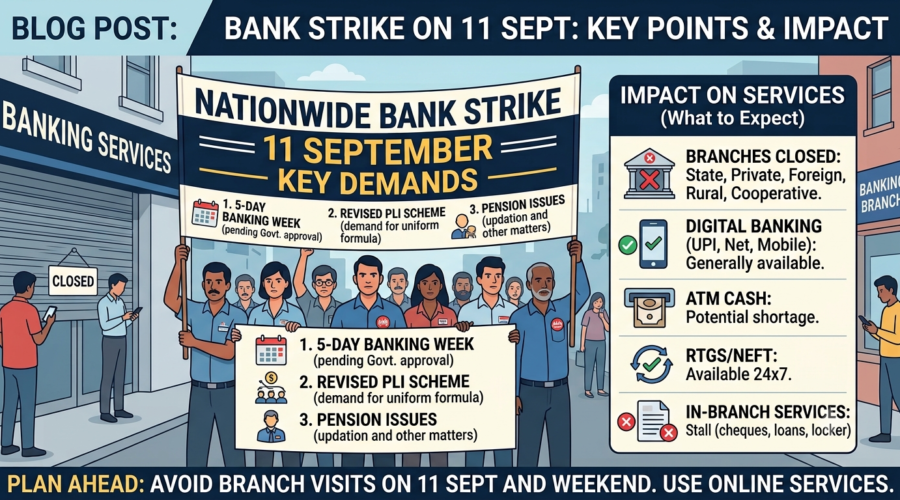
Bank Strike September 2026 is heading into its first phase on the 11th, and I want to be upfront about something before the numbers and dates: I’m writing this as someone who’s spent 14 years on the inside of a public sector bank. So when I explain why lakhs of bank employees are walking out, I’m not reading it off a wire report — I’ve sat in on the same salary structure conversations, felt the same Saturday fatigue, watched senior colleagues wait years for a pension formula that was promised and never delivered. This piece will give you the practical Bank Strike September 2026 dates you need to plan around, and also the fuller story of why this fight has been so long in coming.
Bank Strike September 2026 isn’t a sudden flashpoint. It’s the result of a demand that was agreed to on paper in 2024 and has simply sat there, unimplemented, for two years while everyone waited for a government notification that never came.
Quick Fact Check — Bank Strike September 2026
- Who’s striking: UFBU (United Forum of Bank Unions), representing over 90% of India’s roughly 8 lakh banking employees across public, private, foreign, regional rural, and cooperative banks.
- Phase 1: One-day all-India strike on 11 September 2026 (Friday).
- Phase 2: Three-day all-India strike, 28-30 September 2026, if Phase 1 brings no resolution.
- Phase 3: Indefinite nationwide strike from 26 October 2026 onward, if the demands are still unmet.
- Last chance for talks: the Chief Labour Commissioner has called a conciliation meeting on 7 September, days before the first strike date.
11 Sep
Phase 1 — 1-Day Strike
28-30 Sep
Phase 2 — 3-Day Strike
26 Oct
Phase 3 — Indefinite Strike
90%+
Workforce Represented
The Three Demands — And Why They’re Not Unreasonable
1. The Five-Day Banking Week
This is the one most customers will recognise. Bank employees want every Saturday off, not just the second and fourth. What often gets left out of the coverage: this isn’t a request for less work. Under the 2024 wage settlement, employees agreed to work an extra 40 minutes each weekday to make up for the lost Saturday hours. The Indian Banks’ Association signed off on it. It was sent to the government for approval — and it has simply sat there for more than two years with no formal notification. From where I sit, that’s not a union being unreasonable; that’s a workforce that negotiated in good faith and is still waiting for the other side to keep its word.
2. The Revised PLI Scheme — A Fairness Problem
The Performance Linked Incentive dispute is the one that’s genuinely divided opinion, and it’s worth explaining plainly. The revised scheme applies to Scale IV and above officers — roughly 40,000 people, about 5% of the industry. Under it, senior officers could receive incentives worth up to 365 days’ wages. Everyone else — the remaining 95% of the workforce, the officers and staff actually processing your loans, handling your cash deposits, sitting across the counter from you — are capped at a maximum of 15 days.
I understand rewarding performance. What I don’t understand, and what most of my colleagues at branch level don’t understand either, is a structure where the gap between the top 5% and everyone else is this stark. The matter is currently under challenge in the Delhi High Court, which tells you this isn’t a fringe grievance — it’s serious enough to be litigated.
3. Pension Updation
The third demand is about retirees — a uniform dearness allowance formula and updated pension amounts for people who’ve already given their working years to the sector. This one rarely makes headlines, but for anyone who’s watched a retired colleague or family member struggle with a pension that hasn’t kept pace with inflation, it’s not a footnote. It’s the demand that says the workforce doesn’t forget the people who came before it.
The Momentum Behind Bank Strike September 2026
This isn’t a quiet union notice nobody’s paying attention to. In the run-up to the 11 September strike, UFBU ran a coordinated social media push under the hashtag #5DayWeekandFairPLI — and by the union’s own reported numbers, it generated over 9.10 lakh posts, nearly 13 lakh engagements, and a potential reach of 3.43 crore users in a single day. The hashtag reportedly became the #1 trend in India and the #2 most-tweeted hashtag worldwide over 24 hours. Whatever one makes of the underlying demands, that scale of organic participation from roughly 8 lakh employees signals this is a workforce that feels genuinely, widely aggrieved — not a small vocal minority.
What This Means for You as a Customer
| Date | What’s Affected | What to Do |
|---|---|---|
| 11 September 2026 | Branch banking, cheque clearing, cash deposits/withdrawals at PSU banks nationwide | Finish urgent branch visits before the 11th; use ATM/UPI/net banking instead |
| 28-30 September 2026 | Same as above, extended to 3 consecutive days — likely to affect end-of-month salary credits and cheque clearing cycles | Plan salary-dependent payments and EMI dates around this window if possible |
| 26 October onward (if unresolved) | Indefinite branch disruption | Shift routine banking to digital channels now, before it becomes urgent |
Digital banking — UPI, net banking, mobile apps, ATMs — should keep working through all three phases, since these run on automated systems rather than branch staff. Where you’ll feel it is anything that genuinely needs a human at a counter: large cash transactions, physical document submission, DD issuance, or in-branch loan processing.
Our Verdict
📋 Our Verdict — Bank Strike September 2026
“As a customer, plan your branch visits around 11 and 28-30 September, and lean on digital banking wherever you can — that part is just practical advice. But I’d also ask readers to hold onto some empathy here. This isn’t a workforce striking on a whim. The five-day week was already agreed and simply never notified. The PLI gap is real enough to be in court. And the pension demand is about people who’ve already put in their years. Whatever inconvenience the strike causes for a few days, it’s worth remembering it’s the last resort of people who negotiated fairly and are still waiting to be heard.”
Bank Strike September 2026 — FAQs
Q: Will ATMs work during the bank strike?
A: Yes, ATMs typically continue functioning during bank strikes since they’re automated and not directly staffed by striking employees, though cash replenishment at some ATMs could be slightly delayed if the strike runs longer than a day.
Q: Are private sector banks like HDFC and ICICI also affected?
A: UFBU represents employees across public, private, foreign, regional rural, and cooperative banks, so some disruption is possible across sectors, but public sector banks are typically affected most heavily given union density there.
Q: What happens to cheques deposited right before the strike?
A: Cheque clearing cycles can be delayed by a day or more around strike dates since clearing houses rely on bank staff processing. If you have a time-sensitive cheque, deposit it a few days early or use NEFT/RTGS/UPI instead where possible.
Q: Could the October 26 indefinite strike actually happen?
A: It depends entirely on whether the government and Indian Banks’ Association act on the five-day week and PLI issues before then. The 7 September conciliation meeting is being seen as one of the last real chances to avoid escalation.
To manage your banking around strike dates, try our EMI and Loan Calculators, or browse more Banking News coverage on BadaBanker.
📎 Sources: UFBU strike circular dated 23 August 2026; Chief Labour Commissioner (Central) conciliation proceedings. For informational purposes only — strike dates and outcomes can change based on ongoing negotiations; always check for the latest updates before planning around them.