
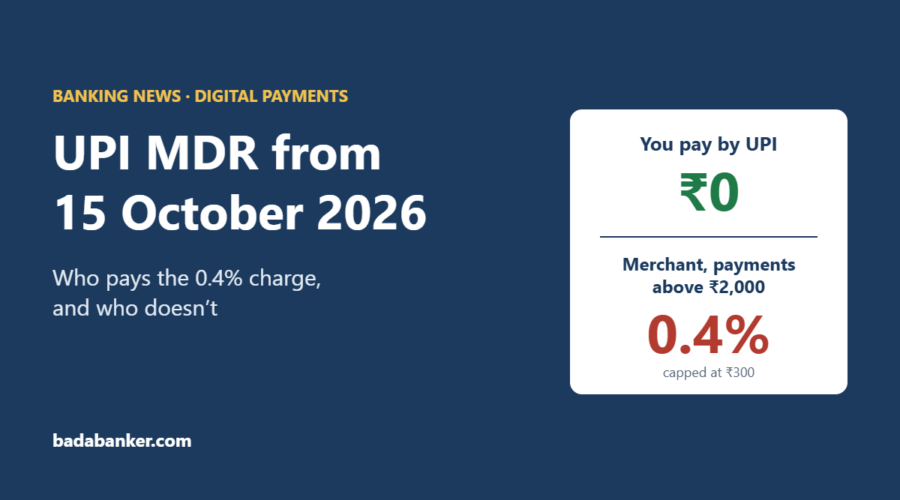
From 15 October 2026, merchants will pay a UPI MDR (merchant discount rate) of 0.4% on some UPI payments above ₹2,000. The news set off a wave of “UPI is no longer free” messages. For customers, it isn’t true: you will not pay anything extra to pay by UPI. The charge is paid by certain merchants, out of the money they receive. This guide explains exactly who pays, how much, the lower rates for fuel, insurance, utilities and investments, and what to do if a shop tries to add the charge to your bill.
UPI MDR at a glance
- Start date: 15 October 2026, according to NPCI’s FAQ of 15 September 2026.
- Customers pay nothing. UPI stays free for people paying by UPI, with no monthly limit on free transactions. UPI apps are not allowed to charge platform fees.
- Person-to-person transfers stay free, whatever the amount, including transfers between your own accounts.
- Merchant payments up to ₹2,000 stay free. NPCI says these make up more than 95% of UPI merchant transactions by volume.
- Small merchants stay at zero: vendors receiving up to ₹1 lakh a month through UPI QR into their own accounts (the P2PM category) pay no MDR.
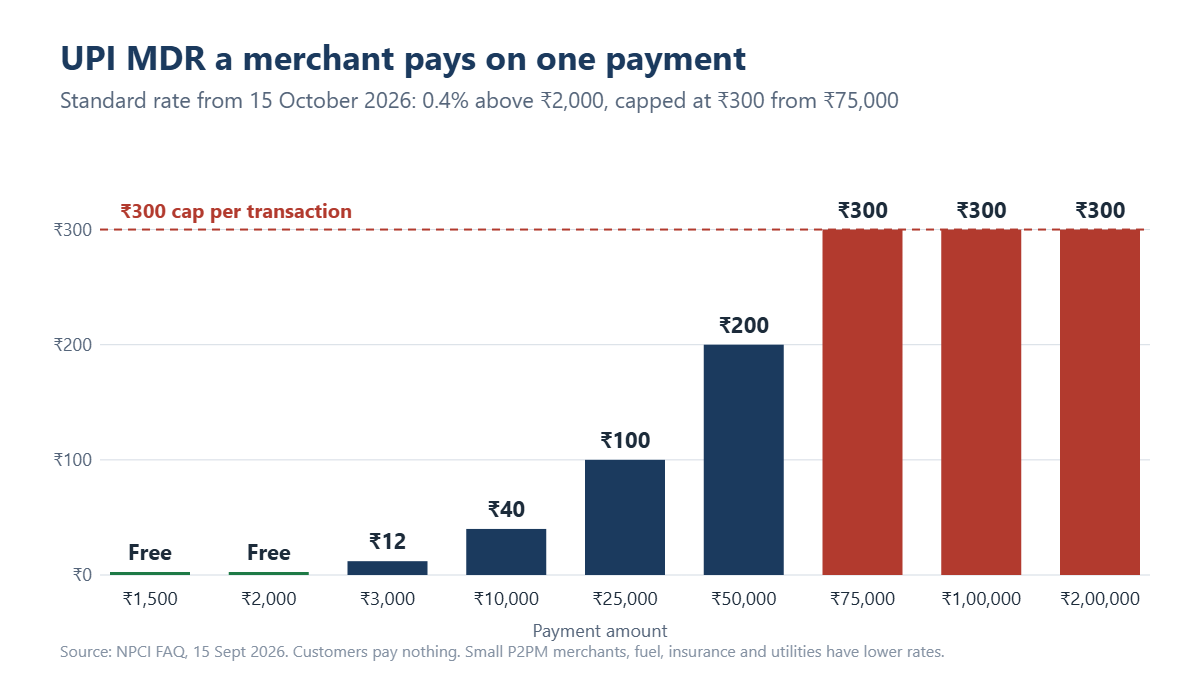
- Who pays: other merchants pay 0.4% on payments above ₹2,000, capped at ₹300 per transaction from ₹75,000 upwards.
- UPI MDR is not a tax. The Finance Ministry says it is not collected by the government or NPCI. It is shared among banks and payment app providers.
The UPI MDR rates from 15 October 2026
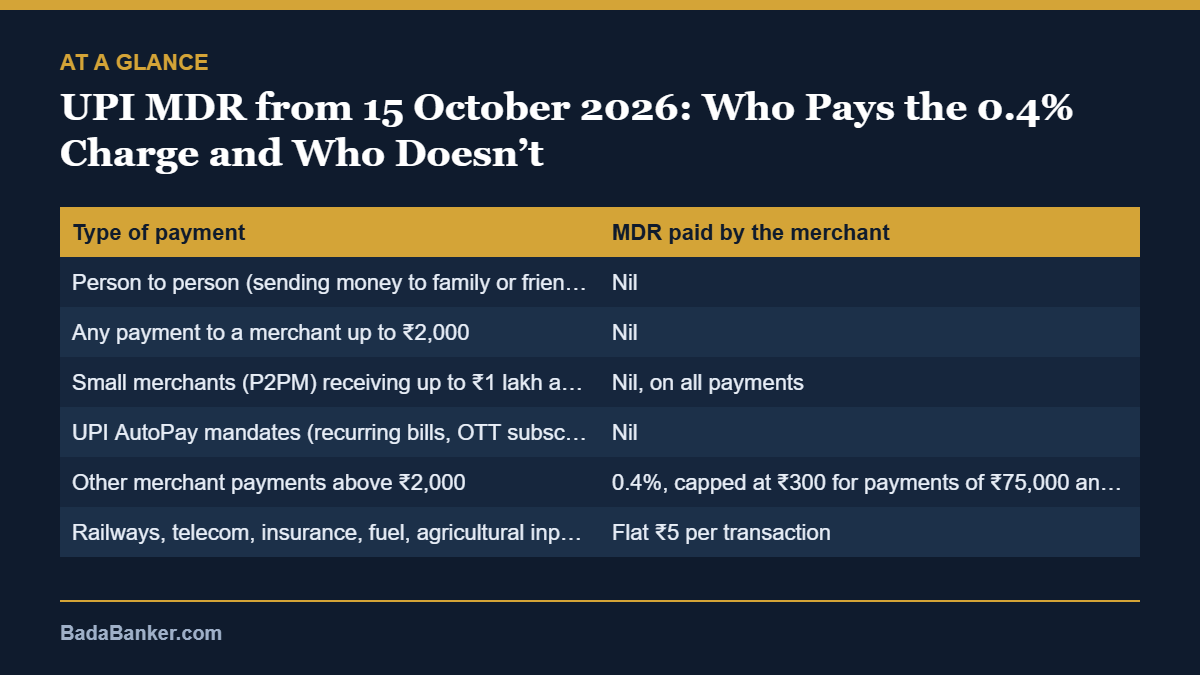
| Type of payment | MDR paid by the merchant |
|---|---|
| Person to person (sending money to family or friends) | Nil |
| Any payment to a merchant up to ₹2,000 | Nil |
| Small merchants (P2PM) receiving up to ₹1 lakh a month via UPI QR | Nil, on all payments |
| UPI AutoPay mandates (recurring bills, OTT subscriptions, SIPs) | Nil |
| Other merchant payments above ₹2,000 | 0.4%, capped at ₹300 for payments of ₹75,000 and above |
| Railways, telecom, insurance, fuel, agricultural inputs and utility bills, above ₹2,000 | Flat ₹5 per transaction |
| Mutual funds, stockbrokers, securities and dealers | 0.02%, capped at ₹300 |
| Education fees above ₹2,000 | Concessional flat or capped rates (NPCI hasn’t published the exact figure) |
Two points from NPCI’s own examples. First, the 0.4% applies to the whole payment, not just the part above ₹2,000: a ₹3,000 payment costs the merchant ₹12. Second, a payment of exactly ₹2,000 attracts no MDR.
What UPI MDR means for you as a customer
Nothing changes when you pay. You scan the same QR codes, pay the same posted price, and there’s no fee whatever the amount or the number of payments in a month. The Finance Ministry has said banks have been told to make sure merchants don’t pass the MDR on to customers, and NPCI’s FAQ says onboarded merchants cannot pass it on.
Your daily UPI limits, usually ₹1 lakh to ₹5 lakh depending on the type of payment, are unchanged. NPCI points out that they are security limits, not charging thresholds.
What if a shop asks you to pay extra for UPI?
- Point out that merchants are not allowed to pass UPI MDR on to customers. You can show them the NPCI FAQ or the Finance Ministry’s release linked below.
- If you paid the extra amount, keep the bill and the UPI transaction ID.
- Raise a complaint through your UPI app’s help section, or with the merchant’s bank, whose name usually appears on the QR code or in the payment details.
- If the bank doesn’t resolve it within 30 days, you can complain to the RBI Ombudsman through the RBI’s Complaint Management System (cms.rbi.org.in).
What UPI MDR means for small shops and street vendors
If you receive UPI payments directly into your own bank account through a QR code, you’re probably in the P2PM (person-to-person-merchant) category. As long as you receive up to ₹1 lakh a month this way, you pay zero MDR on every payment, even payments above ₹2,000. You don’t need GST registration to qualify, and you don’t need a new QR code or soundbox.
The limit is checked over time. NPCI says merchants whose UPI receipts exceed ₹1 lakh a month for three months in a row are moved to the regular P2M (merchant) category. From then on, the 0.4% applies to their payments above ₹2,000.
Example: a vegetable seller collects about ₹85,000 a month through a UPI QR into a savings account. A customer pays ₹2,500 for a bulk order. The seller pays no MDR on that payment, or on any other, as long as monthly UPI receipts stay within ₹1 lakh.
Worked example: a shop with ₹6 lakh of UPI sales a month
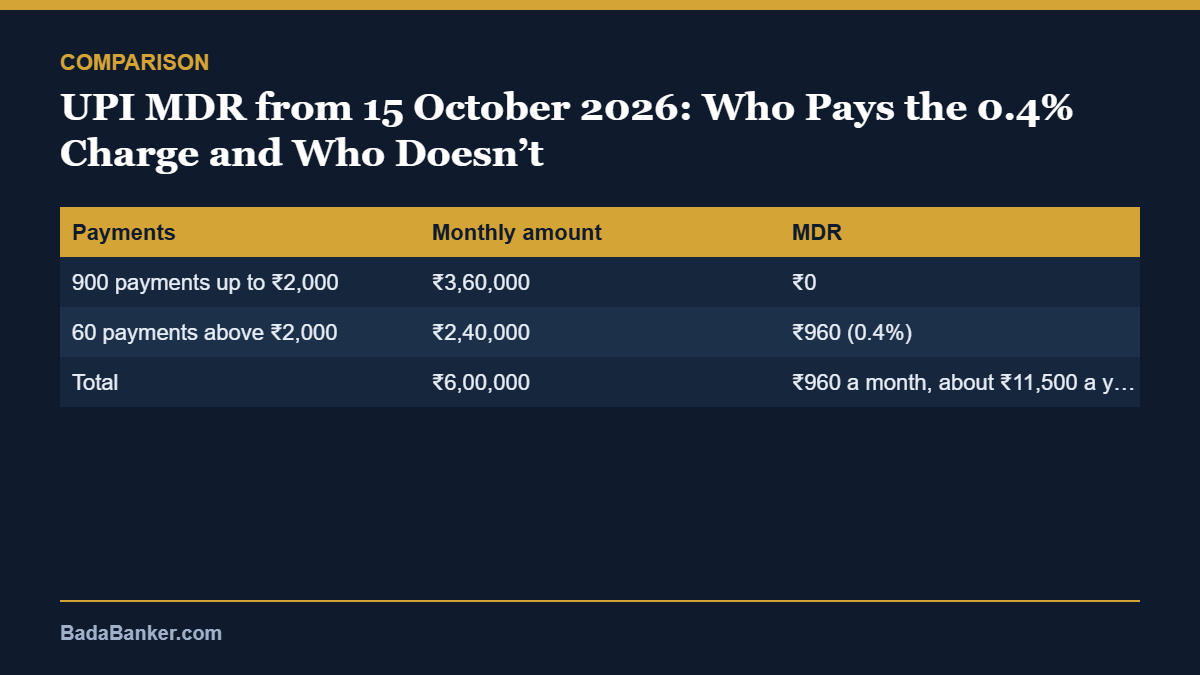
Take a hardware shop registered as a regular merchant. Each month it receives ₹6 lakh through UPI: about 900 payments under ₹2,000 adding up to ₹3.6 lakh, and 60 larger payments averaging ₹4,000, adding up to ₹2.4 lakh.
| Payments | Monthly amount | MDR |
|---|---|---|
| 900 payments up to ₹2,000 | ₹3,60,000 | ₹0 |
| 60 payments above ₹2,000 | ₹2,40,000 | ₹960 (0.4%) |
| Total | ₹6,00,000 | ₹960 a month, about ₹11,500 a year |
That works out to about 0.16% of the shop’s total UPI receipts. For comparison, NPCI’s FAQ puts credit card MDR at 1.5% to 2.5%. If the same ₹2.4 lakh of larger payments came in by credit card, the shop would typically pay ₹3,600 to ₹6,000 a month.
More examples
| Payment | MDR paid by the merchant | Effective rate |
|---|---|---|
| ₹1,800 at a restaurant | ₹0 | 0% |
| ₹3,000 at a clothing store | ₹12 | 0.4% |
| ₹50,000 for a laptop | ₹200 | 0.4% |
| ₹1,00,000 for a refrigerator | ₹300 (cap) | 0.3% |
| ₹3,000 of fuel at a petrol pump | ₹5 (flat) | about 0.17% |
| ₹25,000 insurance premium | ₹5 (flat) | 0.02% |
| ₹50,000 lump sum into a mutual fund | ₹10 (0.02%) | 0.02% |
| ₹5,000 monthly SIP through UPI AutoPay | ₹0 | 0% |
What MSME owners should do before 15 October
- Check your category with your bank or payment aggregator. Find out whether you’re in P2PM (zero MDR up to ₹1 lakh a month) or regular P2M, and how your merchant category is coded. Fuel, insurance, utilities and similar sectors get the flat ₹5 rate only if they’re categorised correctly.
- Look at your own numbers. Add up last month’s UPI receipts above ₹2,000 and multiply by 0.4%. For most small businesses, the cost is modest compared with card fees.
- Don’t add a surcharge. Passing the UPI MDR on to customers isn’t allowed, and your acquiring bank can act on complaints.
- Read your settlement statements after 15 October, so you can check what’s being deducted and match it to the published rates.
- Keep your price list unchanged. NPCI expects merchants to absorb the cost as a normal operating expense, as they do with card fees.
If you’re applying for a working capital limit, the UPI MDR is a small business expense like bank charges. It belongs in your projected profit and loss account, but it rarely changes the numbers a bank looks at. Our guides to CMA data for bank loans and the DSCR ratio explain how those projections fit together.
Why UPI MDR is being introduced
UPI has run with zero MDR on most payments for years, with the government paying banks an incentive instead. NPCI’s FAQ says running UPI’s operations, servers, fraud prevention and bank support costs around ₹20,000 crore a year, according to industry estimates. It also says subsidies were meant as short-term support, not a permanent arrangement. In August 2026, UPI processed 2,451 crore transactions worth ₹29.9 lakh crore.
The framework was introduced under the Payment and Settlement Systems Act, 2007, after deliberations by the UPI Steering Committee headed by NPCI. The MDR is shared among the banks, payment service providers and UPI apps involved in each payment. An amount equal to 5% of total MDR collections will go into a fund to promote UPI acceptance among small merchants, especially in smaller towns and rural areas. NPCI says the details will be finalised with the RBI within three months.
Frequently asked questions
Is UPI no longer free from 15 October 2026?
For customers, UPI stays free. The 0.4% MDR is paid by merchants, and only on certain payments above ₹2,000. Person-to-person transfers and payments to small P2PM merchants stay free.
Is UPI MDR a tax or GST?
No. The Finance Ministry has said MDR is neither a tax nor a charge collected by the government or NPCI. It’s a fee shared among the banks and payment companies that process the payment.
Does UPI MDR apply to payments made with a RuPay credit card?
No. NPCI says this framework applies to payments from a user’s bank account to a merchant’s account. Payments using a RuPay credit card or a pre-sanctioned credit line on UPI follow separate credit card rules.
Will my SIP, OTT or electricity bill AutoPay be charged?
Payments made through UPI AutoPay mandates don’t carry MDR, according to NPCI. One-off utility bill payments above ₹2,000 attract a flat ₹5, paid by the utility, not by you.
Is the ₹2,000 limit per payment or per day?
Per payment. Each merchant payment of up to ₹2,000 is free of MDR, however many you make in a day. The ₹1 lakh limit for small P2PM merchants is different: it’s the total they receive through UPI in a month.
Where can I check official updates?
NPCI recommends relying only on the Ministry of Finance, the RBI, NPCI and releases from the Press Information Bureau (PIB), and not forwarding unverified social media messages about UPI charges.
Related reading
Sources
- NPCI, FAQs: Merchant Discount Rate (MDR) on Select UPI (P2M) Transactions, 15 September 2026 (PDF)
- Ministry of Finance (PIB), UPI Continues to Remain Free for Peer to Peer Transactions and 96% of Merchant Transactions, 15 September 2026
- NPCI, UPI product statistics
This article explains the published UPI MDR framework for general understanding. Rates for specific merchant categories are applied by your acquiring bank or payment aggregator, so confirm your own category and charges with them.